

Audio By Carbonatix
The US and Iran have traded strikes for a second night, as observers report a "dramatic" drop in the number of ships travelling through the Strait of Hormuz since hostilities resumed.
The US military says it struck some 90 military targets, some near the Strait. Iranian authorities say 14 people have been killed in the past two days.
Iran reported explosions in several coastal areas and said it targeted US assets in Kuwait, Bahrain and Qatar in response.
Iran's foreign ministry denounced the US strikes as a "gross war crime", saying it targeted civilian infrastructure including railway bridges.
In a statement, the ministry described the US administration as "evil and psychopathic" and that it condemned the attacks, which have damaged bridges and a railway route connecting Tehran to the city of Mashhad, where the late supreme leader Ali Khamenei is due to be buried at a funeral service later on Thursday.
Iran's Ministry of Health says 14 people have been killed during this latest round of fighting.
Hossein Kermanpour, head of public relations at the ministry, said US attacks targeting five provinces in Iran over 8 and 9 July have also injured 78 people, of whom 47 remain in hospital.
Gulf nations reported Iranian attacks following the US strikes, with explosions in Bahrain's capital Manama, Kuwait intercepting missiles and drones, and Qatar issuing a security alert.
The Islamic Revolutionary Guard Corps (IRGC) has confirmed that it launched retaliatory strikes on US military bases in Kuwait and Bahrain overnight, and called them the "first phase of the punitive response against the American treaty-breakers".
Iran's parliamentary speaker Mohammad Bagher Ghalibaf, who is also the country's chief negotiator with the US, said on X that America "still hasn't learned that bullying and breaking promises are no longer cost-free".
"Let me put it plainly: if you strike, you'll get hit," he wrote, adding that the Strait of Hormuz will only open under Iranian arrangements - not "American threats".
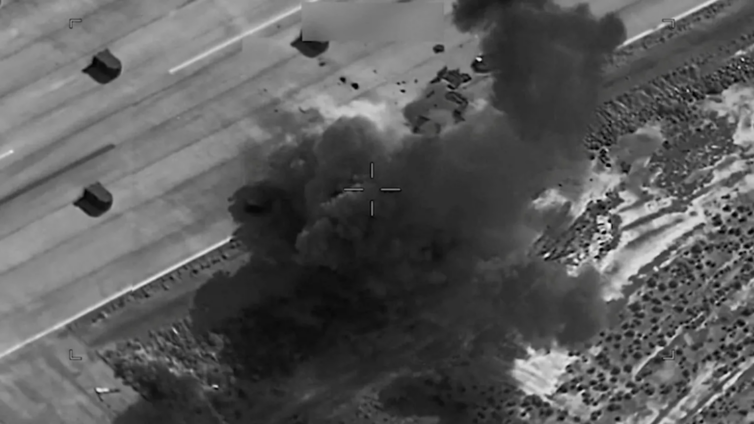
US Central Command (Centcom) said themost recent round of strikes was carried out to "further degrade Iran's ability to attack commercial shipping and innocent civilian mariners" in the vital waterway.
In a statement it said it had struck 90 Iranian military targets, which included air defense systems and military logistics infrastructure along Iran's coastline.
"The latest strikes follow successful execution of offensive strikes in Iran the night before," Centcom added.
Phil Belcher, marine director at Intertanko, an international organisation for independent tanker owners, said the number of ships travelling through the Strait via the southern route was now in "single figures" following the step up in hostilities.
Belcher said the daily figure of about 30 ships was down from about 70 a week ago and well below the normal number of 130 ships that was seen before the Iran war began earlier this year.
"The number of ships that are going through overnight is sort of about single figures in the southern route, which is maintained off the coast of Oman by the US," he told BBC Radio 4's Today programme, while about 20 travelled through a northern route overseen by Iran.
He told the programme that there had been an "exuberance of optimism" around shipping in the region following the signing of the memorandum of understanding between Iran and the US last month, but now the mood has changed.
"This cycle of violence, this cycle of up-and-down, positive-negative news, it's having an enormous impact both on business [and] on the seafarers themselves," he said.
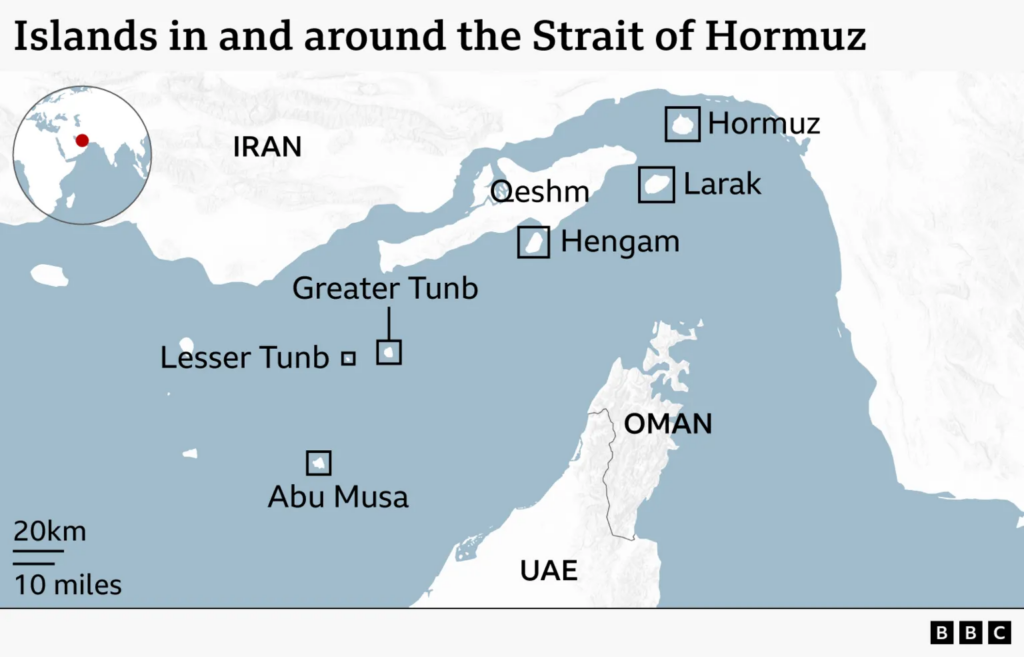
On Wednesday night, several explosions were reportedly heard on other parts of the Iranian coast, including the cities of Konarak and Chabahar.
Iranian state TV reported eight explosions in Bandar Abbas, and said two missiles had hit the ports of both Sirik and Jask - also in southern Iran.
It added that two projectiles had hit the island of Abu Musa, which has been the subject of a longstanding ownership dispute between Iran and the United Arab Emirates.
Air defence systems were activated in Bandar Abbas, according to reports in Iranian state media.
The extent of damage from the US strikes is not yet known, but Iranian media have reported power cuts in Chabahar and a fire at an Islamic Revolutionary Guard Corps (IRGC) barracks in Bushehr.
Two of three power lines cut off in Chabahar had been restored quickly and a third would be operational soon, the Iranian Students' News Agency said.
Earlier on Wednesday, Centcom wrote in a statement that it held Iran accountable for "recent unjustified aggression against commercial shipping and civilian crews freely navigating a vital international waterway."
Speaking to reporters from Air Force One on Wednesday evening, the US president said Iran had "called a little while ago" and wanted to make a deal "so badly".
Trump added: "I just don't know if they're worthy of making a deal - I don't know that they're going to honour the deal, that's the problem."
On Tuesday, the US military said it had launched "powerful" strikes in response to attacks on three tankers in the strait.
The current flare up has been the worst exchange of strikes between the US and Iran since the deal - known as a memorandum of understanding (MoU) - was signed on 17 June.
Trump said on Wednesday that the ceasefire agreement signed last month with Iran was now "over".
He told reporters: "I don't want to deal with them anymore, they're scum. You know what scum is? They're scum. They're sick people."
In response, Iran's Foreign Minister Abbas Araghchi said in a post on X: "We do not answer vulgarity with vulgarity, but with action: fearlessly and with great valour."
The deal between the US and Iran included 14 points, among them a 60-day period for a ceasefire during which negotiations should continue, the safe passage of vessels through the Strait of Hormuz and the US lifting sanctions on Iran.
The 60-day period for negotiations is not yet up, but Trump said he saw further talks as "a waste of time".
These are not the first strikes since the MoU was signed.
The US launched a series of strikes on Iran on 26 June after an Iranian projectile hit a cargo ship in the Strait of Hormuz.
Further US strikes took place on 27 June, following an attack on a tanker. But later that month both sides had agreed to "stand down".
Latest Stories
-
Government support for the arts industry is not enough — Aewura Arts
23 minutes -
Art can be lucrative, but have a side hustle – Aewura Arts to fellow artists
33 minutes -
No two-phone law – GRA clarifies Customs rules for travellers
33 minutes -
My parents opposed my decision to pursue art – Aewura Arts
45 minutes -
IShowSpeed’s manager said my artwork was one of the best he received on tour — Aewura Arts
55 minutes -
Chief of Staff directs ecological restoration of reclaimed Kpeshie Lagoon
1 hour -
Driver convicted over concrete spill on Madina-Adenta Highway
1 hour -
Photos: Prospective homeowners turn up in numbers for final day of JoyNews–Republic Bank Habitat Fair
1 hour -
Aggrieved teachers demand payment of unpaid four-year legacy arrears
2 hours -
Skipping breakfast bad for your health?
2 hours -
Kpeshie Lagoon reclamation linked to first-ever flooding at Tse Addo – ISD
2 hours -
GRA announces major policy proposal under Modified Taxation Scheme initiative
2 hours -
TCL sues Samsung for false advertising over ‘Mini LED’ televisions
2 hours -
US embassy child abuse images suspect flown from UK before police interview
3 hours -
Payment dispute led to murder of Dr Jesse Amuah and wife at Asylum Down – Court told
3 hours