

Audio By Carbonatix
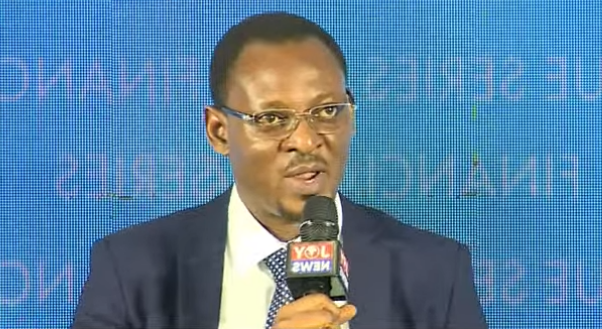
Cybersecurity, AI and Information Systems Expert, Dr. Martin Nana Annan says Artificial Intelligence (AI) has become the only effective way to counter the growing sophistication of cybercrime, as criminals increasingly deploy AI-powered tools that conventional cybersecurity systems cannot detect.
Speaking at the Ecobank–JoyNews Business Financial Dialogue held at the Ecobank Auditorium on Tuesday, July 28, Dr. Annan said AI is fundamentally transforming digital finance by shifting cybersecurity from reactive defence to predictive, real-time automation capable of identifying and responding to threats before they cause significant damage.
"Artificial intelligence fundamentally alters digital finance by shifting from reactive defence to predictive real-time automation," he said.
According to him, while information technology has evolved rapidly and transformed lives and businesses, the rise of cybercrime has slowed confidence in digitalisation, particularly in the financial sector.
"One of the technologies in human life which has really moved so fast is the information technology. However, when we got to the digitalisation space, when cybercrime was prevalent, it has slowed down the advancement of this technology in enhancing the lives of the people because of cybercrime," he said.
Dr. Annan argued that as cybercriminals increasingly harness AI to launch sophisticated attacks, organisations must also adopt AI-powered security tools to defend their systems.
"Therefore, AI now becomes the only way to leverage and counter cybercrime because these criminals are using sophisticated algorithms that are difficult for humans to comprehend and also counter. But with the use of AI, we also leverage machine learning and other sophisticated algorithms to also counter the attackers," he said.
He explained that one of the clearest examples of AI's impact on cybercrime is the emergence of polymorphic malware, which continuously changes its characteristics as it moves through a computer system, making it difficult for traditional antivirus software to detect.
"The malware that we send traditionally will go through the process as it started. But now with AI, the malware will begin to mutate. As it's going through the system, it is changing its behavior in the system. So, it renders antiviruses useless, which means that you also require an AI tool that will be able to detect the mutating nature of the malware, which now the antivirus, your normal antivirus cannot handle."
According to Dr. Annan, AI-powered systems, including machine learning and large language models, are now essential to detecting and responding to these evolving threats.
"That is where now AI comes in, using large language models to also model something higher than for the attackers. So, we have defensive AI and attacker AI. The two are working together. They are all from the same lab, if I put it that way, because it is something we are dealing with," he said.
He noted that cybersecurity has become a constant contest between those developing digital systems and those seeking to exploit their weaknesses.
"So, if I develop a system, another person also look at the loopholes in my system and then take advantage of it. What is now making things easy for these criminals is the use of AI. We should also leverage the same AI to counter them," he added.
Dr. Annan further warned that AI-powered voice cloning and video cloning technologies are creating new avenues for fraud, making it increasingly important for organisations and regulators to strengthen cybersecurity frameworks.
"Importantly, now with voice cloning and video cloning, it is important that we also ensure that we have strong architecture. The regulatory framework ensures that we have a level playing field. Then we also remove ambiguity when something goes wrong," he said.
Latest Stories
-
Bond market: Turnover increased by 177% to GH¢5.01bn
2 minutes -
Glasgow 2026: Abeku Jackson storms into butterfly semis, Unilez bows out
5 minutes -
Odyssey translator writes scathing review of Nolan film adaptation
8 minutes -
Africa CDC set for bigger power as PAP pushes stronger continental disease response
11 minutes -
Betano Ghana refunds fans who backed Black Stars after World Cup exit
13 minutes -
Ariana Grande sues hackers who leaked music and videos
19 minutes -
WAFCON 2026: ‘Black Queens ready to get going’ – Boye-Hlorkah
19 minutes -
Here’s what the IMF expects Ghana to do after its $3bn bailout
23 minutes -
After Ebola and COVID-19, Africa demands stronger laws to fight future pandemics
29 minutes -
Rosemary Selasi Dogbe
32 minutes -
Eduwatch calls for phased rollout of reviewed KG, primary curriculum
35 minutes -
More than one-third of Ghana’s population are young people — GSS
35 minutes -
Dr Hounton lauds UNFPA Ghana’s YoLe initiative, commits to promoting it beyond Africa
40 minutes -
ICS heads to Supreme Court to stop dog and cat meat consumption in Ghana
42 minutes -
West, Central Africa UNFPA Director describes Ghana’s National Service model as a blueprint for Africa
42 minutes