

Audio By Carbonatix
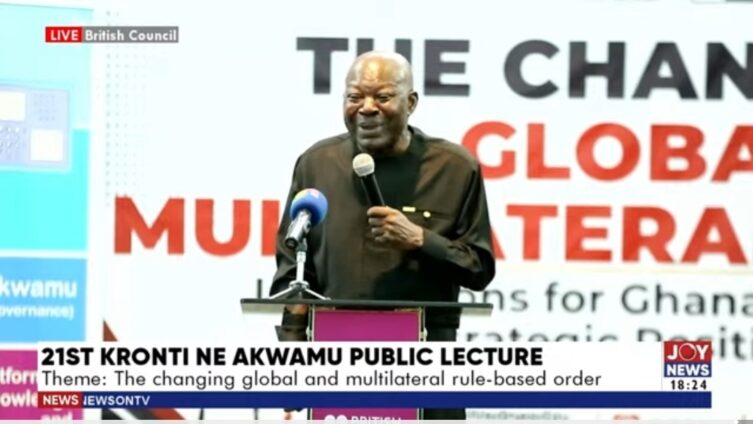
President of the Ghana Council on Foreign Relations, Ambassador D.K. Osei, has urged Ghana to use its upcoming chairmanship of the African Union (AU) to spearhead bold reforms that will advance continental integration and strengthen Africa's position in an increasingly fragmented global order.
Speaking at the 21st Kronti ne Akwamu Public Lecture on the theme, "The Changing Global and Multilateral Rule-Based Order," Ambassador Osei said Ghana's assumption of the AU chairmanship next year presents a rare opportunity to shape Africa's future and champion the reforms envisioned under Agenda 2063.
He argued that the continent must be prepared to make difficult political and economic sacrifices if it hopes to achieve deeper integration and remain competitive globally.
"There are sacrifices the continent will have to make," he said, noting that some of the reforms required under Agenda 2063 could involve ceding aspects of national sovereignty in areas such as security and foreign policy.
He questioned whether African countries are genuinely prepared to deepen regional integration by strengthening the African Continental Free Trade Area (AfCFTA) and even considering ambitious initiatives such as a continental currency.
"I'm not sure we are ready to do that," he remarked, adding that Africa's recent actions on the international stage suggest a reluctance to pursue the bold decisions necessary for meaningful integration.
Ambassador Osei also expressed concern over what he described as growing setbacks to multilateralism and inconsistencies in Africa's collective response to global geopolitical shifts.
Using the Economic Community of West African States (ECOWAS) as an example, he questioned some of the bloc's recent leadership decisions, arguing that they may not adequately position the region to respond effectively to ongoing political and security challenges.
He further criticised what he described as a lack of strategic coordination in Africa's approach to the race for the next United Nations Secretary-General, arguing that presenting multiple African candidates weakens the continent's chances of securing the position.
According to him, Africa should have rallied behind a single candidate in line with the continent's long-standing rotational understanding within the UN system.
Despite the challenges, Ambassador Osei said there remains hope if Africa can produce visionary leaders willing to challenge the status quo.
He recalled a period when leaders such as Ethiopia's late Meles Zenawi, South Africa's former President Thabo Mbeki and Senegal's former President Abdoulaye Wade demonstrated the courage to push for transformative continental initiatives, including the New Partnership for Africa's Development (NEPAD) and the African Peer Review Mechanism (APRM).
He urged today's leaders to demonstrate similar resolve.
"Fortunately, Ghana is about to take over the chairmanship of the African Union next year. My goodness, what an opportunity," he said.
He expressed optimism that discussions such as the Kronti ne Akwamu Public Lecture could help shape Ghana's policy direction and ensure the country uses its leadership role to drive meaningful reforms across the continent.
"Ghana has a huge task on its shoulders, and we should not waste this opportunity," Ambassador Osei stressed.
Latest Stories
-
Aggrieved teachers demand payment of unpaid four-year legacy arrears
13 minutes -
Skipping breakfast bad for your health?
27 minutes -
Kpeshie Lagoon reclamation linked to first-ever flooding at Tse Addo – ISD
34 minutes -
GRA announces major policy proposal under Modified Taxation Scheme initiative
49 minutes -
TCL sues Samsung for false advertising over ‘Mini LED’ televisions
57 minutes -
US embassy child abuse images suspect flown from UK before police interview
1 hour -
Payment dispute led to murder of Dr Jesse Amuah and wife at Asylum Down – Court told
1 hour -
COPEC calls for GH¢1 petrol, continuation of GH¢2 diesel subsidy amid price surge
1 hour -
Petrol to sell at GH¢16.26, diesel GH¢19.07 from Wednesday – COPEC
2 hours -
Massive crowds flock to JoyNews–Republic Bank Habitat Fair on final day to explore mortgages and seek expert advice
2 hours -
Ghana’s Alice Banaaza spotlights fugu weaving at 2026 CHAN Festival in UK
2 hours -
Russia’s Youth Festival could unlock business partnerships and scholarships for Ghanaian youth – John Aggrey
2 hours -
The 21st Century Gold Standard was piloted in Ghana under Bawumia – Gideon Boako
2 hours -
Ahafo NDC Vice Chairman pays nomination fees for 168 constituency executives ahead of 2026 internal reorganisation
2 hours -
Upper West receives GH¢101.9m DACF for development projects
2 hours