

Audio By Carbonatix
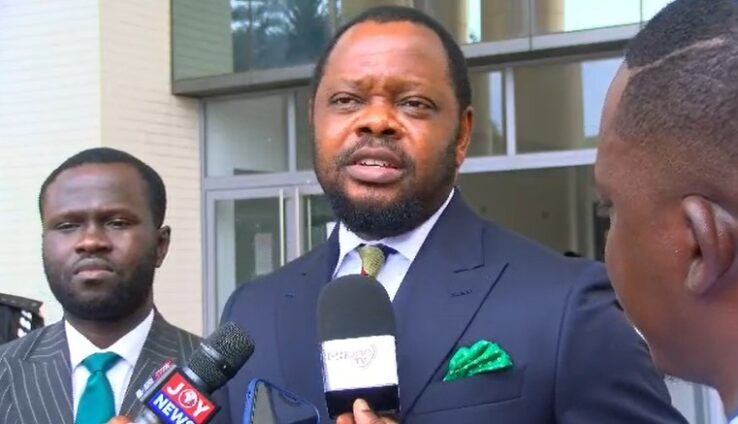
Deputy Attorney-General (A-G) and Minister for Justice, Dr Justice Srem-Sai, has dismissed the Ghana Bar Association’s (GBA) position on legal vacation as having no basis in law, describing it as a “self-imposed understanding” that cannot be allowed to undermine the administration of justice.
According to him, there is no genuine controversy over whether courts can sit and conduct proceedings during the legal vacation, insisting that vacation courts have always been constituted to deal with cases during the period.
Dr Srem-Sai said the assertion that lawyers could determine whether proceedings should take place during legal vacations was unsupported by law, practice or reason.
“No genuine or real controversy here. The matter is simple. It's been the case that vacation courts are always sitting whenever there is a legal vacation,” he said.
He stressed that the authority to determine when courts sit rests with the judiciary and not lawyers appearing before them.
“No one can dispute that simple fact. The claim that it is the lawyers who decide whether they want to have proceedings on vacation is not founded on any facts; it's not founded on any law, it's not founded on reason, and it is not founded on any rule of practice. Nowhere in the world do you see lawyers deciding when a court should sit,” he added.
‘GBA got it completely wrong’
The Deputy Attorney-General's comments come amid a disagreement between the government and the GBA over the conduct of court proceedings during the current legal vacation.
Dr Srem-Sai said the Chief Justice had issued warrants authorising a number of judges to sit during the vacation to deal with cases assigned to them.
“What matters is that the head of the judiciary has given warrants for a number of judges, I think 10 or more judges, to sit across the country to take care of cases,” he said.
He explained that a judge assigned to a vacation court had the authority to administer his or her court during that period, arguing that accepting the GBA's interpretation would create further delays when the legal vacation ended.
“Now this is a thing; a vacation judge has his own courts to administer. Now when the vacation is over, he is also entitled to go on vacation; that is, after October,” he said.
Dr Srem-Sai argued that if vacation judges were prevented from hearing cases during the legal vacation, cases before them could face prolonged delays because those same judges could subsequently proceed on leave when the courts formally resumed.
“If you make the argument, as the GBA president is making, that a vacation judge is not required or cannot hear cases or conduct trial, then when the vacation is over and he goes on vacation, no other judge can have trial for them,” he said.
He said such an interpretation could effectively mean that some cases would not be heard until January next year, given the sequence of the legal vacation and subsequent court recesses.
“So basically what the GBA is saying is that for cases that are pending in the courts that have vacation judges, those cases can only conduct trials in January next year,” he said.
Order 79 cited
Dr Srem-Sai further rejected the suggestion that there was a convention preventing lawyers from conducting proceedings during legal vacations.
“And again, it is not supported by reason that would be positive or advance the cause of justice. So for us, it is a self-imposed understanding of the law, which we do not think should be allowed to prevail,” he said.
He pointed specifically to Order 79 of the High Court (Civil Procedure) Rules, 2004 (C.I. 47), which deals with sittings, office hours and vacations.
Order 79 Rule 1 provides that, subject to the Courts Act, the Chief Justice may appoint any day, including vacation periods, for the hearing of causes or matters as circumstances require.
Dr Srem-Sai therefore said the GBA's claim that there was a convention preventing such proceedings was incorrect.
“And they claim that there is a convention is completely even false. There is no such convention. And even if there is a convention, order 79 of CI 47 is the order that provides expressly for legal vacation,” he said.
Lawyers' absence
The Deputy Attorney-General also addressed the possible consequences for lawyers who decline to appear before a court during the vacation.
He said a vacation judge who had been duly authorised to hear a case could proceed with the matter, and lawyers could not unilaterally prevent the court from sitting.
He said clients whose lawyers decided not to practise during the vacation should be advised of the implications, particularly where their cases involved active proceedings.
“If you don't come, he will treat it as if you are not interested in legal representation,” Dr Srem-Sai said.
He added that where an accused person failed to produce legal representation at the next adjourned date, the court could require the person to proceed without counsel, subject to the applicable legal safeguards.
“If on the next adjournment date, he does not produce, I think the judge has given them one week. If they do not produce a lawyer, then they will have to conduct the cross-examination by themselves,” he said.
The dispute comes against the background of wider concerns over delays in the prosecution of corruption and other high-profile criminal cases. Dr Srem-Sai has previously said that the Attorney-General's Office has identified about 30 cases under the Operation Recover All Loot (ORAL) initiative considered prosecutable, with between five and 10 already at advanced stages before the courts.
The Deputy Attorney-General has also previously indicated that prosecutors intended to use the legal vacation period to file additional ORAL cases.
His latest comments underline the government's position that legal vacation should not become an impediment to the timely administration of justice where judges have been duly authorised to sit.
Latest Stories
-
Caveman Watches partners with Mfantsipim School for 150th anniversary
21 minutes -
We’ll pursue GH¢15m defamation suit against Sammy Gyamfi to its logical conclusion – Afenyo-Markin’s lawyers
21 minutes -
Martin Kpebu urges Afenyo-Markin not to return to court over Sammy Gyamfi lawsuit
30 minutes -
GRA submits preliminary report on drug shipment case to Mahama – Commissioner-General
58 minutes -
Sammy Gyamfi using ‘procedural roadblocks’ to dodge defamation case? – Afenyo-Markin’s lawyers
59 minutes -
The illusion of a good deal: Why some everyday money-saving habits may be costing you more
1 hour -
Family seeks autopsy, police investigation into death of student 12 days after Abomosu SHS enrolment
1 hour -
Trade Minister urges employers to leverage industrial opportunities to create jobs
1 hour -
Asantehene plants trees to commence Jimi Watercourse Rehabilitation destroyed by galamsey
2 hours -
15 arrested, 6 trucks impounded over sandwinning activities on Kumasi-Accra Expressway
2 hours -
OFFICIAL: Vinicius will miss El Clásico, suspended four games
2 hours -
Prayer vigil held after four arson attack murders
2 hours -
GRA fully recovers $154k legacy debt owed by foreign entities between 2022 and 2024
2 hours -
Kwesi Pratt Jr warns bus preachers are adding to passengers’ stress with accident prophecies
2 hours -
MTN Ghana to spend $1.1bn in 3 years, build 500 new sites as MoMo hits 44% Growth
2 hours