

Audio By Carbonatix
Only 27% of Ghana’s 94,200-kilometre road network is paved, while more than half of the country’s roads are in fair-to-poor condition, the World Bank has disclosed.
The Bank says the state of the road network remains a major constraint to Ghana’s economic growth, competitiveness and job creation, particularly in rural areas where feeder roads connect communities and agricultural producers to markets.
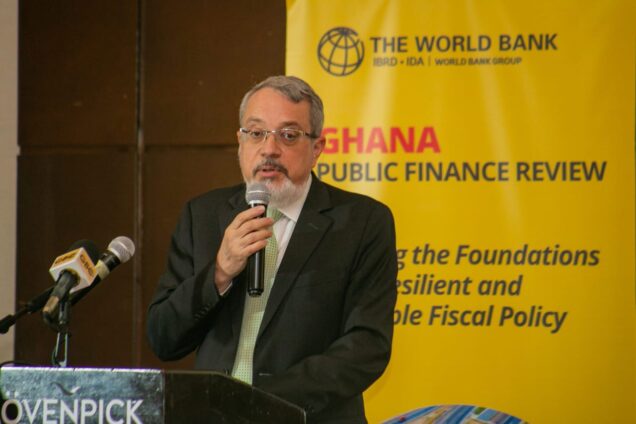
World Bank Division Director for Ghana, Liberia and Sierra Leone, Robert R. Taliercio, disclosed this at the launch of the World Bank’s Tenth Ghana Economic Update in Accra.
He said the challenges facing Ghana’s transport infrastructure require urgent reforms alongside increased investment.
“This is not just an infrastructure story. It’s a growth story, competitiveness story, and a job story,” Mr Taliercio said.
According to him, the poor state of the road network is compounded by weaknesses in maintenance financing and fragmented institutional responsibilities within the transport sector.
The World Bank has therefore identified the operationalisation of the Road Maintenance Trust Fund as one of six priority areas for transforming Ghana’s transport sector.
It has also called for the development of a unified national transport sector strategy, the revitalisation of freight-led rail services along the western and eastern corridors, and stronger measures to address road safety.
The Bank further wants Ghana to adopt climate-resilient infrastructure standards and extend the Digital Single Window to Takoradi and inland terminals.
Mr Taliercio said the World Bank was supporting Ghana’s efforts through the $500 million Ghana Market Access and Connectivity Project, which will finance the rehabilitation of about 1,050 kilometres of feeder roads.
The project is expected to focus on areas where poor road connectivity is restricting agricultural productivity, market access and rural livelihoods.
The World Bank, however, cautioned that increased investment in roads must be accompanied by effective maintenance and stronger institutional coordination.
“Building roads without maintaining them simply accelerates the cycle of degradation that we are all trying to break,” Mr Taliercio said.
The assessment places renewed focus on the need for Ghana to not only expand its road network but also develop sustainable systems for maintaining existing infrastructure and ensuring that roads support broader economic transformation.
Latest Stories
-
Ghanaian woman dies in China after collapsing at airport on journey to pursue Master’s Degree
3 minutes -
We worked with the FBI on Asante Berko case – OSP rejects claims it lacks competence
22 minutes -
Keep political actors out of police affairs to tackle electoral violence — Asah-Asante
24 minutes -
Africa cannot fund energy needs with public budgets alone – Ato Forson
32 minutes -
NSMQ 2026: Keta SHTS secures quarterfinals spot after beating Anum Presby, Kadjebi Asato
38 minutes -
OSP has saved Ghana over 20 times the resources invested in it – Kissi Agyebeng
46 minutes -
Kwabena Donkor, four others named as persons of interest in Asante Berko case – OSP
47 minutes -
Police interdict officer over alleged demolition at Accra Race Course
50 minutes -
Performance of OSP shouldn’t be measured by political applause – Kissi Agyebeng
50 minutes -
April 15 ruling brought OSP prosecutions to standstill – Kissi Agyebeng
1 hour -
The continuity of the self
1 hour -
Claims OSP has achieved nothing are testable – Kissi Agyebeng
1 hour -
First National Bank redefines gifting with launch of Investment Gift Cards
1 hour -
Supreme Court has settled OSP’s prosecutorial mandate – Kissi Agyebeng
1 hour -
OSP recovered GH¢8.5m, $2m and saved state over GH¢100m through payroll cleanup – Kissi Agyebeng
1 hour