

Audio By Carbonatix
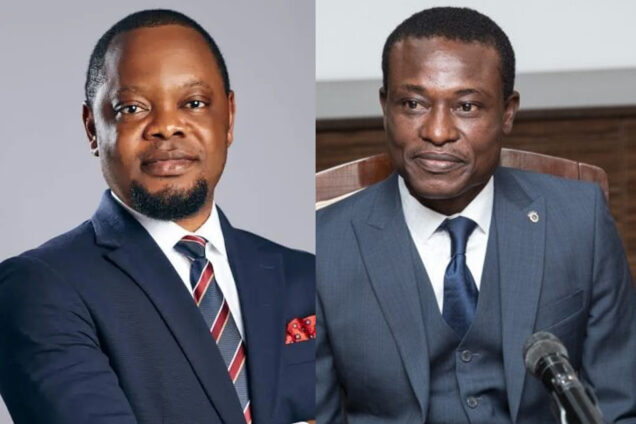
Deputy Attorney-General Justice Srem-Sai has rejected claims by the Office of the Special Prosecutor (OSP) that the Attorney-General’s Office has on several occasions refused requests to collaborate on corruption cases.
He described the allegation as false and insisted that the Attorney-General’s Office remains committed to working with all state institutions mandated to investigate and prosecute crime.
Justice Srem-Sai was responding to comments by the OSP’s Director of Strategy, Research and Communications, Sammy Darko, who said the Special Prosecutor’s Office had previously approached the Attorney-General’s Office to collaborate on some cases but had been turned down.
Speaking on JoyNews’ Newsfile on Saturday, August 29, Mr Darko said the OSP had deliberately refrained from discussing several instances in which it had sought cooperation from the Attorney-General’s Office.
“There are so many issues the OSP has kept quiet and not talked about. Look, there are instances where the OSP has approached the Attorney-General's Office and said, let us collaborate in this matter, and we have been turned down,” he claimed.
However, speaking to JoyNews at the Supreme Court, Justice Srem-Sai dismissed the claim and said there was no institutional tension between the two offices.
Read Also: We’ve asked AG to collaborate on cases but were turned down – OSP
“There has never been any tension between OSP as far as Attorney-General is concerned,” he said.
According to him, Attorney-General Dr Dominic Ayine’s focus is on ensuring that criminal offences are properly investigated and prosecuted while respecting the rights of accused persons.
“My boss has no desire whatsoever to struggle with anyone over a job or what to do. What my boss knows and what he's always asking us to do is to ensure that we fight crime and fight crime properly, respecting the rights of accused persons,” he said.
He said the Attorney-General’s Office had no reason to single out the OSP for a different working relationship from other law enforcement and anti-corruption agencies.
‘We work with OSP like every other agency’
Justice Srem-Sai noted that the OSP was only one of several institutions involved in Ghana’s fight against crime and corruption.
He cited the National Commission for Civic Education (NACOC), the Ghana Immigration Service, the Ghana Police Service and other state agencies as institutions with which the Attorney-General’s Office works.
“Why should there be some particular tension between us and them?” he asked.
He maintained that the Attorney-General, as the country’s Chief Law Enforcement Officer, has a constitutional role in determining the prosecution of criminal offences.
He therefore rejected suggestions that the Attorney-General’s Office was deliberately frustrating the OSP.
“OSP is another agency created by legislation to fight crime. And like the way we work with all the other institutions, we work with the OSP the same way,” he said.
Justice Srem-Sai added that where necessary, the Attorney-General’s Office would provide direction or assistance to the OSP.
“But to say you have come to collaborate with us and we said no, there wouldn't be any need for that approach in the first place,” he said, insisting that the allegation was false.
‘We have no choice’
Asked whether the Attorney-General’s Office would be willing to work with the OSP on cases where collaboration was necessary, Justice Srem-Sai said such cooperation was not a matter of discretion.
“We don't have a choice. It's not about being ready to welcome [the OSP]. We are bound as the Office of Attorney-General to make sure that all the agencies that are fighting crime do their work and do their work properly,” he said.
He said the roles of the two institutions were defined by law and could not be determined by personal preferences.
“We are all creatures of law, either by the Constitution or by legislation. And the law determines our place in the greater scheme of things,” he said.
Justice Srem-Sai therefore maintained that the Attorney-General’s Office remained focused on its mandate and had no interest in creating friction with the OSP.
Why perceptions of tension have persisted
The latest disagreement comes against the backdrop of months of legal and political developments that have brought the relationship between the OSP and the Attorney-General’s Office under intense public scrutiny.
The OSP has faced a series of challenges to its institutional independence and prosecutorial authority, including an attempt in Parliament in December 2025 by Majority Leader Mahama Ayariga and Majority Chief Whip Rockson-Nelson Dafeamekpor to introduce a Private Member’s Bill seeking to repeal the Office of the Special Prosecutor Act, 2017 (Act 959).
President John Dramani Mahama subsequently intervened, asking that the proposed repeal be withdrawn and describing the move as premature. He also publicly defended the OSP, arguing that its ability to prosecute corruption cases independently was an important feature of the institution.
The OSP’s legal authority also came under renewed pressure in the courts.
In April 2026, an Accra High Court ruled that the OSP could not independently prosecute criminal cases without authorisation from the Attorney-General and directed that cases being prosecuted by the Office be transferred to the Attorney-General’s Department. The ruling created uncertainty around ongoing OSP prosecutions while a separate constitutional challenge was pending before the Supreme Court.
That challenge was brought by private legal practitioner Noah Ephraem Tetteh Adamtey, who argued that Parliament could not confer independent prosecutorial powers on the OSP because Article 88 of the Constitution vests prosecutorial authority in the Attorney-General.
The Attorney-General supported the constitutional challenge, arguing that although prosecutorial powers could be delegated, such delegation remained subject to the Attorney-General’s constitutional authority.
The Supreme Court, however, delivered a unanimous ruling on July 29, 2026, upholding the constitutionality of the OSP Act and confirming the legal basis for the Office to investigate and prosecute corruption and corruption-related offences.
The Court nevertheless clarified that the Attorney-General retains constitutional authority to discontinue prosecutions initiated by the OSP. It also affirmed that the OSP’s prosecutorial authority operates within the constitutional framework under which the Attorney-General remains the repository of overarching prosecutorial power.
The judgment effectively overturned the April High Court ruling that had questioned the OSP’s prosecutorial authority and preserved actions previously undertaken by the Office.
A relationship shaped by overlapping mandates
These developments have created an unusual institutional relationship in which the OSP has statutory independence to investigate and prosecute corruption-related offences, while the Constitution continues to vest overarching prosecutorial authority in the Attorney-General.
The Supreme Court’s July ruling clarified that the two positions are not necessarily mutually exclusive: the OSP can prosecute under the authority provided by its enabling legislation and the relevant Legislative Instrument, while the Attorney-General retains the constitutional power to discontinue such prosecutions.
It is against this background that recent public exchanges between officials of the two institutions may be feeding perceptions of a power struggle, even where the parties themselves deny that such a conflict exists.
The OSP has previously expressed concern about threats to its independence, particularly following the attempted repeal of its enabling law and the litigation challenging its prosecutorial mandate. The Attorney-General’s Office, for its part, has maintained that its position is rooted in the constitutional authority of the Attorney-General rather than an attempt to undermine the OSP.
The latest disagreement over alleged rejected requests for collaboration therefore adds another layer to an already sensitive institutional relationship.
For now, Justice Srem-Sai insists there is no conflict and that both institutions are simply operating within the mandates assigned to them by law. The extent to which that relationship translates into practical cooperation in individual corruption cases, however, is likely to remain an important test of Ghana’s anti-corruption architecture.
Latest Stories
-
Challenging Heights rescues 25 trafficked children from Lake Volta in weekend operation
4 minutes -
‘Nobody has any video of me embarrassing myself’ – Afenyo-Markin on ‘extortion’ allegation
10 minutes -
Government listening to ordinary Ghanaians with diesel relief – Duncan Amoah
11 minutes -
Photos: Manya Krobo Ngmayem Festival turns 133
22 minutes -
Government must go beyond short-term fuel relief – COPEC
22 minutes -
‘Revive traditional values to fight plastic pollution’ – EPA CEO
26 minutes -
Mahama’s administration is Ghana’s worst ever – Amin Adam
35 minutes -
BSIFF 2026 puts local language cinema at the centre of African film conversation
40 minutes -
MMFL makes strong showing at 2026 JoySports Invitational
42 minutes -
NPP vetting was candid and went beyond routine questions – Afoko
42 minutes -
CIIG 6th Insurance Excellence Awards highlights need to protect professional standards
48 minutes -
GEXIM Bank’s interest income surges 90% to GH¢153.9m – SIGA report
49 minutes -
GNFS rescues man trapped beneath loaded truck after it overturns at Kibi
50 minutes -
African Union backs Sudanese-led dialogue to end conflict
51 minutes -
VRA reverses GH¢106m loss to record GH¢88m profit in 2025
53 minutes