

Audio By Carbonatix
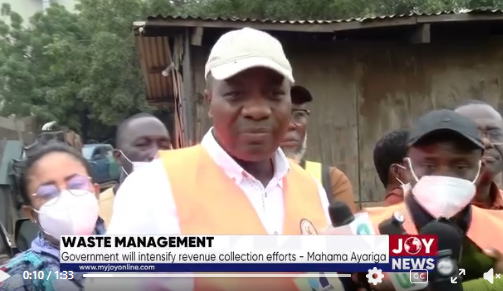
Local Government Minister Mahama Ayariga has declared a “war against indiscipline”, warning of tougher enforcement of sanitation and other statutory rates and insisting that households, businesses, factories and other establishments pay what they owe to the assemblies.
The minister said industries and businesses operating in Accra are partly responsible for the city’s growing waste problem and should therefore bear the cost of managing the waste they generate, rather than relying on the Common Fund.
Mr Ayariga made the remarks during a tour of waste sites in Accra on Tuesday, September 1, where he emphasised the need to fix the city’s waste problem and ensure that those responsible for generating the waste contribute towards its management.
“We have to fix this problem, and it will cost money to fix this problem,” he said.
He said the local government ministry would therefore insist that everyone pay the rates they are supposed to pay to the city authorities.
“So the local government ministry is going to insist on everybody paying what they are supposed to pay,” Mr Ayariga said.
He said the full collection of basic rates, property rates, market rates, and other statutory payments owed to city authorities would provide the resources needed to address sanitation challenges.
According to the minister, improved revenue collection would strengthen the capacity of city authorities to tackle problems confronting them.
The minister also pointed to factories and structures operating in Accra, saying they are expected to pay the assemblies because their physical presence contributes to the generation of waste.
“All these factories that are there, all the structures that are there, are supposed to be paying to the assemblies because it is their physical presence here that is causing the waste,” he said.
Mr Ayariga invoked the “polluter pays principle," arguing that those who generate waste should bear the cost of managing it.
“If you follow the polluter pays principle, you, the person causing the waste, are the one to pay for the waste,” he said.
He maintained that waste generated in Accra should not be financed from the Common Fund, which he said should be distributed to other parts of the country.
“The waste should not be paid for from the common fund. Common Fund is to be distributed to the rest of the country,” he said.
Mr Ayariga argued that people and businesses operating in Accra should take responsibility for the costs associated with the waste they generate.
He said factory owners who generate waste while making profits should also be held accountable for the waste their operations produce.
According to Mr Ayariga, factories also contribute to population concentrations around their locations because people seek to live close to their workplaces.
He explained that, from an economic perspective, people tend to live close to their workplaces, meaning factories and other activities in Accra contribute to the movement of people from the hinterlands into the capital.
He added that the human beings living near factories and other activities in Accra also contribute to the waste generated in the city.
“It is all the factories that are here that are drawing the crowd because we want to live close to their workplaces, as human beings that are living near the factories that are generating the waste,” he said.
Meanwhile, Executive Chairman of the Jospong Group of Companies, Dr Joseph Siaw Agyepong, outlined the way forward for waste management, including the decommissioning of some waste sites and the adoption of more effective waste management systems.
Latest Stories
-
Photos: Mahama holds talks with Serbian President in Belgrade
4 minutes -
Local gold refining good for economy but costs must be controlled – Economist
4 minutes -
Keir Starmer announces he is standing down as MP
5 minutes -
One still missing after Grand Canyon floods kill two and prompts rescue efforts
6 minutes -
Mahama Ayariga calls for major overhaul of Ghana’s waste management system
9 minutes -
GoldBod programme contributed just 1.3% to reserves increase – Amin Adam
10 minutes -
Drive to Inspire–Africa equips UESD students with skills for future careers
12 minutes -
Diana Hamilton reveals she experiences stage fright before performances
16 minutes -
Number of ATMs declined by 0.5% to 2,272 in 2024 – BoG
17 minutes -
Look beyond government securities, GVCA tells pension funds
17 minutes -
COCOBOD settles GH¢2.3bn DDEP obligations for 2026
19 minutes -
Police arrest 6 for allegedly killing tricycle rider over failure to make sales
23 minutes -
Mahama unveils ‘Accra Reset’ blueprint for fairer global economic order
26 minutes -
Mahama calls for stronger climate finance, renewable energy investment for developing nations
27 minutes -
Nepal death toll crosses 1,000 as rescuers race to find workers trapped in mud-filled tunnels
28 minutes