

Audio By Carbonatix
There are certain professions in Ghana where speaking freely is part of the job.
A radio presenter is expected to have an opinion before breakfast. A politician must have one even before knowing the question. A pastor may have an opinion on marriage, football, taxation, hairstyles and occasionally matters concerning the Almighty.
A Chief Justice, unfortunately, belongs to a different profession.
His Lordship Justice Paul Baffoe-Bonnie has discovered this rather dramatically after recent visits to the Social Security and National Insurance Trust and the Minerals Income Investment Fund.
At MIIF, the Chief Justice congratulated management on what he had been told about its performance and then offered the observation that has since sent political temperatures rising.
Sometimes, he said, when one hears what some state organisations are doing now, one wonders what Ghana had really been doing “in the past eight years.”
Ordinarily, eight years is simply a unit of time.
Two presidential terms. Ninety-six months. Roughly 2,922 days, depending on where leap years choose to interfere.
But this is Ghana.
Here, even the calendar has political affiliations.
Say “eight years” in September 2026, and nobody reaches for a calculator. Everybody immediately reaches for a party flag.
The period from 2017 to 2024 belonged to the Akufo-Addo administration, and so the opposition NPP heard considerably more than an innocent historical observation. It heard the Chief Justice assessing its record in government and apparently marking the examination paper in public.
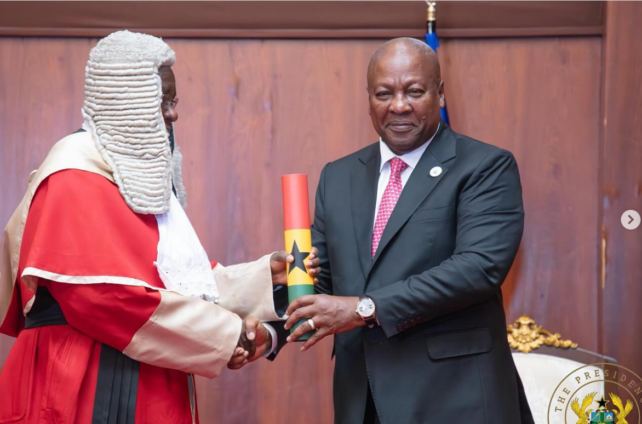
The situation became even more uncomfortable when the Chief Justice, speaking to MIIF management, urged them to work to ensure that President John Mahama’s agenda succeeds.
At SSNIT, too, he had compared what he was hearing about the institution's current performance with the previous attempt to sell certain assets, including the Labadi Beach Hotel, wondering how the country had “sunk so low.”
By the time the Chief Justice finished his institutional tour, the politicians had already assembled the national courtroom.
The NPP called on him to retract his remarks or resign and join the NDC.
Others have been less dramatic but equally concerned. CDD-Ghana has urged greater restraint, warning that the statements risk creating a perception of political bias.
The Judicial Service has since responded, explaining that the observations were made in good faith and were not intended to undermine judicial independence.
And this is where the matter becomes more interesting than the predictable NPP versus NDC shouting match.
I have no reason to doubt the Chief Justice's good faith.
Indeed, nothing he said proves that he belongs to the NDC, dislikes the NPP or would decide a case according to the colour of somebody's party card.
But judicial independence has always suffered from one peculiar complication.
It is not enough for justice to be impartial.
Justice must *look impartial*.
Our elders understood this principle long before anybody drafted a judicial code of conduct.
The person sharing the soup must not be caught licking the ladle.
He may have been merely checking whether there was enough salt. He may have acted in perfect good faith. Indeed, laboratory analysis may later establish that not one drop of soup entered his mouth.
Unfortunately, everybody at the table has already seen his tongue.
That is the difficulty confronting the Chief Justice.
Judges, of course, are citizens. They do not surrender their intelligence, patriotism or capacity for observation when they take judicial office. They may recognise competent management. They may be disappointed by waste. They may privately believe one government performed better than another.
But the higher the judicial office, the smaller the luxury of publicly expressing some of those opinions.
The Judicial Service's own Code of Conduct recognises this danger precisely. Judicial impartiality includes not merely actual independence but the avoidance of conduct that could cause a reasonable and informed person to perceive political alignment.
This is especially important in Ghana, where almost every major political controversy eventually develops a legal address.
Today, the government congratulates MIIF.
Tomorrow, MIIF could become involved in litigation.
Today, the opposition complains about the Chief Justice.
Tomorrow, an opposition figure may appear before a court in a politically sensitive case.
At that moment, the citizen watching proceedings should be able to disagree with the judgment without wondering whether His Lordship had already disclosed his political sympathies during an institutional courtesy call.
This is why judges traditionally do most of their loudest speaking through judgments.
Politicians can tour the country praising government programmes. Ministers can tell us the President's agenda is succeeding magnificently. Party communicators can announce that Ghana has entered paradise and that the only outstanding problem is that some citizens have refused to notice.
That is their job.
The Chief Justice occupies another space entirely.
There is therefore something excessive about calls for his resignation based solely on these remarks. One ill-advised excursion into political-sounding commentary does not establish that the Judiciary has become an extension of Jubilee House.
But there is also something inadequate about simply saying the remarks were made in good faith and closing the file.
High office is not judged by intention alone.
It is judged by consequence, perception and the special responsibilities attached to the chair.
The greater the authority, the greater the restraint.
A chief may dance at a funeral, but our elders say he must remember that even his footsteps are being watched.
And the Chief Justice is no ordinary dancer.
There is a final irony in all this.
Lady Justice is traditionally depicted wearing a blindfold. The symbolism is simple: she should not see wealth, power, status, tribe, friendship or political colour when weighing the scales.
Perhaps Ghana now needs to improve the equipment.
Give her earplugs too.
And while we are at it, remove the calendar from the courtroom.
Because in the Republic of Uncommon Sense, once Lady Justice starts counting backwards eight years, one half of the country will immediately accuse her of remembering too much, while the other half insists she has finally opened her eyes.
The safer course may be the ancient one.
Keep the blindfold firmly in place.
And let the judgments do the talking.
By: Jimmy Aglah
Latest Stories
-
Mahama’s board shake-up should not be linked to indiscipline – Akwatia MP
12 minutes -
‘My Police, Your Police, Our Police’: the Aboso fire and a lesson in Policing together
33 minutes -
Parliament backs OSP probe into alleged GH¢70k payment to Patricia Appiagyei
54 minutes -
Photos: Joy FM Back-to-School Fair buzzes with excitement, strong patronage on Day 2
1 hour -
Dissolving inactive SOE boards is justified – Dennis Miracles Aboagye
1 hour -
John Boadu: I am not contesting for president; I am contesting to make Bawumia President
1 hour -
Zoomlion begins post-flood disinfection exercise in West Gonja to curb health risks
2 hours -
When Lady Justice Counted Eight Years
2 hours -
SIGA reporting should distinguish commercial performance from public service – Yaw Appiah Lartey
2 hours -
SOEs must hold AGMs, not just submit audited accounts – Deloitte Partner
2 hours -
There are errors in SIGA report that affected its conclusions – Miracles Aboagye
2 hours -
Joy FM Back-to-School Fair gains momentum as Day 2 gets underway
2 hours -
Bright Simons fires back, rejects claims he used AI to critique SIGA report
3 hours -
SIGA did not conjure or manufacture figures – Prof Kpessa-Whyte
3 hours -
Government just put a spin on SIGA report – Miracles Aboagye
3 hours