

Audio By Carbonatix
7 September marks the International Day of Clean Air for Blue Skies. It is a United Nations day reminding the world that the air we breathe matters. This year, the day comes with some sobering numbers.
More than 20 African countries have yet to meet even the loosest air pollution guideline set by the World Health Organization (WHO). That is according to the first-ever continent-wide Africa Air Quality Brief, released by the Africa Clean Air Network (AfriCAN), in partnership with the Copernicus Atmosphere Monitoring Service (CAMS) and State of Global Air.
Dr Laurence Rouil, Director of CAMS, which supplied the satellite data behind the brief, says the goal is to give leaders a clear picture of where the problems are and where action is needed.
“Reliable and accessible air quality information is essential for informed decision-making. By combining and interpreting satellite, in-situ observations and model results, this brief provides a clear picture of air pollution patterns and trends across Africa, helping policymakers identify priorities, assess progress, and support actions that protect public health.”
The WHO uses two main tests to measure exposure to PM2.5, tiny particles of dust, smoke and soot that can penetrate deep into the lungs.
The first looks at the annual average. The less strict version allows up to 35 micrograms of PM2.5 per cubic metre of air.
The second looks at individual days when pollution reaches 75 micrograms per cubic metre. It is designed to capture short, sharp spikes in pollution.
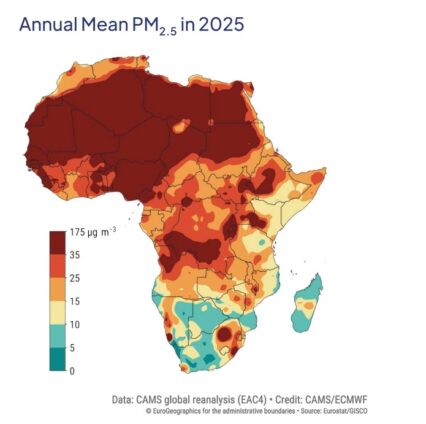
In 2025, only 30 of the roughly 50 African countries assessed in the brief met the easier annual test. That means more than 20 failed it. A handful of other countries did not have enough data to be assessed.
The highest annual pollution levels were concentrated in West Africa and the Sahel, particularly Nigeria, Niger and Senegal.
The daily test tells a slightly different story. Twenty-nine countries recorded zero days when pollution crossed the 75 microgram danger line. But Nigeria, Rwanda and South Africa each recorded more than 50 such days in 2025.
Not all of Africa's pollution comes from human activity. Seasonal Saharan dust blowing towards the Atlantic caused more than 120 days of unsafe air in parts of West Africa between January and June 2025. Senegal and Cape Verde were hit hardest. By comparison, parts of East and southern tropical Africa recorded about 30 such days.
Later in the year, seasonal bush and land fires, known as biomass burning, pushed pollution beyond the daily limit for more than 30 days in southern Democratic Republic of Congo and northern Angola.
But nature is not the main story in Africa's biggest cities. Everyday human activities remain major sources of pollution. These include cooking with charcoal and wood, vehicle exhaust and waste burning. In southern Africa, burning fossil fuels to generate electricity adds further to the problem.
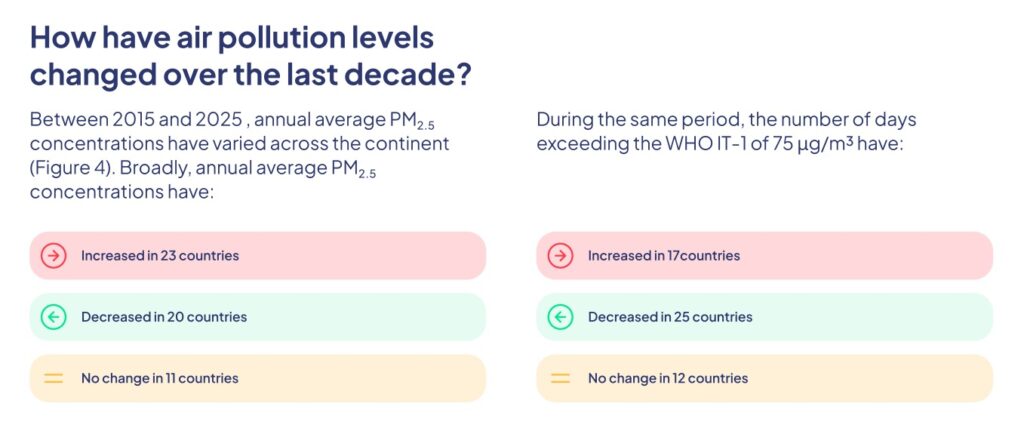
Looking back from 2015 to 2025, the picture across Africa is mixed. Annual average PM2.5 pollution increased in 23 countries, decreased in 20, and remained largely unchanged in 11.
The number of high-pollution days paints a slightly more hopeful picture. They fell in 25 countries, increased in 17, and remained stable in 12.
But air pollution is about more than numbers. It is a health and economic problem.
Dr Caradee Wright of the South African Medical Research Council, speaking at the 2026 Africa Clean Air Forum in Pretoria, puts it simply: “Air pollution taxes our economies quietly, continuously, and regressively.”
South Africa's Deputy Minister of Forestry, Fisheries and the Environment, Bernice Swarts, says the issue goes even further.
“Air pollution is no longer simply an environmental issue. It is a public health emergency, a development challenge, a climate issue and a matter of environmental justice.”
She says poor air quality threatens investment, tourism, food security and sustainable development.
For Moortaza Jiwanji of the UNDP Africa Sustainable Finance Hub, the challenge is also about convincing investors that clean air is worth paying for.
“We need to use cost-benefit analysis and rates of return to show how investing in infrastructure can reduce that loss and turn it into a benefit.”
The Economic Case for Clean Air
That argument received powerful new backing on Blue Skies Day. A separate global report by the UN Environment Programme (UNEP) and the Climate and Clean Air Coalition (CCAC), titled Hidden Assets: The Economic and Health Case for Climate and Clean Air Action, was also released to mark the day.
For every $1 invested in tackling climate change and air pollution together, the report estimates around $15 in economic benefits when health and quality-of-life gains are included. Even when only direct market returns are counted, the return is about $4 for every $1 invested.
It estimates that outdoor air pollution contributed to 6.4 million premature deaths worldwide in 2025. Household air pollution was linked to another 2 million deaths, including around 300,000 children. The report also estimates that delaying action costs the world more than $1.5 trillion every year in lost benefits.
UNEP Executive Director Inger Andersen says governments need to rethink how they see clean-air action.
“For too long, we have treated climate action as a cost to be managed and air pollution as the unfortunate outcome of development. This report shows the opposite: Clean air is a key driver of development, health, food and energy security, and climate stability, an asset we must invest in.”
But failing the clean-air test does not mean countries are standing still. Across the African continent, several countries are beginning to build the systems needed to understand and tackle pollution.
Togo, Malawi and Liberia have launched new air quality monitoring programmes. Uganda has deployed more than 180 low-cost air sensors to help cities develop their own pollution rules. And South Africa is incorporating low-cost sensor readings into its national monitoring system.
Ghana and South Africa are updating their national air quality standards.
The Gambia and Togo are working on their first standards. In Lagos, Nigeria, authorities are testing a pollution tax. Nairobi, Kenya, has launched a five-year clean air action plan. And Ethiopia has banned new fuel-burning car imports while offering tax incentives for electric vehicles.
In Togo, the work is also gathering pace. Project Coordinator Lantam Djeri-Wake says the country is working to monitor air quality in 11 cities using both reference-grade monitors and low-cost sensors.
The country has also developed national standards, with consultations underway to bring air-quality considerations into development planning.
“In Togo, the government has demonstrated its commitment to improving air quality through the Togo Air Quality Project (PQAT), which aims to monitor air quality in 11 cities using a combination of reference-grade monitors and low-cost sensors.”
In West Africa, Ghana is also positioning itself as a regional hub for clean-air research. The West Africa Centre for Clean Air (WACCA) at KNUST is beginning to find its footing. Its Coordinator, Dr Yen Adams Sokama-Neuyam, says the centre is working with institutions and funding agencies to build a sustainable regional centre of excellence.
“We need to be able to drive this regional centre of excellence that we've just established. We've also been working with several institutions and funding agencies to be able to give sustainability to the centre at the end of the funding cycle.”
But more data alone will not solve the problem. Nancy Lozano-Gracia of the World Bank Institute for Economic Development says countries must now turn the growing body of air-quality data into evidence that policymakers can use.
“As more cities in Africa are setting up air quality monitoring, it is important that we invest in capacity, research and engagement to translate data into policy-relevant evidence, including the economic costs of air pollution and the benefits of clean air action.”
Perhaps the biggest change is in the way Africa's air pollution story is being told. For years, the headlines focused on which African city was the most polluted. Prof. Engineer Bainomugisha of AirQo says that narrative is beginning to change.
“I think before, what used to make a story is this is the most polluted city in Africa. But I think now we start seeing stories that actually are talking about what cities are doing. And I think this is the kind of narrative we need.”
More than 20 African countries are still failing the world's easiest clean-air test. But there are also signs of movement.
The continental air-quality brief gives countries a clearer picture of the problem. CCAC’s report shows the economic value of acting. And across Africa, more countries are beginning to monitor pollution, set standards and test new solutions.
This Blue Skies Day therefore arrives with more evidence, but also more reason for hope, than the one before it.
This story was a collaboration with New Narratives. Funding was provided by the Clean Air Fund which had no say in the story’s content.
Latest Stories
-
‘I can’t wait to get started’ – Jordan Ayew after signing for Sheffield United
27 seconds -
Gyakie scores double top 10 entry on Apple Music Nigeria
4 minutes -
Ghana plans EV skills centre to prepare mechanics for electric vehicle boom
7 minutes -
Makeup Ghana holds workshop to develop first Ghana Beauty & Wellness Report
10 minutes -
Armah-Kofi Buah courts Chinese green technology for Ghana’s mining sector
13 minutes -
Adu-Boahene trial: ‘14 days too short for credible no-case submission’ – Atta Akyea
16 minutes -
Placement algorithm must be fixed to end annual CSSPS chaos – Divine Kpe
21 minutes -
‘I didn’t think twice’ – Ayew delighted to join Sheffield United
23 minutes -
Burundians scramble to leave Kenya ahead of crackdown on unregistered traders
28 minutes -
Wontumi campaign team endorses John Boadu in NPP national chairmanship race
29 minutes -
At least two people dead after Russian strikes on Kyiv
33 minutes -
Adu-Boahene trial: Court gives defence until Sept. 25 to file no-case submission
36 minutes -
Daily Insight for CEOs: Profitability beyond revenue growth.
40 minutes -
‘Jordan Ayew can have an impact here’ – Sheffield United boss Chris Wilder
44 minutes -
Education Ministry to digitise SHS placement complaints system
50 minutes