

Audio By Carbonatix
The warning came months before the water did.
On February 24, 2026, the Ghana Meteorological Agency (GMET) launched the fourth Meteorological Awareness Month and presented its 2026 seasonal forecast for southern Ghana. Communications Minister Sam George presented the forecast, with GMET Director-General Dr. Eric Asuman and Board Chairman Selasie Woanyah in attendance. The minister urged residents to clear drains and warned that blocked waterways breach environmental bylaws.
“Weather hazards cannot be prevented, but their impact can be significantly reduced,” Sam George said, through early information, preparedness and responsible action.
In a statement issued on June 30, after touring the flooded areas, President Mahama cited GMET data showing that Accra’s June rainfall rose from 85 millimetres in 2024 to 172 millimetres in 2025 and to about 333 millimetres in 2026. He said,
“The data is clear that climate change is significantly raising the volume of rainfall Ghana receives each year. Instead of steady seasonal showers, large volumes of water now fall on cities and farmland in a matter of hours, overwhelming outdated drainage systems, bursting riverbanks, and turning routine rains into devastating flash floods”.
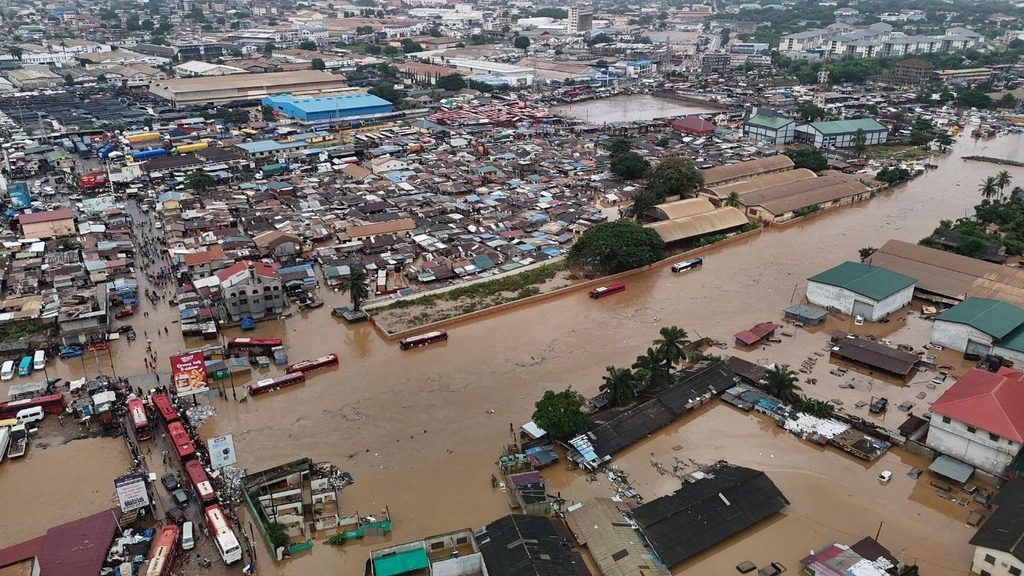
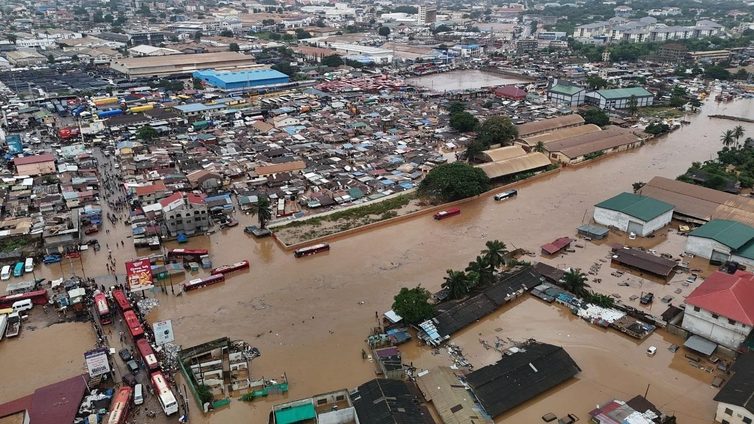
Aerial view of flooded communities in Accra Source: Kobby Imagery
The National Disaster Management Organisation (NADMO) said its relief stocks were already running low from a string of flood incidents since May. Then June arrived. The Interior Minister told Parliament that June 2026 was the wettest month on record since records began in 1995, and that June 29 alone brought 169.2 millimetres of rain. In August, he gave the final count for that day: the floods affected 91,989 people from 18,398 households across 77 districts in seven regions and claimed 39 lives, with a four-month-old baby still missing.
Behind these overall numbers lies an important fact: floodwaters do not affect everyone equally. Comparing regional figures with population data shows that women, informal market workers, and rural farming families are likely to carry the heaviest burden.
REGIONAL DATA SIDEBAR: COASTAL AND URBAN SECTOR
Greater Accra (June 29): 56,022 people affected across 27 districts, 17 deaths. In Krowor district, 6,500 people from 1,300 households were displaced.
Central Region: Floods from June 19 to 23 killed 18 people, collapsed 58 buildings, and displaced 377. On June 29, 21,882 people were affected across 16 districts.
.
Root Causes: Torrential Rainfall vs. River Overflows
Direct Torrential Rainfall and Urban Drainage Collapse
In Greater Accra (June 29, 2026) and the Central Region (June 19 to 23, 2026), the primary driver was high-intensity, short-duration rainfall falling on heavily built-up environments. In Accra, choked storm drains, poor urban planning, and low-lying topography meant that water could not drain away, submerging communities across the city.
Transboundary River Overflows and Continuous Rainfall
In the Volta Region (September 27 to 28, 2026), a nine-hour downpour combined with heavy rain in Togo pushed the River Dayi over its banks. The river rises in the mountains along the Ghana-Togo border and flows through Buem and Hohoe. More than 400 homes were submerged. In Savannah Region’s North East Gonja District (from September 23, 2026), continuous rainfall washed away a key feeder road and collapsed homes and food stores.
Regional Impact and Displacement Across Ghana
The June 29 floods affected 91,989 people across seven regions. Greater Accra carried the heaviest human toll: 56,022 people affected, about 61% of the national total, and 17 deaths.
In the Krowor district, 6,500 residents across 1,300 households were displaced, the highest of any district. In that early count, deaths were recorded in Ga East (five), Ayawaso Central (three), Tema West (three) and Ledzokuku (one).
NADMO Director of Inspectorate Richard Amo Yartey said in early July that the national count then stood at 34 deaths but “could go up.” It did.
In the Central Region, NADMO regional director Kwesi Dawood reported 18 deaths across 13 districts after floods, mudslides and building collapses between June 19 and 23, with 58 buildings collapsed and 377 people displaced. Cape Coast, the regional capital, was the hardest hit with six deaths.
The Cape Coast Assembly said eight houses, mostly mud structures, collapsed in the June 19 and 21 storms, killing four people, three of them children. Official tallies differ: the Interior Minister’s breakdown of the June 29 floods lists 21,882 people affected across 16 districts of the region and eight deaths.
In the Volta Region, the River Dayi overflow on September 28 displaced about 5,336 people in 10 communities of Hohoe Municipality, affecting 4,218 households and roughly 400 houses, according to NADMO. More than 700 residents were sheltered in classrooms, and others in mosques, while the Hohoe Zongo community was among the hardest hit.
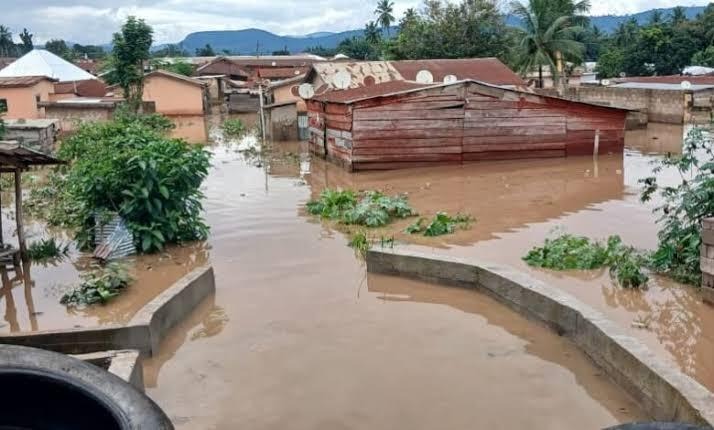
Savannah Region floods Source: Ghanaian Times
MP for Buem, Kofi Adams said many people were left without shelter and described the situation as “pretty terrible.” He explained that Buem and Hohoe are heavily affected partly because of their closeness to Togo and the River Dayi.
MP for Hohoe, Thomas Worlanyo Tsekpo said the major cause was torrential rain in Togo joining local rainfall. He called the situation “overwhelming” and appealed for urgent support.
REGIONAL DATA SIDEBAR: RIVERINE AND NORTHERN SECTOR
Volta Region (Hohoe): About 5,336 people displaced in 10 communities, 4,218 households, roughly 400 houses affected, no deaths reported.
Savannah Region (North East Gonja): 246 people without shelter, 93 houses collapsed, main feeder road cut off.
Other regions (June 29): Western 2,031, Ashanti 1,461, Western North 937 and Eastern 190 people affected, about 4,600 combined.
Primary Drivers: Heavy local rain with rain in Togo feeding the River Dayi, continuous rainfall in Gonja, washed-out roads and bridges.
In Savannah Region’s North East Gonja District, heavy rains collapsed 93 houses, leaving 246 residents without shelter. Floodwaters washed away part of the main feeder road connecting Lantung Park, Kedingi, and Kanankula, and destroyed food stocks, farm produce, and livestock.
NADMO’s Savannah Regional Director Mahama Zakaria, who led the assessment, said the immediate priority was to assess the damage and support displaced residents, with relief expected within 48 hours. District Chief Executive Abdul Mumin Ewuntomah said,
“This road is very important” because it links several communities to the market, including traders from around Bimbila who are now cut off”.
The June 29 floods affected people in the Western Region (2,031), Ashanti Region (1,461), Western North (937), and Eastern Region (190), as inland streams and catchments overflowed.
DEMOGRAPHIC DATA SIDEBAR: GSS STATISTICS
National Female Population Share: 50.7% (2021 census, 15.6 million women). About 52.4% in the Volta Region and 50.9% in Greater Accra.
Never Attended School: 24.4% of females aged 3 and over, compared with 17.0% of males (2021 census).
Unemployment: 12.8% on average in the first three quarters of 2025, with the female rate 3.7 percentage points higher than the male rate (2025 Quarterly Labour Force Survey).
Informal Economy Dependence: About 87% of women’s employment in Greater Accra was informal in the 2015 Labour Force Survey.
What Census Data Shows About Flooded Communities
Disaster data lines up with statistics from the Ghana Statistical Service (GSS). Ghana’s latest census is the 2021 Population and Housing Census, so the population and schooling figures below date from 2021. The labour figures come from GSS’s 2025 Quarterly Labour Force Survey.
More Women in Impacted Areas: Women make up 50.7% of Ghana’s population. The Volta Region has the highest share of women of any region, about 52.4%, with 91 men for every 100 women. In Greater Accra, the share is about 50.9%. If the 91,989 people affected on June 29 matched the national share, about 46,600 would be women and girls.
Informal Work and Few Savings: Most women work informally. In the 2015 Labour Force Survey, about 87% of women’s employment in Greater Accra was informal. GSS’s 2025 labour survey found female unemployment running 3.7 percentage points above male unemployment, so many women have little income buffer when disaster strikes.
Focus on High-Risk Districts: Gender Disparities in Action
Economic Vulnerability and Capital Loss (Greater Accra)
In Adabraka and surrounding communities, an assembly member reported more than 22,000 people and over 2,000 households affected, with homes, businesses and markets badly damaged. Women interviewed by GBC after the June 29 floods described losing both homes and small businesses, and advocates note that many female-headed households depend entirely on small informal trade that a flood can wipe out. Unlike formal wage earners, informal traders rarely have insurance or bank access to rebuild working capital.
Health and Hygiene in Emergency Shelters (Hohoe, Volta Region)
When more than 700 residents of Hohoe were relocated into classrooms after the River Dayi overflow, they joined a pattern seen after floods everywhere: crowded shelters with limited privacy and sanitation.
Agricultural Isolation and Food Insecurity (North East Gonja, Savannah Region)
In rural North East Gonja, NADMO reported that food stocks, farm produce and livestock were destroyed and that the washed-out feeder road cut communities off from the market. Cut-off markets and lost stocks are likely to hit women farmers and food traders hard.
Moving Beyond Emergency Relief
Ghana’s 2026 flood season shows that emergency financial responses, like the GHS 300 million Contingency Fund release, help meet immediate survival needs but do not prevent future disasters. Only half of that release was earmarked for flood mitigation. Managing floods purely through emergency aid leaves vulnerable communities in a continuous cycle of damage and recovery.
Building long-term safety requires shifting from emergency fixes to planned adaptation.
Latest Stories
-
Ghana housing finance conference adopts communiqué to improve affordable housing access
4 hours -
Special Initiatives Minister urges Wa Technical Institute to enrol more girls as EU-backed solar training lab opens
4 hours -
In the matter of my first year at the Bar
4 hours -
ActionAid Ghana calls for an end to child marriage, greater investment in girls’ rights
5 hours -
Newsfile to tackle World Cup visa scandal, beach demolitions, education strikes, BRICS bid
5 hours -
UK-Ghana Trade & Investment Summit: Trade Resource Centre to help businesses maximise UK-Ghana trade opportunities
5 hours -
Embassy of Denmark celebrates World Maritime Day
5 hours -
Linking LEAP to productive inclusion could cut extreme poverty by 2030 – UNICEF
6 hours -
Trade Ministry backs use of creative arts to rehabilitate prison inmates
6 hours -
Negotiations with government to continue despite strike suspension – GNAT
7 hours -
‘Ghana cannot afford to waste public resources; every cedi has a job’ – Ato Forson
7 hours -
Ghana expects economic boost as World Assemblies of God Congress brings 10,000 delegates to Accra
7 hours -
Joy in Nayilifong as Farouk Aliu Mahama donates 100kVA transformer to improve power supply
7 hours -
Chief Justice urges employers to tackle mental health stigma in workplaces
8 hours -
Analysis: Ghana’s yellow fever numbers reveal a gap between vaccination and protection
8 hours