

Audio By Carbonatix
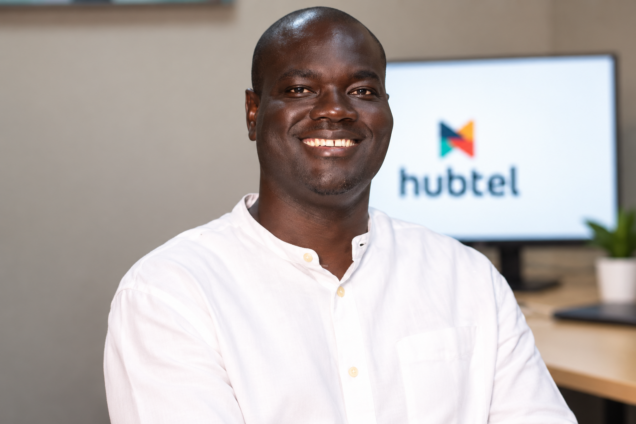
The Chief Executive Officer of Hubtel, Alex Bram, has expressed the company's willingness to contribute to Ghana's proposed Artificial Intelligence (AI) Fund, as the government seeks private-sector support to finance the country's ambitious AI development programme.
He believes collaboration between government and businesses will be critical to building the infrastructure, developing the skills and creating the technological systems needed to position Ghana in the rapidly evolving AI economy.
Asked whether Hubtel would be prepared to contribute financially to the proposed fund, Mr. Bram responded: “Absolutely.”
Speaking in an interview ahead of the second episode of the Digital Economy Forum, the Hubtel CEO explained that private businesses would have a strong incentive to support national AI infrastructure if it provides services that improve their operations and productivity.
“Having access to use it to improve the way you work or the way you get things done in your company, you'd obviously pay for it,” he explained.
He argued that beyond investing directly in infrastructure and skills development, businesses could help sustain the country's AI ecosystem by paying to use the services and solutions developed through the initiative.
“And I think we have enough companies here that will. So definitely, Hubtel is one of them. There's no way if government has some very beautiful services, data and AI and all of that, that we would bypass it and not use it,” he said.
His comments come as Ghana pursues a national AI strategy backed by a government commitment of US$270 million.
The Minister for Communication, Digital Technology and Innovations, Sam George, has disclosed that US$250 million is earmarked for the first phase of a national AI compute centre, while US$20 million is intended to establish an AI fund.
The government expects the fund to attract additional financing, including contributions from private institutions, to support the country's AI ambitions.
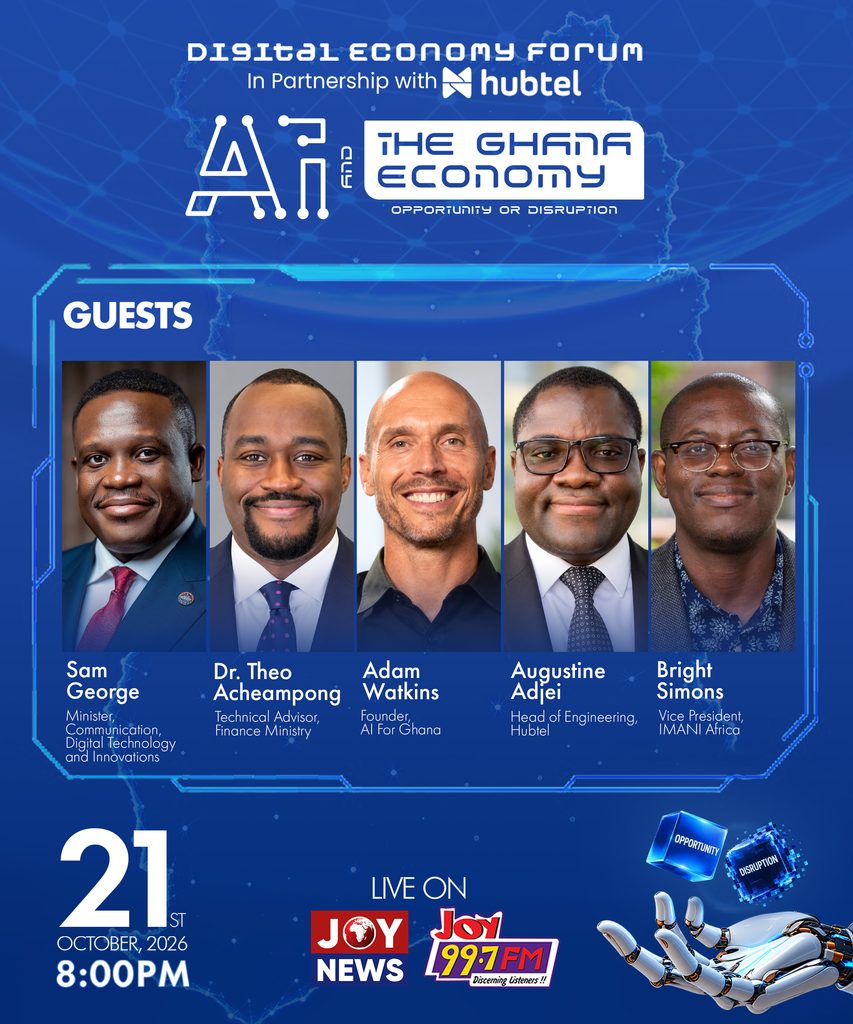
The role of private investment in Ghana's AI development will form part of discussions at the second episode of the Digital Economy Forum, under the theme “AI and the Ghana Economy: Opportunity or Disruption?”
The forum, held in partnership with Hubtel, will feature Sam George; Technical Advisor at the Finance Ministry, Dr Theo Acheampong; Founder of AI for Ghana, Adam Watkins; Head of Engineering at Hubtel, Augustine Adjei; and Vice President of IMANI Africa, Bright Simons.
It will air live on JoyNews and Joy 99.7 FM on Wednesday, October 21, 2026, at 8 p.m.
Private sector support critical
Mr. Bram identified banks, insurance companies, pension funds, fintech firms, telecommunications companies and mobile money operators as important stakeholders in developing Ghana's AI ecosystem.
He argued that these institutions play central roles in the country's economy and would also benefit from the productivity improvements and technological capabilities made possible by artificial intelligence.
He believes that securing their participation would require an investment framework that demonstrates clear value to businesses.
The Hubtel CEO also suggested that government may need to introduce incentives to encourage private enterprises to invest in AI infrastructure and related initiatives.
He pointed to developments in countries such as the United States and China, where governments and major technology companies are collaborating on large-scale AI infrastructure projects.
Mr. Bram believes Ghana must pursue a similar partnership between the public and private sectors to build the capacity required to compete in the emerging global AI economy.
Beyond funding: Ghana's AI challenges
Despite welcoming the government's commitment to developing AI infrastructure, Mr. Bram cautioned that funding alone would not guarantee success.
Drawing on Hubtel's experience in establishing its own AI laboratory in 2023, he disclosed that the company encountered significant challenges accessing the specialised personnel and data required to develop AI models.
He revealed that Hubtel initially sought to recruit about 30 machine learning engineers but could not find enough qualified professionals locally, even after substantially increasing its recruitment budget.
“We increased the budget almost about twice, and we still couldn't find machine learning data scientists that were from Ghana. We offered very generous terms. We still couldn't find, so our tech was a bit behind,” he explained.
The company also struggled to obtain sufficient data to train its AI models, with Mr. Bram citing the absence of an effective data-sharing framework as a major obstacle.
He consequently urged the government to ensure that investment in the proposed national AI compute centre is accompanied by measures to improve data availability and develop the country's technical workforce.
“The money is extremely important. The money to set up the starting data centres and the architecture and the infrastructure around it is very important. But whilst we do that, I think we also have to look at the skills,” he stressed.
Mr. Bram believes Ghana has taken an important step by developing a national AI policy and committing resources to infrastructure, but says implementation must be accelerated to take advantage of emerging opportunities.
He is particularly optimistic about what closer cooperation between government and businesses could achieve, arguing that both sides must work together to determine how Ghana benefits from the technological transformation.
“This is a time that the private sector and government must really be close together because a brand new future is going to get invented very soon,” he said.
For the Hubtel CEO, Ghana's early investments, combined with private-sector participation and deliberate skills development, offer an opportunity to build an economy in which local businesses and young people can benefit from artificial intelligence.
“I think Ghana is well on the path. I mean, starting with the policy building, putting some money where the policy is heading towards, investing deliberately in the skills, the digital skills required to manage and build and translate and take this AI out to, or this new technology out to everybody else, mass enterprises, micro enterprises and all that. I think we're already on the path and that's critical,” he said.
Latest Stories
-
Snake Village: A look at Volta Region’s hidden snake village and its tourism potential (Video)
2 minutes -
Election Watch Ghana calls for constitutional reforms to strengthen Electoral Commission independence
5 minutes -
NACOC, Postal and Courier Services Regulatory Commission intensify efforts to curb drug trafficking
6 minutes -
Ga Mantse chairs committee to drive Accra Green and Clean City Initiative
8 minutes -
Drivers threaten to remove traders from lorry stations over TrafficTech concerns
11 minutes -
AI could create 10 to 20 times more jobs despite current recruitment slowdown – Hubtel CEO
13 minutes -
Sexual abuse in schools persists because perpetrators are not held accountable – Dr Nyarkoa
21 minutes -
Chief Justice has designated Achimota Court to handle petroleum diversion cases – NPA CEO
24 minutes -
Philip Nai and friends gear up for bigger seventh Christmas outreach
25 minutes -
GSA strengthens electricity meter testing to protect consumers and improve energy reliability
26 minutes -
‘Dismissed or suspended? Ghanaians deserve clarity’ – NPP demands clarity on Ampofo Ankrah’s fate
30 minutes -
Teach consent and sexual boundaries from pre-school to prevent abuse – Gender advocate
35 minutes -
Zonda Tec launches HOWO T3M truck to support agric and logistics
44 minutes -
Obuasi SHTS scandal: Eduwatch calls for sex offenders’ register and mandatory background checks for teachers
56 minutes -
GloMeF CEO urges intensified public education on new road traffic regulations
1 hour