


Audio By Carbonatix
The International Criminal Court has sentenced an Islamist militant who destroyed ancient shrines in Timbuktu to nine years in jail.
Ahmad al-Faqi al-Mahdi admitted to leading rebel forces who destroyed historic mausoleums at the world heritage site in Mali in 2012.
Judges at the court in The Hague found he had shown "remorse and empathy" for the crime.
It is the first sentence based on cultural destruction as a war crime.
It is also the first time a suspected Islamist militant has stood trial at the ICC.
Mahdi - described as a "religious scholar" in court documents - led rebels who used pickaxes and crowbars to destroy nine of Timbuktu's mausoleums and the centuries-old door of the city's Sidi Yahia mosque.
The court found he not only offered "logistical and moral support" for the attacks, but also took part in the physical destruction of at least five out of the 10 buildings.
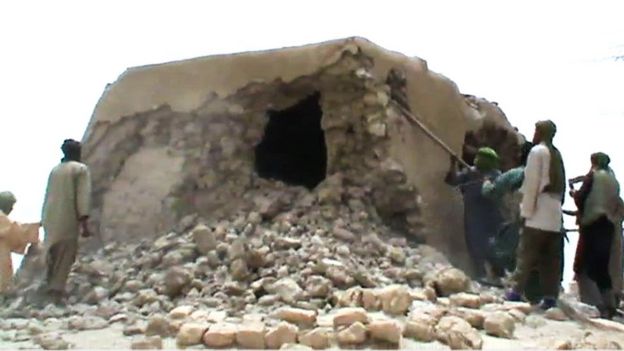
Nine mausoleums and a mosque were destroyed in 2012
However, Mahdi had at first advised rebel leaders not to attack the shrines.
Admitting to the charges last month, Mahdi claimed he had been swept up in "an evil wave".
Pleading guilty, he said: "I am really sorry, I am really remorseful, and I regret all the damage that my actions have caused.
"I would like to give a piece of advice to all Muslims in the world, not to get involved in the same acts I got involved in, because they are not going to lead to any good for humanity," he added.
Rare ICC success: Analysis by Anna Holligan at the Hague
Wearing a grey suit, striped tie and spectacles, there was little sign of the violent jihadist responsible for destroying these treasured shrines.
Ahmad al-Faqi al-Mahdi was a member of a group with links to al-Qaeda and the leader of the morality police (a religious vice squad operating in Timbuktu during the rebel occupation).
According to the judge, he wrote a sermon dedicated to the destruction, gave instruction and tools to complete the operation. His confession, a well-considered apology and apparent willingness to co-operate with the court contributed to the nine year sentence.
While the case is being seen as a rare success for the ICC some of the victims in Mali say the charges don't cover some of the most devastating atrocities committed during the occupation - including violence against women, rape and sexual slavery.
Prosecutors said Mahdi was a member of Ansar Dine, an Islamist group that occupied Timbuktu for months.
Islamists regard the shrines and the city's ancient manuscripts, covering everything from history to astronomy, as idolatrous.
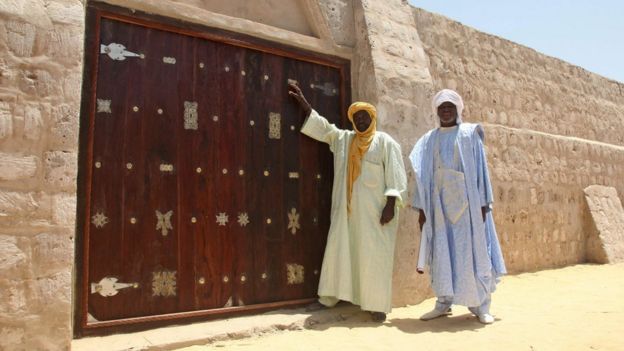
The rebels decided to destroy the buildings, nine of which were protected, after people continued to pray at the historic sites.
Mahdi led a series of planned attacks over the course of about 10 days, starting with a sermon given during Friday prayers on 30 June 2012, and later gave statements to the press defending the actions.
Latest Stories
-
Ga language under threat of decline as children shy away from speaking it – Sylvester Mensah
48 seconds -
‘Let every Ga child you raise know the Ga language and story’ – Sylvester Mensah
7 minutes -
‘We are not deterred’ – Ablakwa responds to backlash over South Africa evacuation
9 minutes -
NCA announces major voice and data disruption across Northern Ghana due to fibre cuts
50 minutes -
Photos: Housing solutions take centre stage at Day 2 of the 3rd Republic Bank-JoyNews Habitat Fair
1 hour -
Video: Immunity should be exercised without creating classism – Inusah Fuseini on cocaine bust
2 hours -
Ghana Air Force passes out 293 recruits after six months of intensive training
2 hours -
EOCO vrs Baffour Awuah: EOCO should have secured warrant before arrest attempt at court – Inusah Fuseini
2 hours -
Triple fibre cuts disrupt telecom services across Northern, Oti regions – Sam George
2 hours -
Politicisation could undermine parliamentary probe into cocaine seizures – Dr Osae-Kwapong
2 hours -
EOCO chases MP: Can Section 41 cure lacuna in EOCO Act? – Inusah Fuseini asks
2 hours -
GNFS, GWL inspect fire hydrants in Ministries enclave; 23 found faulty
2 hours -
Gov’t directs release of 50,000 bags of grain to ECOWAS
2 hours -
Ghana, Germany deepen cooperation on railways, labour mobility
3 hours -
Huge crowds greet Pope in Paris for open-air Mass
3 hours