

Audio By Carbonatix
Section 80 of the National Pension Act, 2008 (Act 766) provides for annual adjustment of pensions in payment by the Social Security and National Insurance Trust (SSNIT), in consultation with the National Pension Regulatory Authority (NPRA).
In practice, the SSNIT and the NPRA agree on what is termed the ‘Overall Rate’ of increment in pensions. Given the overall indexation rate, a ‘Fixed Rate’ of increase for each pensioner and an equally distributed ‘Flat Amount’ are determined.
The Fixed Rate of increase is largely price inflation dependent, whilst the ‘Flat Amount’ is a redistributive factor that is considered as a poverty relief measure for poor or low-earning pensioners.
For 2026, pensions have been adjusted at an overall rate 10%, a Fixed Rate of 6%, and a Flat amount of GHS91.56.
The Africa Center for Retirement Research (ACRR) is particularly excited about the fact that the Minimum Pension has been increased in 2026. The Minimum Pension goes up by 33%, that is, from GHS300.00 to GHS400.00.
Historically, the Minimum Pension had consistently increased each year from the year 2000 until 2017 and 2018. In 2019, it was reviewed from GHS276.00 to GHS300.00. Despite being a poverty relief strategy for poor pensioners, the Minimum Pension got stuck at GHS300.00 for seven (7) years (2019-2025).
Note that the minimum pension is an important poverty relief provision that has found space in the International Labor Organization’s minimum standards. It is therefore exciting that it was reviewed upward by 33% (from GHS300.00 to GHS400.00).
Another important relief measure for poor pensioners is the redistributive factor expressed as the Flat Amount. The 2026 pension indexation awarded a Flat Amount of GHS91.56. This is considered highly significant. In fact, it is the highest redistributive factor in the last 36 years.
How does the 2026 increment in pensions affect the purchasing power of pensioners?
The price inflation averaged 14.63% in 2025, and this means that retirees lost 14.63% of their purchasing power last year, which ought to be replaced in 2026. Now the Social Security Administration has awarded a fixed rate of 6% and a flat amount of GHS91.56. If you do the math, you find that the average pension of GHS1,000.00, which lost 14.63% of its purchasing power, has been fully replaced in 2026.
In addition, price inflation, generally, has assumed a downward trend (currently at 5.4% as of December 2025), and could impact the living standards of Ghanaian pensioners.
Overall Assessment of the 2026 Pension Indexation
On the whole, looking at the figures, and purely from a technical and policy perspective, there is a clear and deliberate attempt to get a good balance between paying good benefits and being mindful of the long-term financial integrity of the scheme.
The rate of increment in the minimum pension and the value of the redistributive factor (Flat Amount) are enough to conclude that the Social Security Administration has strengthened the scheme’s poverty relief mechanisms.
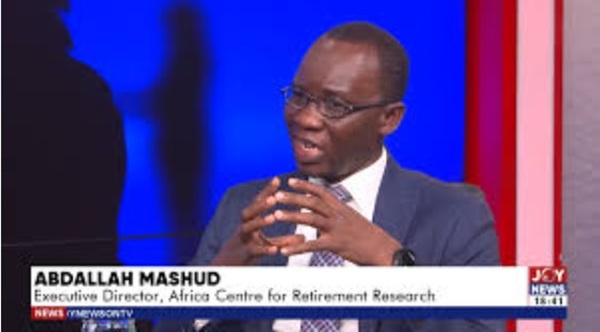
This is commendable because it conforms to global indexation trends of focusing on the income security of poor or low-earning pensioners. As the Executive Director of the ACRR, and based on the foregoing, I will describe this year’s pension adjustment as a responsible and people-centered indexation. I trust that will resonate well with all pensioners across the country.
Other Policy Issues Worth Considering
Despite the Social Security Administration’s attempt to provide more financial protection for low-income pensioners while maintaining the scheme’s financial integrity, many pensioners are dissatisfied with this year’s increase. A sample of 150 pensioners ACRR spoke to revealed that 78.7% (nearly 4 out of 5) of the respondents have assessed the increment as inadequate.
This lends more credence to the ACRR proposal to adopt a means-testing approach to pension indexation in Ghana.
The means-testing approach suggests that instead of awarding an Equal Fixed-Rate Increment to all pensioners (privileged and poor), the government and stakeholders should consider a pension review model that varies the Fixed-Rate, such that high monthly pension-earners receive a moderately lower Fixed-Rate compared to low monthly pension-earners.
Latest Stories
-
Putin warns West that Russia is ready to use every weapon to protect Kaliningrad
1 hour -
Mobile Money Fintech LTD, UMB train hairdressers and beauticians
3 hours -
OpenAI fires workers for mishandling ‘sensitive information’
3 hours -
What’s gone wrong at Nike? How the world’s sportswear giant lost its mojo
4 hours -
Carney pitches oil pipeline as a response to US-Canada trade war
4 hours -
Badenoch welcomes expanded grooming gangs inquiry
4 hours -
GACL MD sues Samuel Buabeng over alleged Facebook defamation
4 hours -
Asylum votes show people want help, says Kemi Badenoch
4 hours -
Christa Pike in critical condition after surviving two lethal injections, lawyer says
4 hours -
Kemi Badenoch backs face covering ban at protest
5 hours -
Man City not ‘above the rules’, says No 10 after backlash to Burnham remarks
5 hours -
Real Madrid submit ‘substantial’ dossier in Barca payments case
5 hours -
Messi completes purchase of second Spanish club
5 hours -
Government must engage horticulturists on tomato crisis – GhIH
5 hours -
King Promise’s ‘Can’t Tame Us’ becomes official Chelsea anthem
5 hours