

Audio By Carbonatix
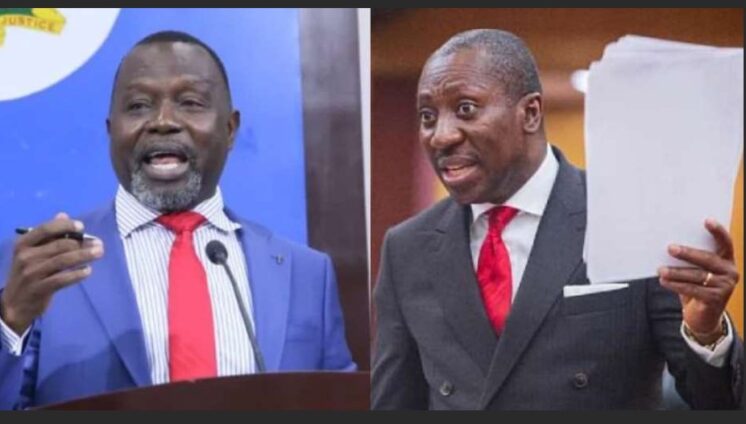
A heated debate erupted in Parliament on Thursday, July 16, as Minority Leader Alexander Afenyo-Markin and Attorney General Dr. Dominic Ayine clashed over the controversial Public Tribunals Bill.
The Minority described parts of the proposed legislation as "populist" and a threat to Ghana's justice system.
The bill returned to the House for consideration after Parliament adopted the committee's report, paving the way for clause-by-clause deliberation.
Leading the opposition to the bill, Mr. Afenyo-Markin called for Clause 4, which mandates the establishment of district and regional tribunals, to be removed, arguing that it would create confusion in the country's judicial system.
"I contend that creating this new tribunal system by this provision, Mr. Speaker, will bring chaos to the justice delivery system we have in our country. Mr. Speaker, this is populism. We need clarity," he said.
The Minority Leader stressed that the country's existing court structure provides sufficient legal certainty and warned against creating what he described as a parallel system of justice.
"Justice must not just be done; it must be seen to be done," he stated.
Drawing from his legal experience, Mr. Afenyo-Markin referenced the case involving Tagor and Anissa Abbas, in which Dr. Ayine successfully argued before the Court of Appeal that a conviction could not rest solely on an accused person's own admission.
"I remember the famous case of Tagor and Anissa Abbas, where the respected Dr. Dominic Ayine took the matter up at the Court of Appeal. These were individuals who were convicted. At the Court of Appeal, his argument was that a man may not just be convicted because of his own words.
"He argued that every element of a crime must be proven and supported by evidence of probative value. That was the argument of the respected Dr. Ayine. It was because we had clarity and certainty in the law," he said.
Mr. Afenyo-Markin questioned the rationale behind introducing new tribunals, warning that they could be used to imprison people without the safeguards available in the mainstream court system.
"Today, you want to have a tribunal? A tribunal? Populism... where people will be sent and people will be thrown into jail. Mr. Speaker, I will not sit here as Minority Leader and allow this provision to stand," he declared.
Responding to the concerns, Attorney General Dr. Dominic Ayine rejected the Minority Leader's assertions, insisting that the bill merely gives effect to provisions already contained in the 1992 Constitution.
"These things are textually incorrect as far as the Constitution is concerned," Dr. Ayine said.
He explained that Article 126 of the Constitution provides for an integrated judicial system comprising regional tribunals and other lower courts or tribunals established by Parliament.
"It provides an integrated judicial system that includes regional tribunals, and also includes such lower courts or tribunals as Parliament may by law establish. This is exactly what we are doing," he said.
According to the Attorney General, the bill does not create a parallel justice system but strengthens the existing constitutional framework.
"In terms of the regional tribunals, what we are doing is simply amplifying the provisions of the Constitution. In terms of the district tribunals, we are implementing Article 126 by creating lower tribunals to deal with specific criminal matters outlined in the bill, including offences related to illegal mining," he explained.
"So we are not creating a parallel justice system. We are simply amplifying what is provided for in the Constitution," Dr. Ayine added.
Latest Stories
-
Make loyalty to NPP a permanent culture, not an election-season tactic – Joseph Cudjoe
7 minutes -
NPP delegates want reform without destroying party’s reputation – Joseph Cudjoe
9 minutes -
Salomey Awiti Baffoe granted GH¢100,000 bail over alleged false news publication
13 minutes -
NPP is for all social classes, not just the middle class – Mike Oquaye
18 minutes -
Freezy Mɑcbones wins WBO Africɑ Light Heɑvyweight title in Lɑgos, Nigeria
21 minutes -
John Boadu is ‘an exceptionally gifted political figure’ – Prof Mike Oquaye
38 minutes -
NDC must study NPP congress closely for strategic lessons – Mustapha Gbande
44 minutes -
NDC has built strong structures to face any electoral challenge – Mustapha Gbande
54 minutes -
John Boadu can appeal across Ghana’s social groups – Prof Mike Oquaye
1 hour -
‘Electing Kojo Bamba is backward politics’ – Mustapha Gbande
1 hour -
Government must order payment of promoted teachers’ salaries – GNAT
1 hour -
Meet Sethina Edem Sunu, the healthcare professional eyeing the NDC UK & Ireland deputy organiser role
1 hour -
The myth of ‘sophisticated customer experience’ in the digital age
2 hours -
What happened to lands reserved for sanitary sites? -WasteCare CEO calls for audit
2 hours -
Manasseh Writes: The shift in the NPP
2 hours