

Audio By Carbonatix
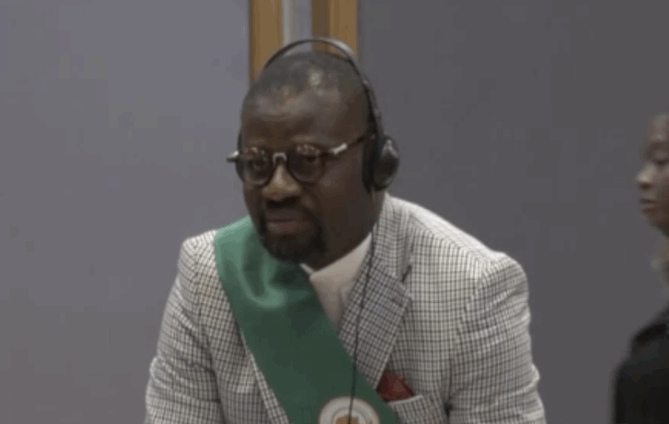
Minority Chief Whip Frank Annoh-Dompreh says the Pan-African Parliament’s discussion of a Model Law on factory marks a powerful turning point in Africa’s economic narrative, if it goes beyond rhetoric.
The Nsawam Adogyiri MP urged his colleague lawmakers to let their countries take full advantage of existing frameworks like the Africa Continental Free Trade Area (AfCFTA).
“Mr President, on the Model Law on factory, let me commend you highly,” Annoh-Dompreh began.
“I’m sure our torch-bearers today will be shaking in their graves. Kwame Nkrumah, Robert Mugabe, Julius Nyerere, all of them will be shaking in their graves that the very views and vision of the continent is beginning to find expression in our fundamental narratives as a continent.”
He hailed the very idea of the model law as historic.
“So for PAP to be talking about Model Law on factory, my day is made, and I feel proud as a son of the soil,” he said.
But he warned that leaving out the AfCFTA would be a major omission.
“Ghana is proud that we are hosts to the African Continental Free Trade Area. We cannot talk about the Model Law on factory without the input or bringing in work on the relevance and the importance of the continental free trade area.
"At least, it’s one of the biggest Free Trade Agreements, after the WTO, and we as a continent moving forward should find a way we can appropriate this into our forward march.”
He urged the Parliament not to repeat historical missteps by ignoring foundational principles.
“Market sources are all important. We’ve also read about the Marshall Plan, what the World Bank and the IMF had done to Europe when Europe was zeroed down. We don’t need to reinvent the wheel.”
“The question is: this concept of Model Law on factory, what are we fashioning it on? Are there best practices? Of course, I concede that we may have a unique challenge.
"But are there best practices globally that we can fashion on — concept of market sourcing, concept of branding, banks, and SMEs? These are fundamental rules of origin, and these are fundamentals that we need to agree on.”
He also stressed the importance of making the law practical, not symbolic.
“Now this model law, Mr. Speaker, as you do know, is rather going to be a persuasive law passed. However, when it is persuasive, then we must also up our activity in terms of convincing member states to buy into the concept and also adopt it. So that it doesn’t become one of the laws that we pass, and it’ll get dusty on shelves.”
Latest Stories
-
A source of excellence across generations – Vice President Opoku-Agyemang lauds Mfantsipim
38 minutes -
(Photos) Mfantsipim School launches historic 150th anniversary
1 hour -
Knights and Ladies of Marshall group backs Catholic Bishops’ stance on anti-LGBTQ+
2 hours -
Bright Simons writes: All the Filla in the Ibrahim Mahama/E&P – Gold Fields Saga
2 hours -
Monetise Idiocy In Ghana
2 hours -
The Ghanaian prophet and the mysterious death of his scottish wife Charmain Speirs
3 hours -
Nearly 400 sentenced in Nigeria for links to militant Islamists
4 hours -
Ghana’s recovery supported by gold strength despite global oil price pressures – Standard Bank Research
4 hours -
Methodist Church hails Mfantsipim@150; calls for “fresh consecration” to excellence
4 hours -
‘Excellence is our inheritance’ – Nana Sam Brew-Butler hails Mfantsipim’s 150-year reign in leadership
4 hours -
Kwaku Azar writes: A-G vs OSP
4 hours -
Mfantsipim–Adisadel rivalry built excellence, not division – Sam Jonah
5 hours -
Vice President launches Mfantsipim’s 150 years of shaping Ghana’s greatest mind
5 hours -
I assure Otumfuo, Mahama will join him to commission KNUST Teaching Hospital by end of this year – Haruna Iddrisu
6 hours -
Barcelona dominate derby to extend La Liga lead
6 hours