


Audio By Carbonatix
A pathologist with the Komfo Anokye Teaching Hospital is cautioning against excessive masturbation and use of aphrodisiacs for sexual enhancement.
Dr. Paul Poku Sampene Ossei says the use of concoctions by men to satisfy themselves and their partners, poses serious health risks and possible death.
According to the medical officer, the urge by most men to last longer during intercourse may lead them to engage in acts that go beyond their heart rate.
He says the heart of men who patronize these enhancers may overwork during sex, thus they could easily pass out while in the act.
The unforeseen deaths are attributed to aberrations of the heart.
“These days in Ghana the young guys take alcohol mixed with some many aphrodisiacs, especially those that can give you potency within the shortest possible time and then they go in for the act and probably go beyond their limits.
“We also have people who have anomalies of the heart which can be in the heart’s muscle or some channels. So there are some people who may not go for these sex enhancing drugs but because of these complications they die during the act,” he said.
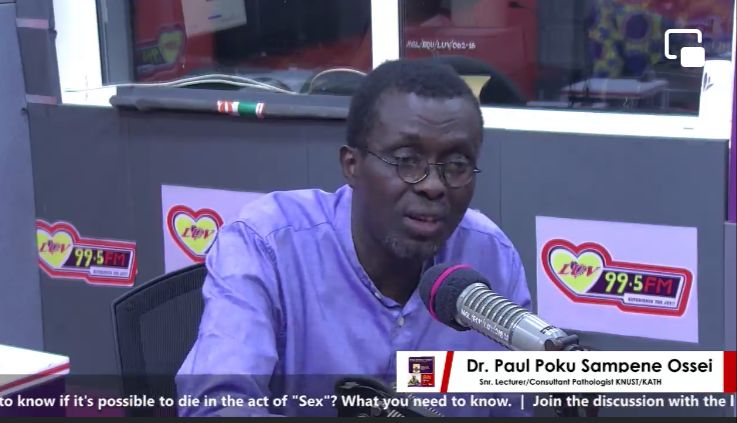
Speaking on Luv in the Morning on Luv FM, Dr. Sampene revealed that research has established that the heart’s activity during an ejaculation could be likened to an individual running over 800 meters.
He also debunked claims of sex positions causing deaths. “It doesn’t really matter the sex position. But, the heart plays a very important role during sex. If you are running and you become so tired even within a short time then you should know your heart is not in support of what you are doing,” he told host, David Akuetteh.
There is however a growing trend of sudden arrhythmic death syndrome in Ghana.
Dr. Sampene revealed that there are records of people dying suddenly at an early age of 25, attributable to the emerging syndrome.
Dr. Sampene also revealed that masturbation could result in cardiac deaths when the normal heart rate is exceeded during the act.
“Masturbation is a form of sex. Sex is not only about penetration of the woman. Masturbation can trigger the heart and you can die from that. When you are ejaculating, there are two things that come in, the heart is an accomplice in all of this. The heart is at the centre in this case. Try as much as possible to know if your heart can support the act you’re being involved in,” he advised.
Meanwhile, an urologist is advising men to have regular sex with their partners, at least three times a week.
Dr. Kwaku Addai endorsed the proposition of men reducing the risk of prostate cancer with frequent sexual intercourse.
“If you allow the toxin to stay in there, then the risk of prostate cancer is increased. But the new concept of frequent sex seem to have a sound reasoning,” he said.
Latest Stories
-
Ballon d’Or Power Rankings: Lamine Yamal leads race for Golden Ball ahead of Rodri and Kane
7 minutes -
‘Nothing worked for us’ – Gideon Mensah takes responsibility for Gambia defeat
26 minutes -
2026 Women’s Super Cup: FC Savannah beat Epiphany Warriors to win trophy for first time
2 hours -
AFCON 2027Q: ‘The last time Ghana won was eight games ago’ – Carlos Queiroz
2 hours -
AFCON 2027Q: Gambia defeat doesn’t make me a loser – Carlos Queiroz
2 hours -
2027 AFCONQ: Late goals seal 2-0 for Côte d’Ivoire against Somalia
3 hours -
AFCON 2027Q: My resignation won’t solve Ghana football issues – Queiroz
3 hours -
Morocco call off Ghana friendly after Black Stars’ AFCON setback
3 hours -
‘We have to say sorry’ – Queiroz apologises after Ghana’s humiliating defeat to Gambia
3 hours -
New Yorker identified as Yaw Boahene, 57, killed after bag was caught in subway train doors
3 hours -
Former American Idol contestant and pastor found guilty of murdering wife
3 hours -
Trump rules out joint US-China venture to develop AI
3 hours -
‘Beating Ghana did not surprise me’ – Gambia boss
4 hours -
OpenAI agents get rebrand – as ‘dots’ – while safety worries delay new model
4 hours -
US ban on Canadian alcohol and dairy takes effect as trade war drags on
4 hours