

Audio By Carbonatix
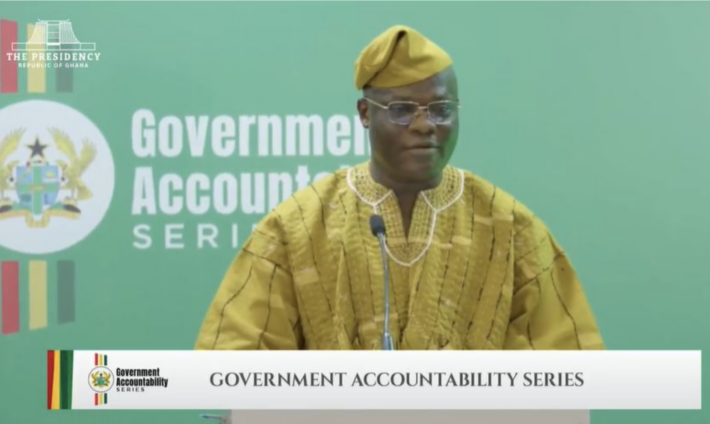
Minister of Local Government, Chieftaincy and Religious Affairs, Ahmed Ibrahim, has urged assemblies to ensure strict compliance with the Ghana Building Code in constructing 24-hour economy markets to prevent fire outbreaks.
He said adherence to approved standards and the use of quality materials were critical to safeguarding markets and protecting investments under the initiative.
Mr. Ibrahim made the call at the Government Accountability Series organised by the Presidency in Accra.
He urged Metropolitan, Municipal and District Chief Executives (MMDCEs) to prioritise the construction of the 24-hour economy markets in their assemblies, following the sod-cutting by President John Dramani Mahama for two such markets in Northern Ghana.
“In the construction, take good care. We are going to apply the Ghana Building Code. Parliament has approved the law…there are standards you have to comply with,” he said.
Mr. Ibrahim attributed most market fire outbreaks in the country to the use of unapproved building materials and failure to follow standard procedures.
“We live in a country whereby the contractor will tell you that the thing is 16 but 12 can do so that we cut cost.
“Twelve can do but when the time comes, because it was 16 and you used 12, it will catch fire, then we complain that market fire. Market fires are not political fires; they are economic fires,” he said.
The Minister appealed to the MMDCEs to ensure timely completion of the projects to enable their commissioning next year.
The 24-hour economy programme is aimed at promoting round-the-clock economic activity, strengthening local commerce, and improving linkages between agricultural production and market access.
President Mahama, on Saturday, April 18, 2026, cut the sod for the construction of two 24-hour economy markets at Bimbilla and Kukuo, a suburb of Tamale, in the Northern Region.
The model markets, to be replicated across all 261 districts, would include clinics, fire and police posts, banking services, crèches and food outlets to support continuous operations.
They would also feature 10 large warehouses to enhance storage and redistribution of food products, reduce post-harvest losses, and boost economic activity.
Latest Stories
-
2 injured amid gunshots during raid at Nawara Mining office at Nsuapemso
4 minutes -
St Augustine’s College retains 2026 National Investment Quiz title
8 minutes -
KNUST Nursing and Midwifery School staff recognised at 2026 Health Ministry Excellence Awards
17 minutes -
JoyNews’ Esther Esi Nkrumah selected for UK Media Excellence for Emerging Technology Fellowship
22 minutes -
Five NDC youth organisers in Western Region pay courtesy call on Armah-Kofi Buah
34 minutes -
NACOC demands tighter port controls to prevent Tema Harbour drug trafficking
37 minutes -
Ghana’s startup ecosystem must build sustainability into innovation – Ghana Hubs Network
48 minutes -
Friday’s beachfront demolition was carried out at Labadi Beach Hotel’s request, not for flood mitigation – Stan Dogbe
50 minutes -
LA 2028: Mukarama returns to Black Queens squad for Olympic Games qualifiers
51 minutes -
Fusaini Yakubu Abanga leads NPP National Youth Organiser race with 45% in Global InfoAnalytics poll
1 hour -
Suame Methodist JHS marks 120 years with a call for STEM innovation
1 hour -
Global fashion coalition launches in the heart of Kantamanto Market
1 hour -
‘No concrete commitments from government’ – Brong Ahafo teacher unions maintain strike
1 hour -
Finance Minister demands greater returns from NLA after GH¢10 million dividend presentation
2 hours -
National Customers’ Choice Awards set to celebrate Ghana’s best customer-centred brands
2 hours