

Audio By Carbonatix
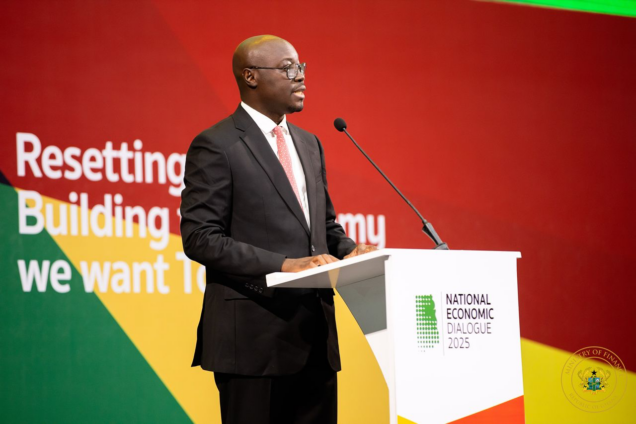
Dr Cassiel Ato Baah Forson, the Minister of Finance, Monday unveiled what he says is a comprehensive strategy aimed at resetting Ghana’s economy through rigorous structural reforms.
The Minister emphasised the urgent need for fiscal discipline and sustainable growth, describing the current macroeconomic situation as “very fragile.”
The announcement was made during the inaugural day of the National Economic Dialogue held at the Accra International Conference.
In a detailed presentation, the Minister outlined seven key focus areas designed to address the nation’s economic challenges.
These included enhanced domestic revenue mobilisation, which would involve strategies to broaden the tax base and improve collection efficiency, ensuring a balance between equity, simplicity, and efficiency.
The Minster said the government also planned to achieve quantitative fiscal consolidation through controlled borrowing and reduced costs, allowing for increased investment in national development.
“Ensuring compliance with public financial arrangements and public procurement rules is another critical area, with a focus on strengthening financial governance and promoting transparency in public spending,” he said.
“Additionally, the Government aims to enhance the efficiency of public spending and social programmes by optimising resource allocation to maximise value for money and ensure fiscal adjustment.”
Dr Forson announced plans to phase out costly, regressive, and ineffective subsidies in the energy sector, transitioning towards targeted social programmes to protect vulnerable populations while reducing fiscal strain.
“Reforming state-owned enterprises (SOEs) is another priority, with specific attention given to addressing contingent liabilities and reducing fiscal burdens in entities like Cocoa Board and the Electricity Company of Ghana,” he said.
He revealed government’s decision to working on strengthening Ghana’s fiscal framework by redesigning fiscal rules and enhancing automatic stabilizers to contain budget fragilities and address revenue year market issues.
The Minister stressed the importance of discipline and a long-term perspective, urging citizens to recognise that “short-term benefits we gain today have long-term consequences for our future.”
He acknowledged the ineffectiveness of fiscal policy over the past eight years and called for a “momentum for reforms,” emphasising that the “quality of adjustment will be key to support growth and protect the poor and most vulnerable.”
“The new reforms are intended to address the current economic climate, particularly the high cost of borrowing and the need to channel dividends to support national development,” he said.
Latest Stories
-
One of six inmates who escaped from Konongo police cells rearrested
1 minute -
Sam George cautions ministers against reading unverified AI-generated speeches
5 minutes -
Ghanaian entrepreneur Mary Nyamekye Asamoah wins Africa Travel 100 award
8 minutes -
Obuasi SHTS abuse: Sanction all officials who failed to act – Moving Masculinity
13 minutes -
Lucy Agyepong honoured for excellence in engineering education at maiden GAAS Women’s Awards
16 minutes -
Harriet Afia Konadu Asiedu
23 minutes -
AFCON 2027: Sports Minister ‘convinced’ Black Stars will qualify despite losing opening two games
24 minutes -
CUTS welcomes VAT collection on cross-border digital services, urges fair treatment of Distance Learning students on overseas programmes
28 minutes -
Leave the Chiefs and fix the Galamsey Problem: Dr Solomon Owusu Advises President Mahama
31 minutes -
Pay attention to teachers and give them what is due – Ho District GNAT tells government
35 minutes -
Authorities knew of abuse allegations against Obuasi headmaster months before suspension – JoyNews investigation
40 minutes -
US teenager appears in court over alleged Hindu temple shooting plot
42 minutes -
Academic City donates paediatric rehabilitation staircase to Ga East Hospital
45 minutes -
Services drive 7.4% expansion in Ghana’s economic activity
57 minutes -
‘I don’t make music for awards, I make it to connect people’ – Rocky Dawuni
1 hour