

Audio By Carbonatix
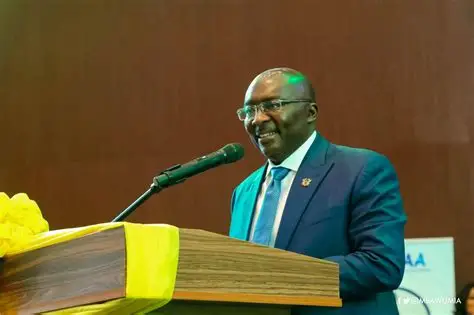
Flagbearer of the New Patriotic Party (NPP), Dr Mahamudu Bawumia, has defended Ghana’s Gold-for-Reserves programme, describing it as an unconventional but necessary response to the country’s foreign exchange crisis following the Russia-Ukraine war.
According to him, the initiative was developed at a time Ghana had lost access to international capital markets and was struggling to raise the billions of dollars needed annually to support the economy.
Speaking at a public event in a video shared on his Facebook page, Dr Bawumia said Ghana had traditionally relied on international capital markets to raise about $3 billion each year.
However, the disruption of global markets following the Russia-Ukraine war made it impossible for Ghana to access those funds, worsening the country’s balance of payments difficulties and placing significant pressure on the cedi.
“We were really constricted in terms of availability of foreign exchange. At the same time, the cedi was depreciating almost on a daily basis. And we had to think about how to deal with this problem,” he said.
Dr Bawumia said the situation forced policymakers to consider alternative ways of building the country’s foreign exchange reserves.
He said Ghana’s status as one of the world’s leading gold producers presented an opportunity that had not been fully exploited.
Despite being Africa’s leading gold producer at the time, he said Ghana held only about 8.7 tonnes of gold in reserves at the Bank of Ghana in 2021.
“I said this cannot be right,” he recalled.
The NPP flagbearer explained that Ghana had a unique advantage because it could purchase locally produced gold with cedis rather than first acquiring foreign exchange to buy the commodity on international markets.
“The thing about gold for us is that because we produce gold, we can use our cedis to buy the gold. We don't need to export cocoa or diamonds to get dollars to go out there and buy gold,” he said.
Dr Bawumia described the initiative as an example of “out-of-the-box thinking”, arguing that there was no conventional economic model that offered Ghana a ready-made solution to the challenge.
“There was no textbook in economics that would tell you about the gold and reserves problem. It was out-of-the-box thinking,” he said.
He said the Bank of Ghana spent nearly a year studying the proposal before concluding that it could be implemented.
“And this is really how the domestic gold purchase program started,” he added.
According to Dr Bawumia, the programme enabled Ghana to purchase about $5 billion worth of gold within two years, strengthening the country's reserve position.
He argued that the increased reserves had subsequently improved Ghana's ability to intervene in the foreign exchange market.
Dr Bawumia said that by the end of 2024, the International Monetary Fund had removed a restriction that limited the Bank of Ghana to a maximum of $80 million in monthly intervention in the forex market.
“Since then, the Bank of Ghana has been able to put at least $1 billion a month into the market,” he said.
He argued that the increased supply of foreign exchange should, based on demand-and-supply principles, help reduce pressure on the cedi.
“From $80 million maximum to $1 billion a month. What does economics tell you? When you have an increase in supply, what will happen to price? It comes down,” he said.
Dr Bawumia maintained that the Gold-for-Oil and Gold-for-Reserves initiatives were born out of an urgent need to find alternatives at a time conventional sources of foreign exchange had dried up.
Latest Stories
-
Energy Minister commends NPA CEO for maintaining petroleum market stability amid global shocks
4 minutes -
Armah-Kofi Buah, Sam George, other MPs among newly qualified lawyers
12 minutes -
Ghana exporting eggs to Burkina Faso amid local surplus – Agric Minister
12 minutes -
Governance failure in Ghanaian football and a presidential reform agenda
18 minutes -
IJM Ghana welcomes country’s upgrade to Tier 1 in 2026 Trafficking in Persons report
20 minutes -
REAC urges stakeholders to comply with Real Estate Act or face sanctions
20 minutes -
‘Nkoko Nketenkete’ boosts local poultry production from 4.6% to 22% in one year – Agric Minister
44 minutes -
ARK Foundation boss warns against stigmatisation of abuse victims
51 minutes -
Health investment beginning to improve access to care – Akandoh
59 minutes -
“It is meaningless” – Parent laments as teachers’ strike leaves boarding school students idle
1 hour -
Austin Gamey predicts possible end to teachers’ strike, urges better negotiation
1 hour -
Mahama and Trade Minister champion local manufacturing during Ghato Foods visit
1 hour -
Labour Minister, ILO Country Director strengthen partnership on decent work and jobs
1 hour -
Approved vaccine for Yellow Fever to be rolled out in Upper West next week-GHS
1 hour -
Fear, institutional bias and lack of support deter domestic abuse victims from reporting – Lawyer
1 hour