

Audio By Carbonatix
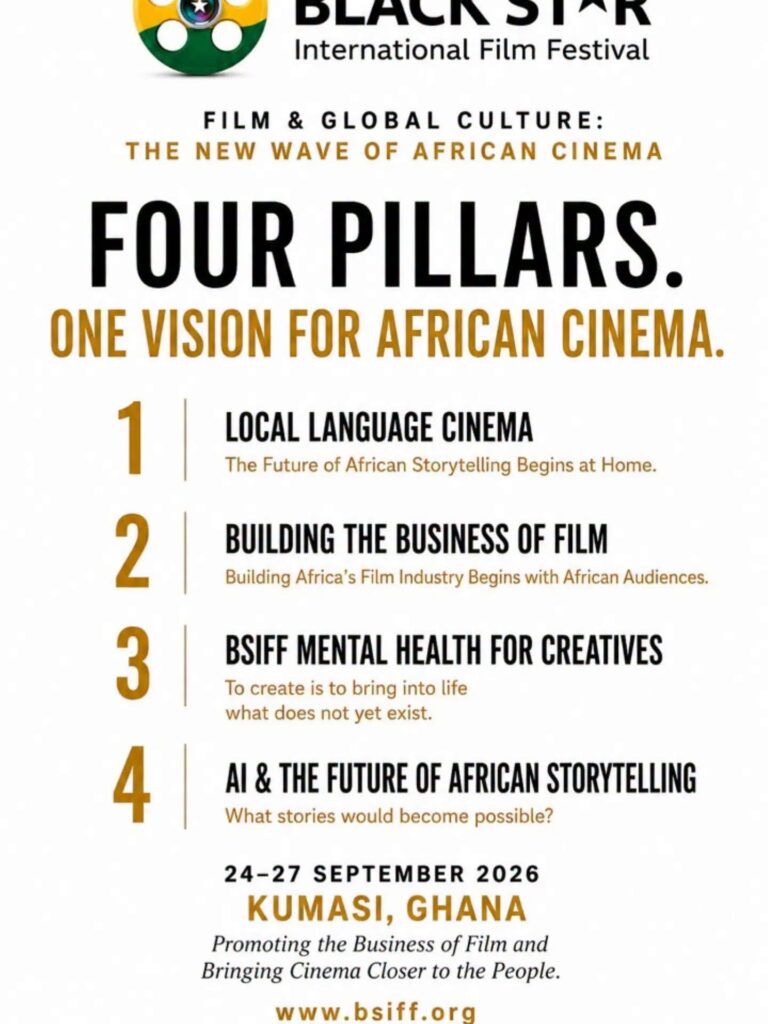
The 11th Black Star International Film Festival will explore four key pillars under its 2026 theme, ‘Film & Global Culture: The New Wave of African Cinema’.
Rather than standalone topics, these pillars will serve as the lenses through which the festival’s conversations, screenings, workshops and industry engagements have been curated.
The four areas cover local language cinema, building African audiences, mental health for creatives, and emerging technologies such as artificial intelligence, with each offering a different perspective on strengthening Africa’s film industry.
Together, the pillars form the intellectual foundation of BSIFF 2026, bringing together filmmakers, producers, animators, game developers, writers, students, policymakers, technology innovators, entrepreneurs and audiences to imagine the next chapter of African storytelling.
This year’s festival will take place in Kumasi from 24 to 27 September 2027.
Pillar 1: Local language cinema
The future of African storytelling begins at home.
Language is more than a means of communication. It shapes how we see the world, preserves our history and carries the culture that defines us.
Across the globe, audiences are increasingly embracing stories told in their original languages. From Korea to India, Spain to Nigeria, local language cinema is proving that authenticity travels. The more rooted a story is in its own culture, the more universal it can become.
For African filmmakers, this presents an exciting opportunity.
How do we confidently embrace our own languages, cultures and identities while creating world-class films that connect with audiences everywhere?
How do we move beyond translation and invite the world to experience Africa through stories told in the languages that first gave them life?

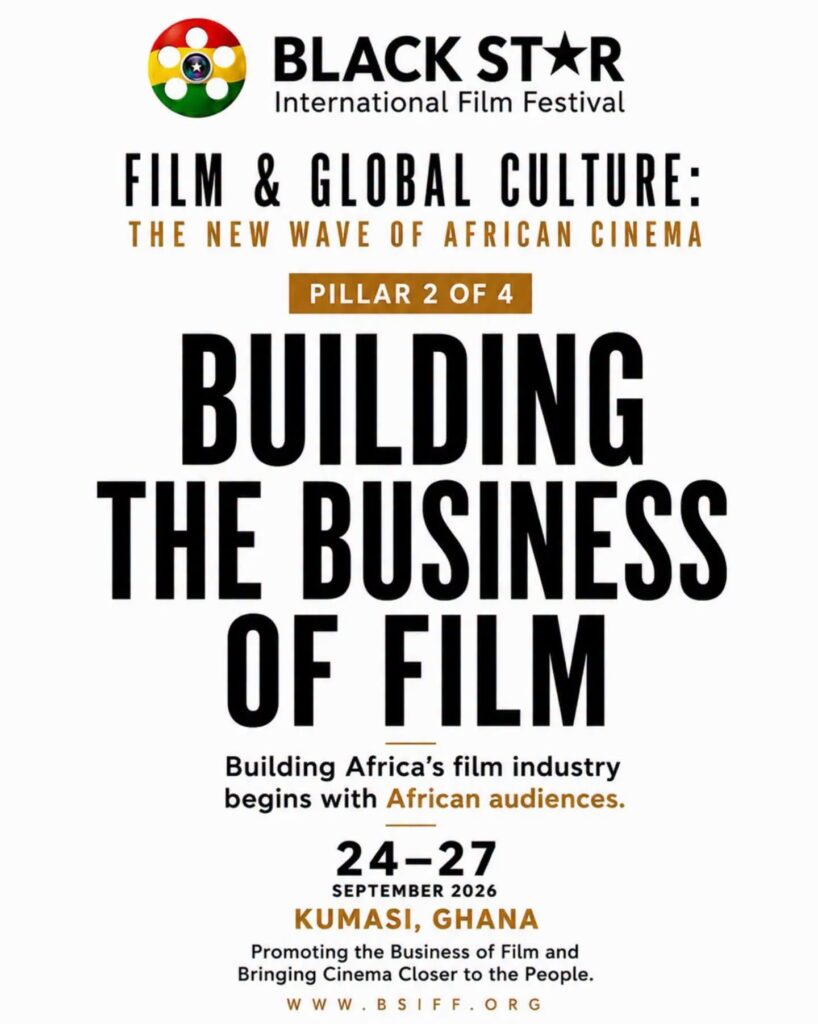
Pillar 2: Building the business of film
How do we rebuild a culture where Africans watch African stories?
Perhaps this is one of the most important questions facing African cinema today.
For more than a decade, the Black Star International Film Festival (BSIFF) has championed not only the art of filmmaking, but also the business that allows stories, industries and careers to thrive.
Through advocacy, strategic partnerships, industry dialogue and market connections, BSIFF has helped create new opportunities for filmmakers while championing stronger distribution, co-production, audience development and collaboration across Africa.
Yet perhaps our greatest opportunity lies much closer to home.
As Africa becomes the youngest continent on Earth, with almost 40% of the world’s youth expected to live here by 2030, our greatest film market may not be overseas. It may be our own people.
Building Africa’s film industry begins with African audiences. It means rebuilding cinema culture, creating lifelong film lovers and ensuring that African stories become a natural first choice for African audiences.
Pillar 3: Mental health for creatives
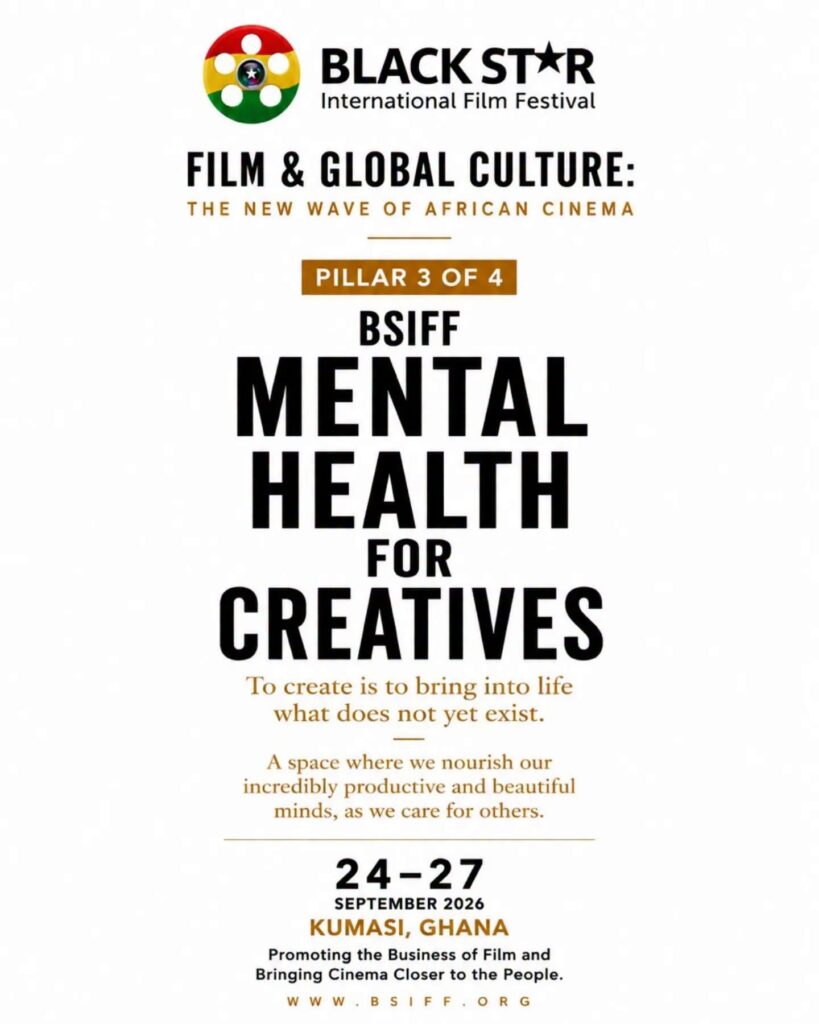
A space to nourish our incredibly productive and beautiful minds, as we care for others.
To create is to bring into life what does not yet exist.
Every filmmaker, writer, actor, musician, designer and artist spends a lifetime pushing beyond boundaries, questioning assumptions and venturing into places the mind has never been before. Creativity asks us to imagine, to feel deeply, to embrace uncertainty and to pour ourselves into the stories we share with the world.
This is one of the greatest gifts a creative offers society: the ability to bring the future into the present through imagination, while capturing the past and present in ways that help us understand where we have been, who we are and who we are becoming.
We are creatives ourselves. BSIFF was created by creatives, and it continues to be shaped by creatives. BSIFF Mental Health for Creatives grows from that shared experience.
Together, we are creating a space where we can care for one another and nurture the minds that imagine, question, create and inspire.
We believe the creative mind is one of humanity’s greatest gifts. It imagines what does not yet exist. It challenges assumptions. It captures our past, helps us understand our present and dares us to imagine our future.
Because when we care for one another, we also care for the stories we tell, the cultures we preserve, the futures we imagine and the generations we inspire.
Pillar 4: AI and the future of African storytelling
Africa leapfrogged the desktop era. Could AI become our next leap?
When mobile phones arrived, Africa did not simply adopt a new technology. It leapfrogged an entire era. Millions of people who never owned a computer suddenly gained access to communication, banking, education, commerce and opportunity through the devices in their hands.
Today, artificial intelligence presents a similar moment of possibility.
Across much of Africa, filmmakers and creators continue to face familiar barriers: limited funding, inadequate production infrastructure, a shortage of studios and specialist facilities, expensive visual effects, post-production constraints, and limited access to advanced sound engineering, storyboarding, concept development, key art creation and many of the tools that bring ambitious ideas to life.
The limitation has rarely been our imagination. More often, it has been access to the tools that help imagination flourish.
But what if those barriers began to fall?
Imagine a future where:
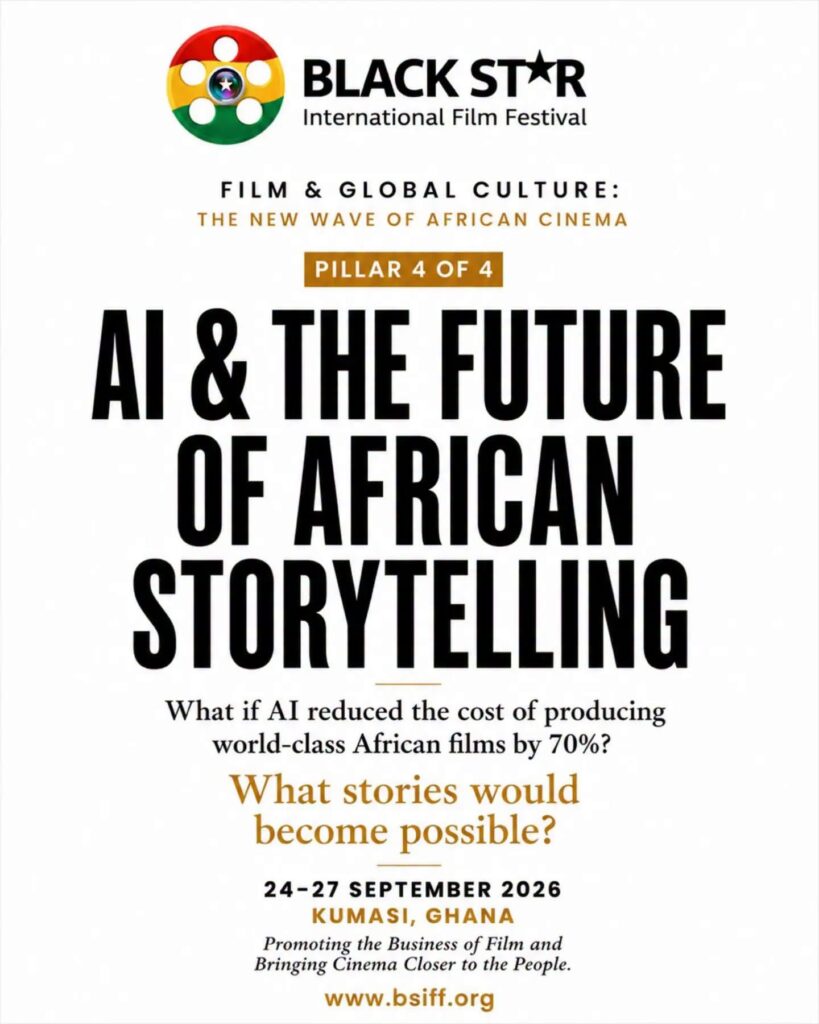
The cost of producing world-class African films is reduced by 70%.
Independent filmmakers gain access to world-class storyboarding, concept development and key art creation.
Visual effects, virtual production and previsualisation become achievable for productions that could never previously afford them.
Sound design, editing and post-production become faster, more accessible and more affordable.
Animation becomes accessible to creators regardless of budget.
Local languages are translated, subtitled and dubbed more efficiently for global audiences.
Filmmakers, animators, game developers, musicians, designers, software developers and writers collaborate in entirely new ways.
Creativity is amplified rather than limited by technology.
Stories that are currently impossible suddenly become possible
Entirely new creative industries could begin to emerge. Barriers to entry could begin to fall, giving African storytellers tools that match the scale of their imagination and ambition.
AI cannot replace creativity. That has never been the question.
Creativity has always been Africa’s greatest resource. AI simply gives it new tools.
The question is how we use it to enhance human imagination, remove unnecessary barriers and give more African storytellers the means to create at a global scale.
Africa has never been defined by following the technological journey of others. Time and again, we have demonstrated our ability to leapfrog traditional pathways and create new possibilities.
Perhaps the future of African cinema will be shaped not only by the stories we choose to tell, but by the courage to embrace the tools that help us tell them.
About Blackstar International Film Festival
The Black Star International Film Festival (BSIFF) is a Ghanaian film festival founded in 2015 by filmmaker Juliet Asante.
The festival promotes African cinema and provides a platform for filmmakers, producers, actors and other industry professionals to showcase their work, exchange ideas, build networks and explore opportunities within the film industry.
BSIFF features film screenings, workshops, industry discussions, networking sessions and awards, with a focus on developing filmmakers and strengthening the business of film in Africa.
The festival also seeks to encourage greater appreciation for African stories among local audiences while connecting African filmmakers with the international film community.

Latest Stories
-
Labour Minister wants SOEs to help shape new public pay system
1 hour -
IPEC will ensure Equity and Sustainability in SOEs Compensation
2 hours -
White House bars CNN from travelling with Trump on Air Force One
2 hours -
Fennis wins second consecutive ITF J60 title in Accra
3 hours -
Spain beat England in thriller after Kane penalty miss
3 hours -
GPL 2026/27: Zaidan’s late goal ends Hearts of Oak unbeaten start
3 hours -
CEOs demand clarity on pay harmonisation, board autonomy as FWSC engages SOEs bosses over IPEC transition
3 hours -
2026 Women’s Super Cup: FC Savannah, Epiphany Warriors maintain top spots ahead of final group games
3 hours -
‘Is EOCO responsible for determining lawyers’ fees?’ – Baffour Awuah
3 hours -
David Beckles claims second J60 Accra title
3 hours -
No France cocaine suspect linked to Mahama, Vice President’s security details – NACOC
3 hours -
Anwelle Foundation launched in Jirapa to tackle poverty, youth unemployment
4 hours -
Joy Sports Editor Fentuo Tahiru Fentuo to moderate inaugural Music Meets Football Summit in Zambia
4 hours -
Court premises too volatile for Baffour Awuah’s attempted arrest by EOCO – Inusah Fuseini
4 hours -
Drug bust: Under no circumstances will NACOC leadership be compromised – Twum-Barimah
4 hours