

Audio By Carbonatix
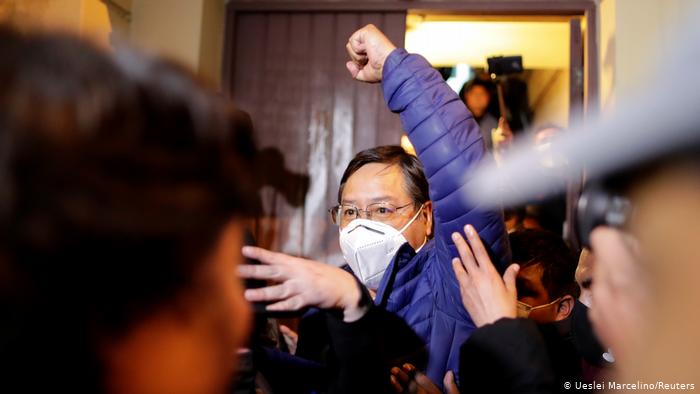
The leader of the leftist MAS party gained 55.09% of the vote. Luis Arce was nominated by Evo Morales, the president who was ousted from power last year after a coup d'etat.
Bolivia's final vote count on Friday confirmed Luis Arce from the Movement Toward Socialism (MAS) party as the winner of the country's nationwide elections.
The result gave Arce 55.09% of the vote after five days of scrutiny. To win the first round, one of the party leaders had to attain at least 50% of the votes, along with a 20 percentage-point lead for an outright win.
This was also confirmed when Arce's nearest rival, former president Carlos Mesa, won 28.83% of the ballot.
The next nearest challenger, Luis Fernando Camacho, received 14% of the vote.
To the left
The outcome marks a return to the left for Bolivia from the present conservative caretaker government that stepped in after long-term leader Evo Morales was ousted last year.
The final count confirms Arce as president-elect of Bolivia, ahead of the formal proclamation from the country's Supreme Electoral Tribunal which is scheduled later on Friday afternoon at a ceremony in La Paz.
Arce was already recognized as the winner by Mesa, the interim government of Jeanine Anez and a large part of the international community, including Russian President Vladimir Putin.
The elections were held last Sunday and initial projections had Arce, who held the position of finance minister in the Morales government, as a comfortable winner after a turnout of 87%. Electoral laws in Bolivia mean voting is mandatory for those residing in the Latin American country.
Backdrop
Bolivia was shaken by unrest in the wake of the last presidential election, in October 2019. The opposition accused President Morales of electoral fraud, and hundreds of thousands of people took to the streets.
Morales subsequently resigned and went into exile, first to Mexico and later to Argentina. From exile, he chose Arce to be the party's candidate — despite resistance from within the MAS base.
After Morales was ousted from power, counter demonstrations were commonplace across Bolivia and a commission from the Organization of American States recommended new elections.
Latest Stories
-
Africa’s richest man helps fund $660m fuel pipeline between Ethiopia and Djibouti
26 minutes -
Security lapses at Utah campus where Charlie Kirk was killed, review says
30 minutes -
White House bars CNN from travelling with Trump on Air Force One
36 minutes -
Pope praises young people’s ‘energy and commitment’ at huge open-air Mass in Paris
45 minutes -
Nyankamam residents benefit from free medical screening, healthcare outreach
50 minutes -
Ghana, Boeing explore setting up regional aircraft maintenance hub
50 minutes -
Bangkok roads submerged as flood disaster declared
51 minutes -
Four killed in helicopter crash near Montreal
56 minutes -
Ghana could have national airline back in skies within 18 months – Boeing to Mahama
1 hour -
NDC suspends vetting exercise in Krowor constituency, reschedules to September 29
1 hour -
Extractive firms urged to strengthen cyber defences as digital risks grow
2 hours -
Photos: Mahama engages Ghanaian diaspora in New York on Ghana’s economic recovery
2 hours -
Man jailed 10 years for defiling 11-year-old girl at Kpandai
2 hours -
At least 27 people killed in two shootings in South African township
3 hours -
Iranian minister says only negotiation can end conflict after Trump rejects Hormuz deal
3 hours