

Audio By Carbonatix
Farmers in the Bono East Region are calling for immediate government intervention as challenges with market access, farm inputs, and climate change continue to threaten agricultural productivity and livelihoods.
The farmers raised concerns over unreliable markets, limited access to farm inputs, and the growing impact of climate change, which they say are severely affecting their work.
The Regional Director of Agriculture, James Adu, described the situation as serious, particularly in the Kintampo North farming communities.

He noted that the lack of machinery, such as tractors, is hindering farming activities.
“Farmers in this region are facing serious challenges with access to reliable markets, farm inputs, and the effects of climate change, which are affecting productivity,” he stated.
Mr Adu also pointed out that storage remains a major challenge, with many farmers forced to keep their produce in their homes due to the absence of proper warehousing facilities.
He therefore appealed to the government to fast-track the establishment of District Farmers Service Centres to help absorb produce and reduce post-harvest losses.
He further identified poor market access as a key issue affecting farmers after harvest.
“Most farmers are using their living rooms to store produce. We are appealing to the government to establish the District Farmers Service Centres to help absorb produce.”
On climate change, Mr Adu explained that erratic weather conditions are impacting crop yields, stressing the need for farmers to study changing weather patterns and adopt resilient crop varieties.
He also emphasised the importance of proper planting timing and stronger collaboration with agricultural extension officers.
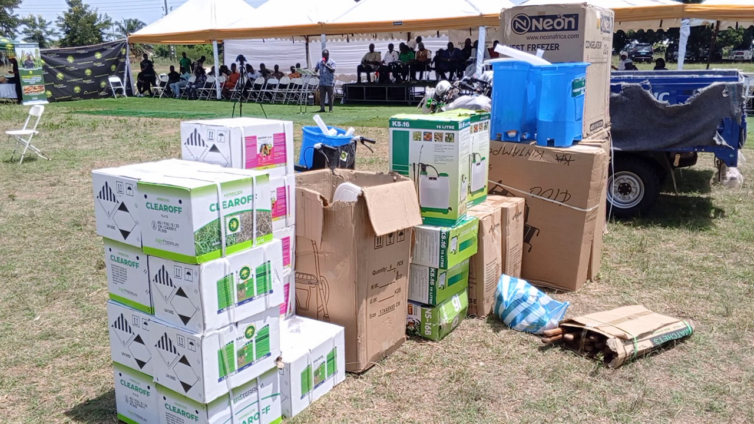
These concerns were highlighted during a farmers’ durbar in the Kintampo North Constituency, where Oyster Agribusiness Limited honoured 49 farmers with farm tools and equipment.
A farmer, Awel Alhasaan, also lamented the lack of tractors, fertilisers, and irrigation systems, appealing to the government for support
“Tractors, fertilisers, and irrigation systems have become major challenges for farmers in this area. We are appealing to the government for support.”
The CEO of Oyster Agribusiness, Elizabeth Bidzakin, said the company has supported farmers in the Bono East and other regions of the north for the past eight years through training and provision of inputs.
She added that the organisation aims to expand into poultry, fish, and vegetable farming while creating job opportunities for the youth.
“Our aim is to support farmers with training and skills, and to promote agribusiness development in the region,” he said.
Latest Stories
-
He entered at eight. He is now 16: Ghana’s children growing up in prayer camps
2 minutes -
‘Development must not always begin from Accra’ — Anwelle Foundation launched in Jirapa
4 minutes -
PKO trio eye victories at Odwira Festival
3 hours -
346 Ghana Navy recruits pass out after 26 weeks of intensive training
3 hours -
Newsfile to discuss EOCO-MP arrest, drug trafficking, speech arrests and $235m water debt
3 hours -
JoyNews gets results as listeners raise GH¢40,000 to help 17-year-old student with cerebral palsy attend SHS
4 hours -
Vice President calls for stronger local pharmaceutical production to reduce medicine imports
4 hours -
The brewing tension at KNUST; Beware the Ides of October….
4 hours -
Health Ministry moves to integrate traditional medicine into mainstream healthcare
5 hours -
550 pupils in Kintampo South get educational lifeline as ‘Seeds of Hope’ reaches farming communities
5 hours -
Opoku Mensah urges Christian Council, House of Chiefs to speak up on democratic freedoms
5 hours -
Teacher unions’ strike: Minority demands immediate payment of teacher arrears, 20% deprived area allowance
5 hours -
The Accra-Kumasi Expressway: Building it right
6 hours -
Beyond gold exports: Building value and economic resilience from Ghana’s gold
6 hours -
2027 AFCONQ: Ghana under pressure as Gambia beat Somalia 2-1
6 hours