

Audio By Carbonatix
Brent crude futures breached $100 a barrel on Wednesday for the first time since late July, as Iran and the U.S. hit tankers in the biggest wave of attacks on shipping since the war began, threatening to worsen the ongoing impairment of energy supplies from the Middle East.
Front-month Brent crude futures were up $3.40, or 3.5%, at $101.32 a barrel as of 11:15 a.m. ET (1515 GMT), after touching a high of $101.55. U.S. West Texas Intermediate crude was up $3.45, or 3.7%, at $96.48 a barrel, highest since early June.
Since late May, oil benchmarks have generally traded well below the $100-per-barrel psychological threshold, reflecting expectations that the conflict would remain on a low simmer. Optimism rose in particular after the U.S. and Iran came to a temporary agreement to cease attacks, even though a permanent peace deal had not been reached.
That calculus has been shifting of late with the resumption of strikes. Iran said on Wednesday it had attacked 10 ships near the Strait of Hormuz and the U.S. sank five Iranian oil tankers, in a sharp escalation of the six-month-old war.

"The move towards and back above $100 Brent is reflecting a market that increasingly has to change its view on how long the Middle East crisis will continue to curb supply from the region," said Ole Hansen, head of commodity strategy at Saxo Bank.
Futures prices are moving closer to physical crude and fuel markets, where the reality of tight supply has been apparent for the bulk of the conflict.
Since the Iran war began on February 28, Brent has surged as high as $126.41 a barrel, a peak reached on April 30, but had only briefly touched $100 a barrel in late July after retreating below that threshold in late May.
The contracts were headed for their biggest daily rises in percentage terms since September 1.
SUPPLY RISKS MOUNT
Shipping volumes through the Strait of Hormuz remain far below their prewar peak. That artery was responsible for transiting about one-fifth of the world's oil-and-gas supply, making it key to worldwide energy trade.
"The near-term fundamentals have suddenly turned to much tighter supplies, and the back & forth strikes from the US & Iran looks to now be a mainstay, with any chance of a peace agreement moving further out in the distance," said Dennis Kissler, senior vice president of trading at BOK Financial.
The overnight activity once again raises concerns about attempting to use the strait. Six commodity vessels passed through the strait on Tuesday, down from nine a day earlier and below the 10-day average of about 12, preliminary Kpler shipping data showed.
In the week before a resumption in fighting on August 30, roughly 8 million to 9 million barrels per day had flowed through Hormuz, double the previous week's volume, according to Rystad Energy's chief economist Claudio Galimberti. More recently, flows have fallen below 2 million bpd.
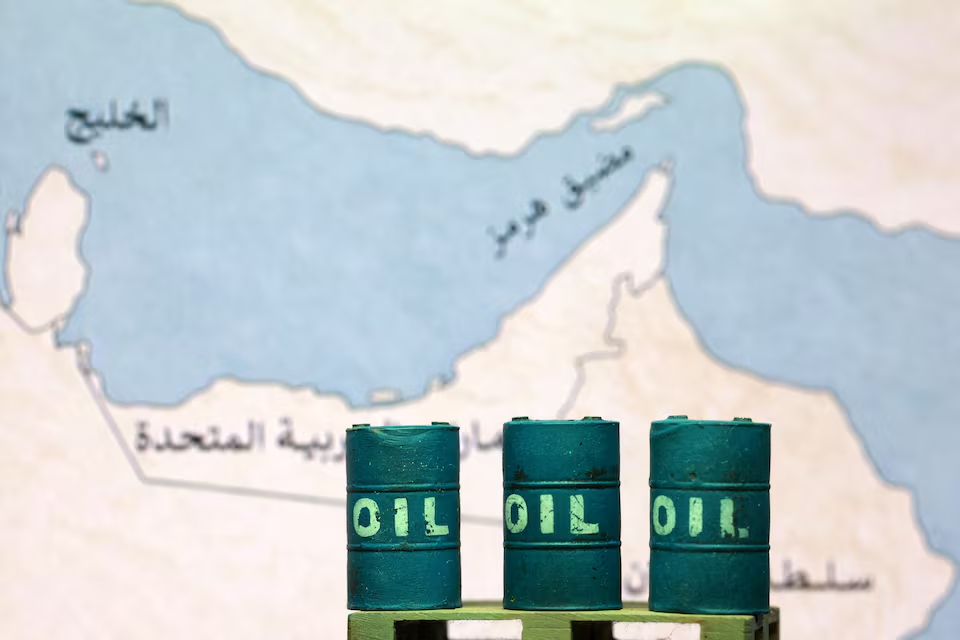
A tanker carrying about 2 million barrels of Iraqi fuel oil was struck by a drone in Iraqi territorial waters on Wednesday, port officials said, while UKMTO, a British navy-linked agency, reported that several merchant vessels in the Gulf had been hit by disabling fire overnight.
A seafarer was killed in an incident involving the Gibraltar-flagged oil products tanker Hercules Star while at anchorage off Dubai, the vessel’s charterer Peninsula said on Wednesday.
"The key risk is whether the recent attacks on oil tankers lead to fewer ship-to-ship transfers taking place in the Gulf of Oman, which have so far played a key role in providing oil to global markets and keeping a lid on prices," said Hamad Hussain, senior climate and commodities economist at Capital Economics.
FUELS, PHYSICAL CRUDE OIL ALREADY ABOVE $100
In the physical crude oil market, the dated Brent oil benchmark, against which roughly two-thirds of supply is priced, has been above $100 per barrel since September 3, according to LSEG data.
Physical oil markets, linked to prompter deliveries than futures contracts which typically start a month out, react quickly to supply disruptions as buyers need to go into the market swiftly to seek alternative cargoes.
Meanwhile, consumers have been paying the equivalent of more than $100 a barrel for their oil in the form of refined fuels such as gasoline and diesel for most of this year, as conflicts created a global refining crunch which sent fuel prices soaring even relative to crude. U.S. gasoline prices are currently averaging $4.22 a gallon, while diesel prices are at a record, and closing in on $6 a gallon.
European fuel markets remain extremely tight, with diesel futures near $200 a barrel and record refining margins driven by supply disruptions from Hormuz and Russia, pushing fuel prices to historic highs in Europe and the United States.
RED SEA THREATS
This week, attacks by Iran-backed Houthis on Saudi energy facilities have also set oil installations ablaze, threatening a significant expansion of the conflict.
"Houthi attacks on Saudi energy facilities have widened the threat further, raising concerns that disruption could spread beyond Iranian supply to the infrastructure and alternative routes that have helped keep Gulf crude flowing," said Daniela Hathorn, senior market analyst at Capital.com.
The attacks threaten crude shipments via the Red Sea, which has been a key alternative route to the Strait of Hormuz.
Latest Stories
-
AFCON 2027Q: ‘Our Black Stars team is gone’ – Former Sports Minister
3 minutes -
Prof. Prempeh calls for public review of draft constitutional reform bills
15 minutes -
AFCON 2027Q: ‘I have never seen a poor performance from Black Stars like against Gambia’ – Nii Lante Vanderpuye
20 minutes -
Nigeria set to launch National Digital Address System 9 years after Ghana showed the way
43 minutes -
Policy rate decision takes time to reflect in lower lending rates – BoG
53 minutes -
Western Regional Minister applauds Karpowership’s role in Ghana’s power sector
1 hour -
Livestream: Road safety crises: Where are we getting it wrong?
1 hour -
Enterprise Life celebrates 25 years of protecting families and building trust
1 hour -
ICC London rules in favor of Ghana against Tullow over $400m tax charge
2 hours -
We are disappointed in ICC’s ruling over our corporate income tax assessment in Ghana – Tullow Oil
2 hours -
Cost of building inflation for August 2026 increases to 4.6% – GSS
2 hours -
Today’s front pages: Wednesday, September 30, 2026
2 hours -
Bawumia highlights agricultural, compulsory insurance reforms in IBAG engagement
2 hours -
Ghana will secure Tullow tax revenues while protecting Jubilee, TEN investments – Ato Forson
2 hours -
Ghana wins $393m Tullow tax arbitration as tribunal upholds GRA assessment
3 hours