

Audio By Carbonatix
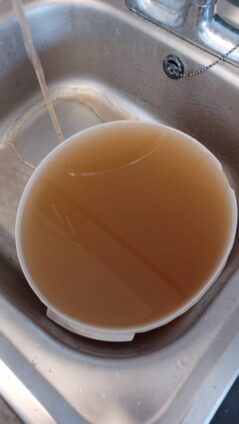
Imagine turning on your tap after a long day, expecting clear water, only to watch brown, muddy liquid flow into your bucket.
You wait.
You let the tap run.
You hope it will clear.
But it does not.
Now imagine having to decide whether that same water should be used to cook your food, wash your dishes, clean your room or maintain your personal hygiene.
For some students living in hostels in Winneba, this is not an imagination.
It is an everyday frustration.
And that is why the recurring problem of discoloured tap water deserves more attention than it is currently receiving.
We have become so accustomed to problems in our communities that sometimes we mistake endurance for normality.
Students complain.
People adjust.
Life continues.
Until another problem replaces the old one.
But access to a reliable water supply should not be treated as a luxury.
Water is one of the most basic necessities of life.
So when students repeatedly open their taps and see brown or muddy water, the question should not simply be, “Can they manage it?”
The question should be:
“Why should they have to?”
The colour of the water is only the beginning
For many people, brown water may initially appear to be nothing more than an unpleasant inconvenience.
But for students, the implications go much further.
A student who wants to cook has to think twice.
Someone who wants to wash their utensils has to consider whether the water is suitable.
Someone who wants to clean their room has to deal with the unpleasant appearance of the water.
And perhaps most importantly, students are left wondering whether the water is safe for the purposes for which they need it.
That uncertainty is the real problem.
If the water is safe despite its appearance, students deserve to be told.
If it is not safe, they deserve an immediate warning and an alternative.
Silence helps nobody.
Students should not have to become water experts
Some students reportedly allow their taps to run for several minutes before using the water, hoping it becomes clearer.
But how are they supposed to know when it is safe?
After one minute?
Five minutes?
Ten?
Should the colour be the only measure?
Should they boil it?
Should they filter it?
Should they buy sachet water?
These are not questions students should be forced to answer on their own.
They are students, not water-quality scientists.
They should not have to conduct informal experiments every time they open a tap.
Authorities responsible for water supply have the expertise and responsibility to investigate the problem and provide clear information.
The financial burden is easy to overlook
There is also a hidden cost to this problem.
When students lose confidence in their tap water, many turn to sachet water or other alternatives.
That means additional spending.
For a student already managing food, transportation, academic materials, accommodation and other expenses, every additional cost matters.
A few cedis may appear insignificant to someone with a regular income.
For a student trying to survive on a limited allowance, it can mean sacrificing something else.
That is why the problem should not be dismissed as simply “brown water.”
It is also an economic issue.
Students already have enough to worry about
University life is not easy.
Students are expected to attend lectures, complete assignments, prepare for examinations, participate in group work and meet deadlines.
Many are also dealing with accommodation challenges, transportation costs and rising food prices.
The last thing they need is to worry about whether the water coming from their tap can be trusted.
Accommodation is supposed to provide a basic level of comfort and security.
A hostel does not need to be luxurious.
But students should at least be able to expect basic necessities such as reliable water.
We must stop normalising poor services
Perhaps the bigger problem is the culture of adjustment.
When something does not work properly, people are often told to manage.
The water is brown?
Let it run.
There is no water?
Buy some.
The road is bad?
Drive carefully.
The electricity is unreliable?
Charge your devices whenever power returns.
At what point do we stop telling citizens to adapt to problems and start demanding that the problems be fixed?
There is nothing wrong with being resilient.
But resilience should not become an excuse for institutional failure.
A population should not have to be permanently resilient because basic services are not functioning as they should.
Where are the answers?
This is where the Ghana Water Company Limited and other relevant authorities need to take the concerns seriously.
Students are not necessarily demanding miracles.
They want an explanation.
What is causing the discolouration?
Is there a problem with the pipelines?
Is it related to maintenance?
Is there sediment in the system?
Is the affected supply being monitored?
What steps are being taken to resolve it?
And most importantly:
Is the water safe for domestic use?
These questions deserve clear answers from the appropriate authorities.
Not rumours.
Not assumptions.
Not silence.
The students deserve to be heard
There is sometimes a tendency to dismiss student complaints because students are young or because their stay in a particular hostel may be temporary.
That is the wrong approach.
Students are residents.
They pay for accommodation.
They contribute to the local economy.
They buy food from local businesses.
They use transportation.
They form part of the Winneba community.
Their concerns therefore deserve attention.
A student's voice should not become less important simply because they are expected to leave campus after graduation.
This is bigger than Winneba
The issue also raises a broader national question.
How do we treat basic public services?
Do we only respond when problems become crises?
Do citizens have to complain repeatedly before authorities act?
Do we wait for someone to become seriously affected before investigating?
Water problems should be dealt with before they become public-health emergencies.
Infrastructure should be maintained before it collapses.
Problems should be investigated before they become disasters.
That is what responsible public administration should look like.
Transparency matters
Even if authorities discover that the brown colour does not pose a serious health risk, communicating that information matters.
People are more likely to panic when they are left uninformed.
If the problem is temporary, say so.
If maintenance work is responsible, explain it.
If old pipelines are being repaired, communicate the timeline.
If the water requires testing, conduct the tests and share the relevant findings.
People deserve information about the services on which their daily lives depend.
Do not wait until the complaints become louder
The affected students have already adjusted their lives around the problem.
Some are spending extra money.
Some are waiting for water to clear.
Some are questioning its quality.
That should be enough reason for action.
Authorities should not wait until students organise demonstrations, flood social media with videos or demand public explanations before the matter receives attention.
Good governance is not simply responding to loud complaints.
It is identifying problems early and solving them before they grow.
A basic expectation should not become a privilege
At the end of the day, this is not about demanding luxury.
Students are not asking for bottled water to flow from their taps.
They are asking for something much simpler:
Clear, reliable and properly monitored water.
That should not be too much to ask.
For a student preparing for an examination, water should be one less thing to worry about.
For someone preparing food, water should not create anxiety.
For someone washing their clothes or cleaning their room, water should not become a financial burden.
And for every person opening a tap, there should be confidence in what comes out.
The brown water flowing from some taps in Winneba may look like a small inconvenience to those who are not experiencing it.
But to the students living with it, it represents something much bigger: uncertainty, additional cost and the feeling that their concerns may not be receiving the attention they deserve.
We should not wait for a serious health incident before taking water-quality concerns seriously.
We should not wait for students to become desperate before listening.
We should not normalise brown water simply because people have learned how to survive it.
Winneba students deserve answers.
They deserve reliable services.
And they deserve authorities who do not merely hear their complaints, but act on them.
Because when a student turns on a tap and sees brown water, the problem is not only what is flowing through the pipe.
The deeper problem is the silence surrounding it.
Brown taps should not produce empty answers.
Latest Stories
-
NPP shall prevail in 2028 – Afenyo-Markin rallies delegates
3 minutes -
Baffour Awuah’s detention is about showing him where power lies after resisting EOCO’s ‘unlawful arrest’ – Oppong Nkrumah
4 minutes -
NPP NEC elections – Bawumia sets the tone for post-election peace and unity for victory in 2028
9 minutes -
NPP needs leaders with vision, track record to support Bawumia – Mike Oquaye
11 minutes -
Kufuor urges NPP unity, says Ghana needs party back in power
12 minutes -
Let’s select NPP leaders based on careful examination, not great talk – Kufuor urges delegates
17 minutes -
Investigations, arrests aimed at silencing opposition MPs – Ahmed Shaib
28 minutes -
NPP Conference: Akufo-Addo urges new officers to unite party for 2028
47 minutes -
NPP delegates approve constitutional amendment making flagbearer leader of party
47 minutes -
Mahama Ayariga gives MMDCEs 30-day deadline to secure land for waste transfer stations
59 minutes -
NPP approves 14 constitutional amendments despite earlier call to defer exercise
1 hour -
NDC walks out as NPP Delegates Conference suffers hours of delay
1 hour -
PNC cautions NPP against making flagbearer automatic party leader
1 hour -
Treat healthcare as an investment, not a budget cost – Mahama
2 hours -
Mahama outlines Ghana’s strategy to expand healthcare and produce medicines locally
2 hours