

Audio By Carbonatix
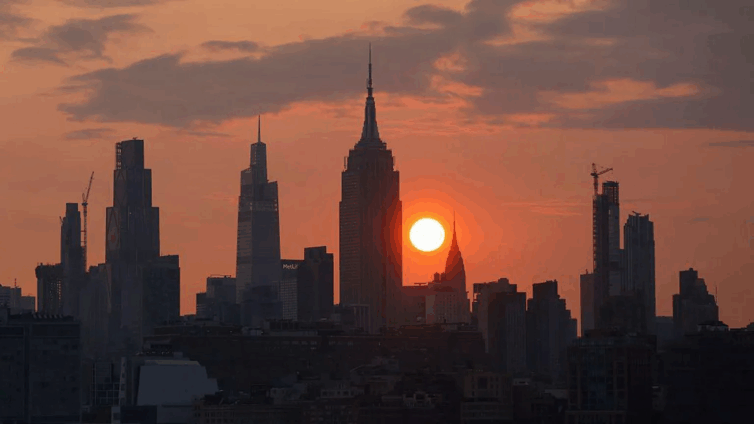
An air quality health advisory has been issued for New York City and its surrounding areas because of smoke from wildfires in Canada.
In a post on X, New York state's Department of Environmental Conservation (DEC) and Department of Health (DOH) issued the advisory for Long Island, New York City Metro, Lower Hudson Valley, Upper Hudson Valley, and the Adirondacks on Saturday.
Authorities are warning air quality in those regions is "unhealthy for sensitive groups".
Wildfires in Canada have forced tens of thousands of people to leave their homes, and the smoke drifting over the border has sparked air quality concerns across the northern United States.
The air quality index (AQI) is predicted to be above 100 in much of New York state on Saturday, and could reach 135. Alerts are also in place for parts of New England.
The AQI measures the severity of pollution in the air and categorises health risks. The higher the number, the more unsafe the air is to breathe.
This is not the first time US authorities have issued air quality alerts because of smoke from the Canadian wildfires.
In mid-July, a similar alert was issued for Chicago, with additional precautions advised for babies and the elderly.
The political implications of the wildfire smoke have also reached Washington.
Earlier in July, six members of Congress wrote to the Canadian ambassador complaining that smoke from wildfires was making it difficult for Americans to enjoy their summer.
There are currently more than 550 active fires in Canada, with the most concentrated in the province of Manitoba, according to authorities. 6.1 million hectares (15 million acres) of land has been burnt across the country in the past year.
May and June were particularly destructive months in western Canada, with roughly 30,000 people forced to evacuate in the provinces of Saskatchewan and Manitoba, where local administrations declared a state of emergency.
Scientists have consistently linked the intensifying wildfire seasons to climate change.
Canada is believed to be warming at twice the global average rate, and its Arctic regions are heating up at nearly three times the global rate, scientists have warned.
Latest Stories
-
Struggling Real suffer title blow with Girona draw
1 hour -
Mahama nominates Pamela Graham as Auditor-General
2 hours -
The five big sticking points in US-Iran talks
2 hours -
Melania Trump’s speech propels Epstein crisis back to forefront
3 hours -
What everyone should know about C-sections
3 hours -
Gunmen kill at least four people at Afghanistan picnic spot
4 hours -
Health Ministry engages Ga Mantse ahead of Free Primary Healthcare launch
4 hours -
We can tackle multiple priorities – Sam George defends Anti-LGBTQ Bill push
5 hours -
Statement: Ghana Chamber of Mines’ Response to Claims in Joe Jackson’s “Ananse Stories about the Economy of Ghana”
5 hours -
GES opens 2026 teacher recruitment for licensed B.Ed graduates
5 hours -
Ghana must value skilled trades, build resilient learners — Ibn Chambas
5 hours -
Ghana must rethink education around relevance, resilience and responsibility — Ibn Chambas
5 hours -
Prince Harry faces defamation lawsuit from charity he co-founded
5 hours -
South Korea deploys thermal cameras to track escaped zoo wolf
5 hours -
Calls for royal meeting with Epstein survivors grow ahead of US visit
5 hours