

Audio By Carbonatix
Smallholder farmers are not the future. This is according to the host of a popular radio morning show.
Smallholder farmers are the present. Across Africa, smallholder farmers produce more than 70% of the food we eat. Globally, smallholder farmers, family farms, grow more than a third of the food that we eat.
Why should smallholder farmers not be the future?
If you listen to this radio show the reason is clear. They believe that agribusiness is the future. By agribusiness, they seem to mean very large farms practising industrial agriculture. The farmers they celebrate have hundreds or thousands of acres.
Why do these journalists think agribusiness is the future? They claim it is more productive. They will tell you, as a member of the morning show’s team did, that the production of sweet potato, for example, is only 26% of its potential. This “productivist” perspective is embedded within the logic of industrial monoculture agriculture.
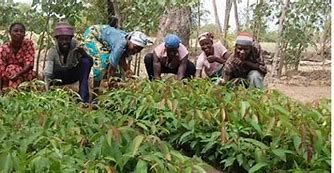
I know smallholder farmers in Ghana, farming less than ten acres who are extremely productive. They inter-crop bitto with maize and cassava.
They grow Bambara beans and groundnuts, millet and sorghum, garden eggs, tomatoes, and alefu. These farms have live fences which use acacia and jatropha, which not only keep out livestock but also sequester carbon dioxide. Areas of their farms are covered with moringa trees, pawpaw, pigeon peas, and a few cashew trees. They raise chicken, guinea fowls, and ducks.
The ponds on their farms contain tilapia and catfish. They keep sheep and goats. Some have a few cattle and/ or pigs. Everything is integrated. They grow their own animal feed. When they clean out the ponds, the water, rich in fish manure, is used as organic fertilizer for their crops. The manure from their sheep and goats or from the pigs is used to increase soil fertility. Areas of the farm are left wild. Here you find pollinators. These smallholder farmers produce almost all their family’s needs. The overall productivity of these agro-ecological farms per acre is incomparable.
We need more of the smallholder farmers who farm in this way; we need them to thrive. They feed their family diverse and nutrition-dense foods, free of pesticides. They sell the same to others in local markets. These farms are productive in diversity.
They do not aspire for “productivity” of one or two crops following the industrial agricultural model. For smallholder farmers practising agroecology, it is not smart to grow one or two crops with hybrid seeds, designed in a laboratory to work with huge doses of toxic fertilizers and pesticides, which will give you a high yield as long as you supply all the required inputs.
The agroecological farms of the smallholder farmers I know would be more productive compared to a monoculture farm. Count all that agroecological farms give you: garden eggs, Bambara beans, bitto, millet, maize, cassava, and tomatoes for food; then add animal fodder as well as fuel for cooking and medicinal herbs and plants.
And do not forget, such a farm also gives you improved soil health and fertility. In the time of climate change, agroecological farming builds resilience to climate variability because it increases soil organic content, which enables the soil to store more water as well as sequester carbon. This is the superior productivity of an agroecological farm. This should be the future of more of Ghana’s farms, a future where small and large farms practice agroecology.
Agroecology envisions an equitable food system. Agribusiness is not committed to a future where the food system is more equitable. When Industrial agriculture expands, it deepens inequality. It is concerned mainly, if not only, with profits. Farming is not first and foremost for feeding people healthy food without destroying the environment. Thus, agribusiness advocates promote out-grower schemes, despite their mostly exploitative history, as an alternative to farmers having autonomy.
Yet, smallholder farmers will remain. Despite the lack of substantive support for smallholder farmers, especially female ones, they will continue to grow most of the food we eat. They will continue to develop and share their indigenous seeds. Smallholder farmers will refuse dependence on chemical fertilizers because they recognize that as the prices increase the financial cost of fertilizers alone makes it bad for business. Smallholder farmers will also increasingly reject using agro toxins on their farms.
Why is this so? Increasingly, smallholder farmers appreciate just that they are indeed the future of agriculture. More and more of them recognize that the best way to build climate-resilient farms is to practice agroecological farming and avoid the use of environment polluting fossil fuel-based inputs.
When people become “food citizens” and advocate for culturally appropriate nutritious and diverse foods, free of pesticide residue, smallholder farmers become the future. When food citizens demand a food system that enables smallholder farmers to earn a dignified living from their farms, smallholder farmers will grow stronger. When these smallholder farmers practice agriculture that ensures biodiversity and sustainability while creating rewarding jobs for youth and catalyzing rural development, smallholder farmers brighten our future.
*****
Chaka Uzondu (Ph.D.) is a researcher and policy analyst. His writings cover topics ranging from agroecology, climate change, economic justice, food sovereignty, health, housing, political ecology/economy, and water, sanitation, and hygiene (WASH).
Latest Stories
-
Ghana explores centre of excellence for hearing, communication and cochlear implant care
10 minutes -
Schizophrenia-related disorders lead mental health cases recorded in Ghana
32 minutes -
Dutch authorities enlist Ghana in hunt for fugitive drug lord Bolle Jos
55 minutes -
Ghana housing finance conference adopts communiqué to improve affordable housing access
5 hours -
Special Initiatives Minister urges Wa Technical Institute to enrol more girls as EU-backed solar training lab opens
6 hours -
In the matter of my first year at the Bar
6 hours -
ActionAid Ghana calls for an end to child marriage, greater investment in girls’ rights
6 hours -
Newsfile to tackle World Cup visa scandal, beach demolitions, education strikes, BRICS bid
6 hours -
UK-Ghana Trade & Investment Summit: Trade Resource Centre to help businesses maximise UK-Ghana trade opportunities
7 hours -
Embassy of Denmark celebrates World Maritime Day
7 hours -
Linking LEAP to productive inclusion could cut extreme poverty by 2030 – UNICEF
8 hours -
Trade Ministry backs use of creative arts to rehabilitate prison inmates
8 hours -
Negotiations with government to continue despite strike suspension – GNAT
8 hours -
‘Ghana cannot afford to waste public resources; every cedi has a job’ – Ato Forson
8 hours -
Ghana expects economic boost as World Assemblies of God Congress brings 10,000 delegates to Accra
8 hours