

Audio By Carbonatix
Climate-driven temperature changes are on track to cause about 430,000 additional deaths every year by 2050, with 10 times more deaths occurring in poor countries than in richer ones. How many of those lives can be saved largely depends on access to energy, particularly the electricity needed for cooling. But how many of those lives can be saved will largely depend on access to electricity, especially the power needed to keep people cool during extreme heat.
A new report by the Climate Impact Lab warns that many of the countries expected to suffer the most from rising temperatures are also the least able to provide enough electricity for fans, air conditioners and other cooling systems.
“Air conditioning is a life saver, and climate change will no doubt lead to more AC adoption in today’s wealthy countries. Our research finds, however, that in too many countries around the world people will not be able to respond in the same way. The result is one of climate’s great cruelties: lots of death in the very countries that have contributed the least to climate change,” says Michael Greenstone, a co-founder of the Climate Impact Lab and the Milton Friedman Distinguished Service Professor in Economics at the University of Chicago.
“These findings are a clarion bell that many countries do not have much time to improve the functioning of their electricity markets so they deliver inexpensive and reliable energy and identify other successful adaptations that can save lives.”
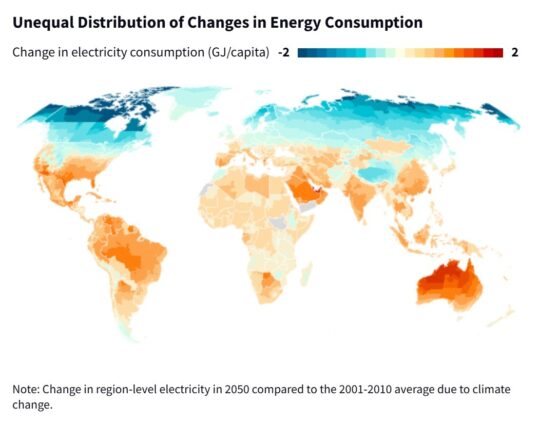
The report finds that today only the world's richest have the resources needed to power cooling. As temperatures rise, many middle-income countries are expected to expand their electricity supply and use more power for cooling. Electricity used for cooling is projected to grow seven times more in middle-income than in low-income countries due to climate change. In fact, the growth of electricity use per person due to a warming climate in low-income countries is projected to be so small it would only be enough to power a single LED bulb for four months.
The same poor countries projected to see so little increase in electricity also tend to be hotter than other countries. The report identifies areas in 18 countries, home to 676 million people, that are trapped in this deadly combination of extreme heat and lack of cooling. Due to hotter temperatures and little projected increase in energy consumption, around 377,000 people in these areas are set to die annually by 2050. All of these people live in either low-income or lower middle-income countries today, mostly in northern sub-Saharan Africa such as Niger, Mali, Burkina Faso and Chad. The rest live in Southern Asia, including Pakistan, Bangladesh, Nepal and Myanmar.
These trapped countries sit in stark contrast to their wealthier neighbors. For example, countries across the Gulf like Bahrain, Kuwait and Saudia Arabia are equally as hot as sub-Saharan Africa. But Gulf countries consume much more electricity for cooling and are projected to have big increases, leading to far fewer deaths. Take Niger and Saudi Arabia. The projected increase in electricity use per person in Niger will be 1/9th that of Saudi Arabia, and communities in Niger will lose 27,000 more lives annually in 2050 due to a warmer climate than its wealthier counterpart.
Africa
Africa is expected to become much hotter, and that could lead to many more deaths caused by extreme heat. The biggest increases are expected in Niger, where heat-related deaths could rise by 68 people for every 100,000, followed by Burkina Faso (60), Djibouti (55), Chad (47) and Mauritania (42).
But there is a worrying problem. These are also some of the countries expected to see only small increases in electricity supply. Niger, Burkina Faso and Chad are projected to gain only about 0.06 to 0.07 gigajoules (GJ) of electricity per person. That means many homes may still not have enough power to run fans, air conditioners or other cooling systems to protect people from the extreme heat.
In Chad, electricity use is expected to increase by 162%, but that is because the country is starting from a very low level, so many people could still remain without reliable access to electricity.
Meanwhile, countries in Southern Africa are expected to see much smaller increases in heat-related deaths. The report says the biggest challenge is that the countries facing the worst heat are also the ones with the least electricity and the fewest resources to help people stay safe.
Ghana
Ghana is also expected to get hotter The report projects about 19 additional heat-related deaths for every 100,000 people as temperatures continue to rise.
Researchers say Ghana is among the countries caught in what they call a "heat trap"—where temperatures are rising, but electricity supply is not growing fast enough to help people stay cool through fans, air conditioners and other cooling technologies.
About a third of the population live in these tricky, high-risk areas. By 2050, the country could record more than 4,000 additional heat-related deaths every year.
Compared with its neighbours, Ghana's outlook is mixed. It is expected to be less affected than Burkina Faso and Togo, but more vulnerable than Nigeria and Côte d'Ivoire.
“We’ve identified the places most at risk of seeing more people die from the heat and least able to power up ACs to save them, so people and governments can zero in on saving the greatest number of lives,” says Ashwin Rode, a fellow at the Climate Impact Lab and director of scientific research at the Energy Policy Institute at the University of Chicago (EPIC).
“Communities will need to find ways to protect people from heat like improved energy access, employing heat early warning systems and action plans, expanded healthcare access, and targeted social programs. But as of now, many adaptation approaches remain untested. We’re working to change that.”
The Climate Impact Lab says it is developing a global guide to help governments and communities identify the most effective ways to adapt to climate change. The report is the second in its Adaptation Roadmap series, which argues that alongside cutting greenhouse gas emissions, countries must also invest in practical measures that help people survive the growing impacts of climate change.
END.
Latest Stories
-
Sylvester Mensah urges Latenu FM to promote trade, export opportunities in Ga
4 minutes -
Ga language under threat of decline as children shy away from speaking it – Sylvester Mensah
9 minutes -
‘Let every Ga child you raise know the Ga language and story’ – Sylvester Mensah
16 minutes -
‘We are not deterred’ – Ablakwa responds to backlash over South Africa evacuation
17 minutes -
NCA announces major voice and data disruption across Northern Ghana due to fibre cuts
58 minutes -
Photos: Housing solutions take centre stage at Day 2 of the 3rd Republic Bank-JoyNews Habitat Fair
2 hours -
Video: Immunity should be exercised without creating classism – Inusah Fuseini on cocaine bust
2 hours -
Ghana Air Force passes out 293 recruits after six months of intensive training
2 hours -
EOCO vrs Baffour Awuah: EOCO should have secured warrant before arrest attempt at court – Inusah Fuseini
2 hours -
Triple fibre cuts disrupt telecom services across Northern, Oti regions – Sam George
2 hours -
Politicisation could undermine parliamentary probe into cocaine seizures – Dr Osae-Kwapong
2 hours -
EOCO chases MP: Can Section 41 cure lacuna in EOCO Act? – Inusah Fuseini asks
2 hours -
GNFS, GWL inspect fire hydrants in Ministries enclave; 23 found faulty
3 hours -
Gov’t directs release of 50,000 bags of grain to ECOWAS
3 hours -
Ghana, Germany deepen cooperation on railways, labour mobility
3 hours