

Audio By Carbonatix
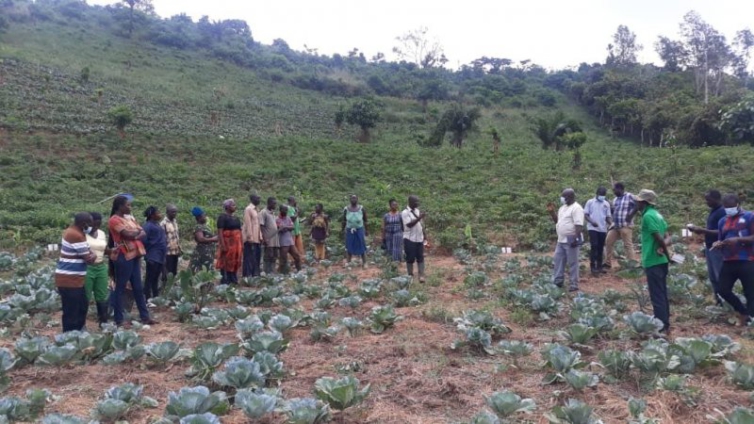
A team of Research Scientists from the Centre for Scientific and Industrial Research (CSIR) under the Crops Research Institute (CRI) and Extension Officers from the Amansie Central District Agriculture Department has organized a field visit to some research-extension-farmer trial cabbage sites in the Bosome Freho and Amansie Central Districts of the Ashanti Region.
The visit formed part of efforts to promote the Modernizing Agriculture in Ghana (MAG) programme.
The purpose of the visit was to observe and assess the efficacy of some laboratory- tested insecticides (both bio and synthetic) and fungicides on the management of Diamondback Moth (DBM) and leaf blight on cabbage production.
Speaking at the sites, Mr Gyasi Boakye, the Head of Public Relations Section said the visit was a way to upgrade their knowledge and practices on pest and disease management as they had been over the years involved in cabbage production across the districts.
He said the Diamondback Moth was an insect that attacked the cabbage head and destroyed the crop, thereby affecting its growth, yield, and marketability.
He said the leaf blight also affected the cabbage, turning the leaves from green to yellow, then brown, and ultimately, reducing the suitability of cabbage head as food.
He said the Amansie Central and the Bosome Freho Districts were known to be the hub of cabbage production and it was in order to expose the farmers to the diseases that affected their income status.
''Over the years, farmers have desperately been using different agrochemicals and combinations of insecticides and fungicides but to no breakthrough'', leading to pests showing resistance, Mr. Boakye added.
He said the CSIR- CRI had assessed a number of insecticides and fungicides in the laboratory for their bio-efficacy against the diamondback moth and cabbage leaf blight respectively.
Mr Boakye said the CSIR- CRI had selected five bio and synthetic insecticides for field verification trial at Adeito in the Bosome Freho District and three at Hemang in the Amansie Central District, adding that all trial sites had three fungicides.
''The team observed that, most of the bio-insecticides and all the fungicides were doing well in managing the DBM and leaf blight'', he said.
''The resultant effect was that, there was low infestation of the pest and disease on the crop, leading to better and more vigorous growth and yields'', he added.
Professor Moses Brandford Mochiah, the Director of CSIR-Crops Research Institute, briefing the farmers, asked them to always adopt proper crop management practices to ensure a healthy environment and safe food for consumers.
He gave the assurance that the CSIR- CRI would continue to partner with the Ministry of Food and Agriculture, other agencies, and farmers, to ensure the realization of the government's objectives of achieving improved livelihoods for all Ghanaians.
Latest Stories
-
Power restoration fault suspected in Kumasi Central Market fire
3 hours -
The 7-foot giant of Ngleshie Amanfro: Seven-foot Ghanaian Ephraim Saawa dreams of joining the national basketball team
4 hours -
Government promises support for Kumasi Central Market fire victims
4 hours -
Vibes The Movie: Big Ghun’s Ghanaian film earns five nominations at 2026 REFFA
4 hours -
MamaCare CEO warns unresolved conflicts among health workers could undermine maternal and neonatal care
5 hours -
Health professionals urged to translate medical knowledge into practice to save mothers
5 hours -
Conflicts among care providers linked to maternal, neonatal deaths – Expert
6 hours -
GIS marks 10th TIME conference, champions improved teaching practices
7 hours -
BRICS Or Balance? What Ghana’s bid really means
7 hours -
GPRTU wants full TRAFFITECH-GH implementation to start in 2027
7 hours -
Mahama announces plans to import electric wheelchairs for PWDs
7 hours -
KGL U17 Colts 2026: Western beat Prempeh Elite Academy to set up final final with Greater Accra Region
8 hours -
Late Solanke strike salvages 10-man Spurs draw at Man United
8 hours -
Gender Ministry to monitor welfare of Nana Akua Addo’s children amid domestic violence case
8 hours -
Benedict Okyere Yeboah: Ghana’s football problem goes beyond sacking a coach
8 hours