

Audio By Carbonatix
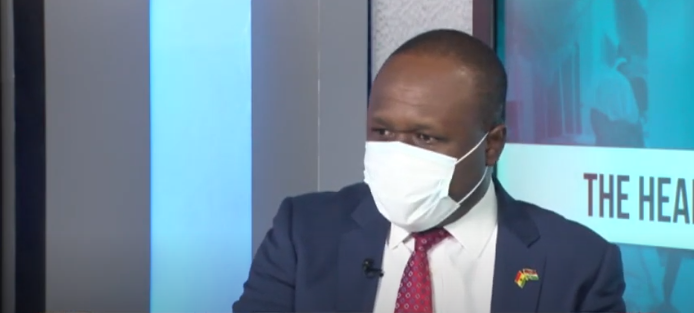
National Democratic Congress (NDC) spokesperson on health and former Minister of Communication, Edward Omane Boamah, says the Danquah Institute’s review of the NDC’s People’s Manifesto, especially their take on health is totally flawed and pointless.
Speaking Joy FM’s News Night, he stated that their review is devoid of a health policy test, a health economic test and a health financing test.
According to the Danquah Institute, the NDC’s proposed Free Primary Health Care policy would render the National Health Insurance Scheme (NHIS) redundant.
However, Edward Omane Boamah said that assertion was unfounded and false, as the two would work together; the NHIS would focus on regional hospitals (secondary and tertiary healthcare) while the Free Primary Health Care Policy would focus on providing healthcare at the district level.
“Free primary healthcare stands on three legs; curative care, prevention and health promotion, and that is going to be at the district level. So for example, if you went to Kaneshie Polyclinic, Mamobi Polyclinic or St. Dominic Hospital in Akwatia etc you’ll not pay for it. If you went to a CHPS compound, you’ll not pay for it. If you went to a health centre, you’ll not pay for it. This is in addition to emphasizing preventive care and health prevention.
“Beyond that, what we are saying is that the National Health Insurance Scheme will then be freed from spending at the district level and then it can focus on secondary care. That is regional hospitals and tertiary care facilities.”
Omane Boamah stated that considering that a greater percentage of Ghanaians are not subscribed to the NHIS, it was worrying to think that many Ghanaians with meagre incomes could not afford proper healthcare in the country.
According to him, restricting the NHIS to secondary and tertiary healthcare will strengthen the scheme and at the same time ensure that every Ghanaian is able to access free primary healthcare.
“And this is why we are proposing free Primary Healthcare so that we can take care of people at the district level and the National Health Insurance Scheme will be stronger because it would have been relieved of expenditures at the district level and can focus on secondary and tertiary care,” he said.
Latest Stories
-
Asantehene plants trees to commence Jimi Watercourse Rehabilitation destroyed by galamsey
4 minutes -
15 arrested, 6 trucks impounded over sandwinning activities on Kumasi-Accra Expressway
4 minutes -
OFFICIAL: Vinicius will miss El Clásico, suspended four games
8 minutes -
Prayer vigil held after four arson attack murders
14 minutes -
GRA fully recovers $154k legacy debt owed by foreign entities between 2022 and 2024
16 minutes -
Kwesi Pratt Jr warns bus preachers are adding to passengers’ stress with accident prophecies
17 minutes -
MTN Ghana to spend $1.1bn in 3 years, build 500 new sites as MoMo hits 44% Growth
19 minutes -
I have no regrets joining Assemblies of God – Mahama
19 minutes -
Starlink restrictions in Ukraine war linked to political situation, Zelensky aide says
22 minutes -
Furniture boost for Techiman North schools as MP donates to 20 institutions
22 minutes -
Assemblies of God to loan 10,000-seater dome for Ghana@70 celebrations
23 minutes -
Government to audit 2,016 community network sites – Communications Minister
23 minutes -
Heritage Series notes: BoG promises more inclusive cedi with improved sizes, tactile features
40 minutes -
‘We want answers’ – Family seeks probe into 14-year-old’s death 12 days after starting SHS
51 minutes -
No preacher has the right to impose beliefs on bus passengers – Kwesi Pratt Jr backs preaching ban
55 minutes