

Audio By Carbonatix
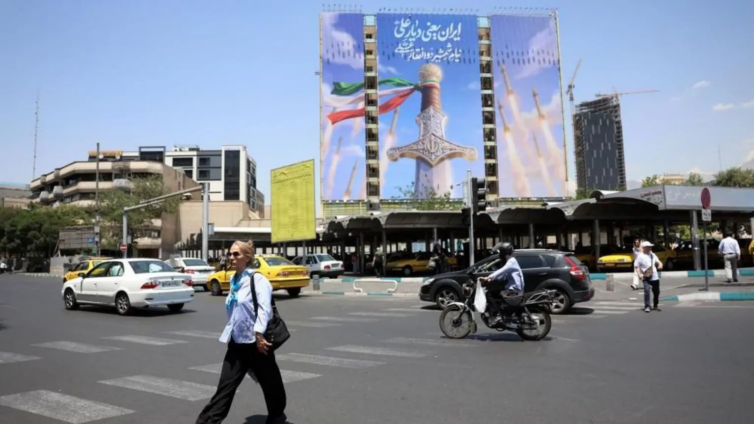
A deal with the US to end fighting in Iran is close and includes reopening the Strait of Hormuz, Iran's Foreign Minister has said.
Seyed Abbas Araghchi told state TV the deal also includes the lifting of a US blockade of Iran, but that talks on Iran's nuclear programme would begin later.
US officials have confirmed some of the details of the agreement, saying economic benefits for Iran would depend on Tehran meeting its obligations.
The war began with US and Israeli strikes across Iran on 28 February, prompting Iran to attack Israel and US-allied states in the Gulf - as well as effectively closing the Strait of Hormuz, a key shipping route for the world's oil and liquefied natural gas.
Despite having agreed a ceasefire in April, the US and Iran have exchanged intermittent fire, including two rounds of tit-for-tat strikes this week.
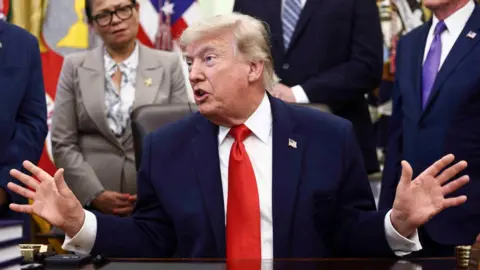
US President Donald Trump said on Thursday that he had cancelled "scheduled attacks" against Iran, because negotiators had "just made a great settlement" - a deal that was likely be to signed imminently.
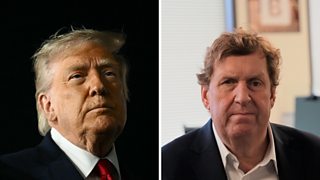
On Friday, Iranian media published some details from the alleged 14-point deal which Trump said had "nothing to do with the terms that were agreed to" and "bears no relation to the truth".
A few hours later, Pakistani Prime Minister Shehbaz Sharif, whose country helped mediate the deal, said the Memorandum of Understanding (MOU) between the US and Iran had been agreed and awaited finalising.
Iran's Araghchi was quoted in state media saying there are "supporters and opponents" of the latest terms of the deal among Iran's top security body, the Supreme National Security Council.
However, he added that a collective decision had not been reached. "For now, we must wait. If approved, the agreement will be signed remotely," he said.
In a detailed briefing with journalists on Friday afternoon, US officials said the deal would reopen the Strait of Hormuz, in return for the US lifting its blockade on Iranian shipping.
Those steps would come into effect more or less immediately. This would be followed by a 60-day period of negotiation - focusing on Iran's enriched uranium - an essential ingredient to make a nuclear bomb. Officials said that this would result in all that material being destroyed on site and then removed from the country, though the precise mechanism for doing so is still to be worked out.
On the economic side, officials stressed there would be no money provided up-front - an apparent rejection of earlier Iranian news reports suggesting some Iranian assets would be unfrozen before substantial negotiations had begun.
Instead, US officials said, there would be a staged reintegration of Iran into the global economy, with measures such as the lifting of sanctions and the potential unfreezing of assets happening incrementally.
The deal calls on Iran to stop funding proxy groups in the region - a reference to Hezbollah and other Iranian proxies across the Middle East.
The US officials emphasised that the MOU was not based on trust or promises, but on "performance" - Iran would only receive economic benefits when it could be verified it had implemented measures it had committed to.
Even though there is a sense of cautious optimism from all sides - the US, Iran, Pakistan and Qatar which has also helped with mediation efforts - there is still a small distance to go. Variations of this agreement have been expected several times over the past month or two, only to fall away at later stages.
The difference now, according to the US administration, is both a greater level of optimism and a greater openness about the substance of the agreement.
For his part, the Iranian foreign minister said that "as soon as the final stages of our negotiations are completed, this agreement will be signed and announced".
"This could happen in the coming days. I am very hopeful," Araghchi told state TV.
He stressed that the first point mentioned in the MOU was the lifting of the US naval blockade of Iran.
As for the Strait of Hormuz - the crucial waterway through which some 20% of the world's oil and liquefied natural gas normally transits - Araghchi said its administration would "no longer be the same as before". Since closing the Strait, Iran has insisted on a fee to be paid by vessels seeking to cross, with the US insisting passage should be free to all shipping.
The senior Iranian official also said the MOU envisaged an end to the conflict between Israel and the Hezbollah in Lebanon. Previous reports from the US have suggested Lebanon may not be part of this deal - with Iran reportedly insisting on it.
Israel's prime minister has said his country will strike Hezbollah if it continues attacks against northern Israel.
Latest Stories
-
The job interview question you don’t have to answer
1 hour -
Trump unveils ‘Super Intelligence Force’ to oversee AI policy
1 hour -
Actress Chioma Chukwuka announces death of father in emotion-laden post
4 hours -
[Video]‘I have asked God to take me when it is time’ – Pete Edochie on health struggles
4 hours -
Manager remanded over $1m auto fraud
4 hours -
Mr President, Ghana was mentioned at the UN; why aren’t we talking about it?
4 hours -
US Marine arrested over murder of woman in Okinawa, Japan
4 hours -
Accra to convene Africa’s regulators and markets on tokenisation at AVAS 2026
4 hours -
Indian police accused of sexually harassing journalists at protest
5 hours -
Jeffrey Archer returns to his former school library
5 hours -
France to close up to 500 schools on Monday over student protests
5 hours -
The Paradox of Plenty — When every smartphone becomes a newsroom
5 hours -
Australia investigating Flydubai co-pilot’s links to country
5 hours -
GTA sensitises taxi drivers in ‘Know Ghana’ tourism campaign
6 hours -
Archbishop Agyinasare calls for responsible speech amid growing social media abuse
6 hours