

Audio By Carbonatix
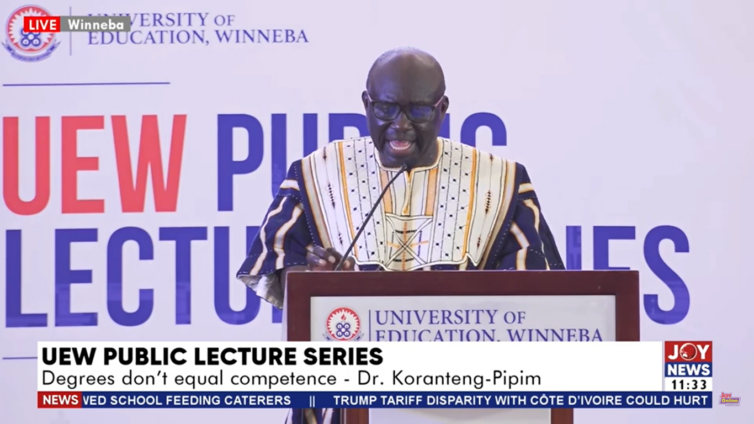
The Executive Director of EAGLESonline, Samuel Koranteng Pipim, has called attention to a critical flaw in Ghana’s education system, arguing that degrees do not necessarily translate into competence.
Speaking at the University of Education, Winneba (UEW) Public Lecture Series on Friday, April 11, Mr Pipim stressed that the education system is failing to adequately prepare graduates for the demands of the modern workforce, with a significant disconnect between what is taught in academia and the skills required by industries.
"Degrees don’t equal competence," Pipim asserted during his address. "There is a gaping disconnect between academia and industry needs, and the data supports it." According to the International Data Science Association (IDSA), a study on the Ghanaian economy in 2022 revealed that 40% of employers reported that graduates lacked critical problem-solving skills," Mr Pipim stated.
He further questioned the value of academic accolades that do not prepare individuals for real-world challenges, stating, “What good is a first-class degree if it leads to a third-class life?”.
In his view, the system is training people for poverty rather than prosperity, as it does not foster the entrepreneurial spirit necessary for economic growth.
Mr Pipim criticised the focus on academic qualifications rather than practical skills, lamenting that the education system rewards "paper over productivity."
He explained that this narrow focus on degrees and academic credentials has contributed to the country’s growing problem of job seekers rather than job creators.
"We produce job seekers, not job creators," he said.
He also pointed out the detrimental impact of the obsession with white-collar jobs, which has led to a stifling of creativity and enterprise among young people.
"The system rewards conformity to the ‘white-collar job’ ideal, which has stifled innovation and entrepreneurial spirit," Mr Pipim said.
According to him, this mentality has led many young people to view entrepreneurship as a last resort, rather than a viable career option, and has ultimately undermined the country’s ability to generate its own wealth.
Latest Stories
-
Services drive 7.4% expansion in Ghana’s economic activity
5 minutes -
‘I don’t make music for awards, I make it to connect people’ – Rocky Dawuni
17 minutes -
Farmer jailed for three months over assault on wife in viral video
23 minutes -
Police arrest eight in Okaishie operation targeting illicit drugs and medicines
26 minutes -
David Agyemang Yeboah: Marriage is not the problem; your approach is
29 minutes -
Lawyer sues Standards Authority over used-vehicle import restrictions
31 minutes -
Ukraine to restart strikes on Russian oil refineries, Zelensky says
31 minutes -
CIMG awards drive competition among Ghanaian businesses
37 minutes -
NSA regional director Emmanuel Reagan files nomination to contest NDC Ashanti Regional Organiser position
42 minutes -
Obuasi SHTS: Number of students alleging sexual abuse rises to 16
47 minutes -
Ghana’s economy grows by 7.4% in July 2026
58 minutes -
NDC member challenges Dennis Yeboah Twumasi’s eligibility for Bono Regional Secretary elections
1 hour -
Popular Nigerian gospel singer Toluwanisings dies
1 hour -
Spio-Garbrah proposes debt swaps to fund reparative justice in Africa and Caribbean
1 hour -
Alban Bagbin calls for governance reforms and coordinated action to address Africa’s debt crisis
1 hour