

Audio By Carbonatix
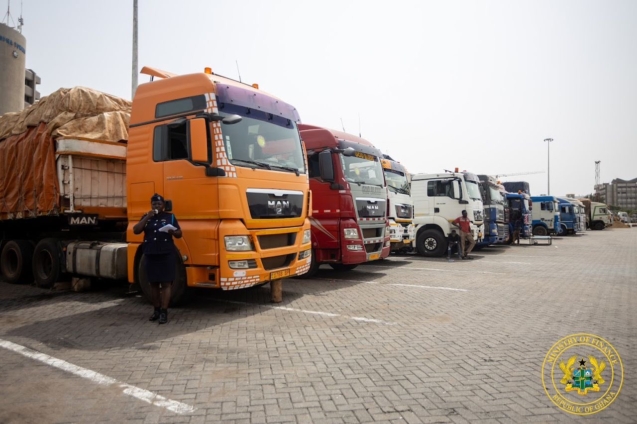
Deputy Finance Minister Thomas Nyarko Ampem has commended the Customs Division of the Ghana Revenue Authority (GRA) for intercepting 12 articulated trucks suspected to be involved in transit diversion, describing the operation as a bold move to protect state revenue.
In a post on Thursday, Mr Ampem praised the enforcement team for their swift action, noting that the interception sends a clear signal about the government’s determination to curb revenue leakages and clamp down on transit diversion.
“Investigation is ongoing to identify the six outstanding trucks,” he stated.
He further disclosed that he has directed the Commissioner-General of the GRA to conclude investigations within one week, adding that two Customs officers connected to the matter are being tracked.

“We take these things seriously because the impact on our revenue is serious,” he stressed.
On his part, the Commissioner-General of the GRA, Anthony Kwasi Sarpong, warned businesses and traders to comply strictly with Customs laws and procedures.
He cautioned that the Authority would not hesitate to enforce the law against offenders.
“We will apply the law of confiscation. The full arms of the law will be applied,” he said, adding that the GRA will take decisive action against.
The enforcement exercise, carried out between 10:00 p.m. and 5:00 a.m. along the Dawhenya–Tema Road, was led by the Deputy Commissioner in charge of Operations.
The team included the Chief Revenue Officer, Preventive (Tema Collection), officers from Customs Headquarters and the Revenue Mobilisation Taskforce of National Security.
The 12 trucks form part of a consignment of 18 articulated vehicles that had been electronically gated out of the Customs system as transit goods. The cargo had been declared as goods in transit from Akanu and destined for Niger through Kulungugu.
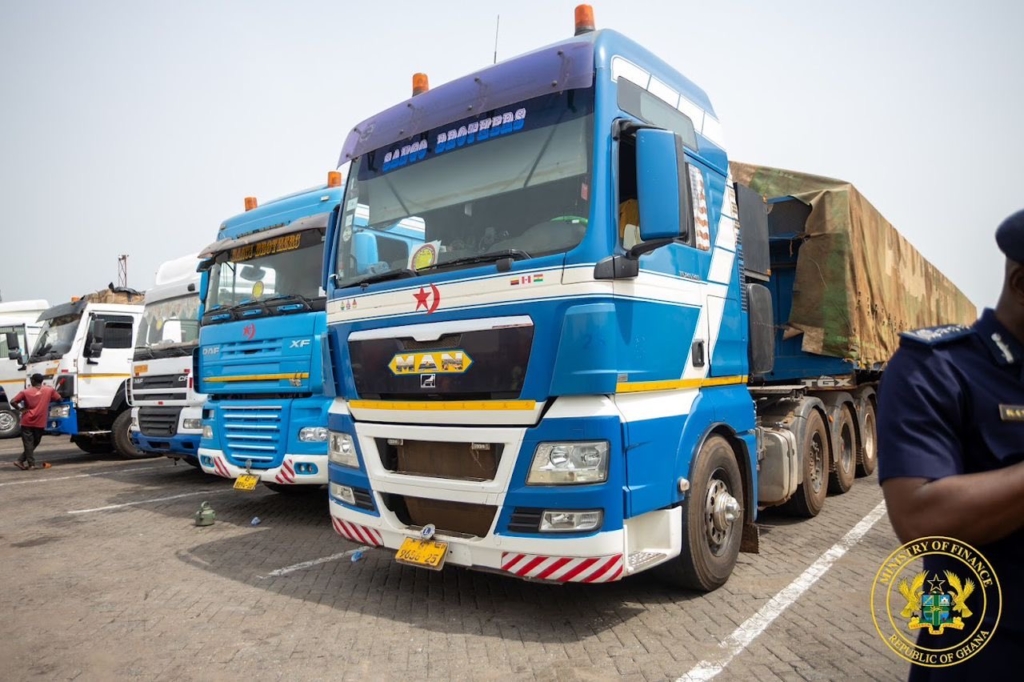
However, the trucks were intercepted while moving without the mandatory Customs human escort, contrary to Ghana’s transit regulations.
The vehicles were loaded with 44,055 packages of edible cooking oil, tomato paste and spaghetti. Authorities estimate that the potential tax exposure linked to the consignment exceeds GH¢85 million.
Eleven of the trucks have since been secured at the GPHA Transit Terminal under strict Customs supervision, with support from the Ghana Ports and Harbours Authority. One truck developed a mechanical fault during the operation, and arrangements are underway to transfer its cargo to another vehicle to ensure the goods remain secured.
Preliminary checks indicate that all 18 trucks were electronically cleared from the system, yet only 12 have been physically accounted for. Investigations are ongoing to trace the remaining six trucks.
Latest Stories
-
Mr President, Ghana was mentioned at the UN; why aren’t we talking about it?
18 minutes -
Accra to convene Africa’s regulators and markets on tokenization at AVAS 2026
21 minutes -
The Paradox of Plenty — When every smartphone becomes a newsroom
54 minutes -
GTA sensitises taxi drivers in ‘Know Ghana’ tourism campaign
2 hours -
Archbishop Agyinasare calls for responsible speech amid growing social media abuse
2 hours -
‘It will be inexcusable for gov’t not to honour payment of teachers’ arrears by 30th October’ – Haruna Iddrisu
2 hours -
Forbes’ World’s Best Employers 2026: No Ghanaian firm ranked among 900 companies
2 hours -
Electronic processing of teachers’ data: ‘The decision is the Controller’s’ – GES boss
2 hours -
Teachers’ Strike: Haruna Iddrisu questions paper-based processing of promoted teachers’ data
3 hours -
Savannah Region: Kunfusi bridge collapses again, leaving nearly 4,000 residents cut off
3 hours -
Teachers’ strike: GES targets Monday deadline to submit promotion data to Controller
3 hours -
Inflation to average 11.3% in 2027 – Fitch Solutions
3 hours -
‘I didn’t campaign for NDC to come and do this nonsense’ – Kpebu on EOCO’s conduct
3 hours -
Fitch Solutions maintains policy rate forecast of 14% by December 2026
3 hours -
Diaspora Nasara Caucus congratulates Mohammed Ali Suraj, new NPP executives
5 hours