

Audio By Carbonatix
Deputy Chief Executive Officer of the Forestry Commission, Mr Elikem Kotoko, has called for increased investment in climate action, environmental protection and sustainable development, stressing that Environmental, Social and Governance (ESG) principles have become central to economic growth, business competitiveness and long-term resilience.
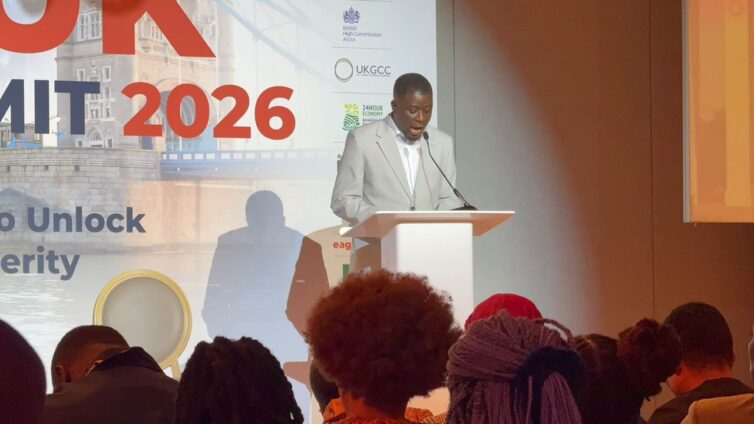
Speaking at the Ghana-UK Summit in London, Mr Kotoko said ESG is no longer merely a sustainability reporting framework but a critical factor influencing investment decisions and corporate performance worldwide.
“Today, ESG is no longer simply a sustainability reporting framework. It has become a key driver of investment decisions, business competitiveness, risk management and long-term economic resilience,” he said.
He noted that climate change should not be viewed solely as an environmental concern but as a broader social and governance issue that requires inclusive and sustainable solutions.
“The social dimension reminds us that climate action must improve livelihoods, create jobs, empower women and young people, and ensure that local communities benefit from sustainable development,” he stated.
Mr Kotoko highlighted Ghana's progress in implementing climate and forestry initiatives, including the Ghana Cocoa Forest REDD+ Programme and the Ghana Shea Landscape Emission Reduction Project, which he said are contributing to land restoration, emissions reduction and improved livelihoods for local communities.
According to him, Ghana's growing participation in international carbon markets is creating new opportunities in agroforestry, ecosystem restoration, ecotourism and biodiversity conservation.
“Investors are increasingly looking for opportunities that generate both financial returns and measurable environmental and social impact. This presents a significant opportunity for Ghana,” he said.
The Forestry Commission Deputy CEO emphasised that attracting sustainable investment requires robust governance systems, transparency and accountability, adding that these remain essential to building investor confidence and ensuring long-term success.
Looking ahead, he outlined key priorities for Ghana's climate agenda, including expanding investment in nature-based solutions, ensuring local communities benefit from climate finance, strengthening governance frameworks and increasing private sector participation in climate-related projects.
“Public finance alone will not be sufficient to address the climate challenge,” he stressed.
Mr Kotoko therefore called for stronger collaboration between governments, development partners, investors and local communities to unlock the full potential of climate financing and sustainable development initiatives.
Concluding his remarks, he urged stakeholders to recognise the evolving role of forests in national development and economic transformation.
“For Ghana, forests are no longer only conservation assets. They are climate assets, development assets and investment assets,” he said.
His remarks formed part of broader discussions at the Ghana-UK Summit aimed at promoting investment opportunities and strengthening partnerships to support Ghana's sustainable development and climate resilience agenda.
Latest Stories
-
Diaspora Nasara Caucus congratulates Mohammed Ali Suraj, new NPP executives
42 minutes -
Dr Antwi-Boasiako’s cybersecurity book showcased at UN crime prevention congress
44 minutes -
We will empower the grassroots and protect every vote – NPP’s 1st Vice Chair Kojo Bamba
54 minutes -
I do not see myself as better than anyone – NPP’s 1st Vice Chair Kojo Bamba
1 hour -
Police blur the line between invitations and arrests – Reindorf Twumasi Ankrah
2 hours -
Turning invitations into arrests is making citizens reluctant to assist police – Twumasi Ankrah
3 hours -
The Traffitech-GH SMS spot-fine system: The good, the sad, and the funny – Bright Simons writes
3 hours -
Hawa Koomson pledges experienced and mature leadership of NPP women’s wing
4 hours -
Young woman found dead at Kasoa Peace Town
4 hours -
Playback: The Law examined lawful arrest in Ghana
5 hours -
Mahama urges African governments to treat healthcare as an investment, not budget cost
5 hours -
Bawumia congratulates John Boadu and new NPP executives, pledges support ahead of 2028
5 hours -
Aksa Energy delegation pays courtesy call on GRA Commissioner-General
5 hours -
‘No talent should be left out’ – Bawumia pledges inclusive NPP campaign for 2028
5 hours -
Prof. Mike Oquaye recounts how he blocked the Special Prosecutor’s attempt to arrest Bawku Central MP
6 hours