

Audio By Carbonatix
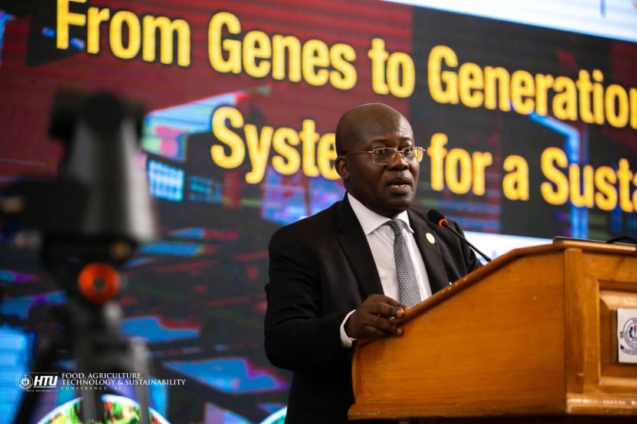
The Founding Director of the West Africa Centre for Crop Improvement, Prof. Eric Yirenkyi Danquah,
has said that the Feed Ghana Programme (FGP) must aim for transformative change rather than mere improvement.
He stressed that the FGP, the government’s flagship initiative designed to accelerate the transformation and modernisation of the agricultural sector, should be a catalyst for revolutionary change in the sector.
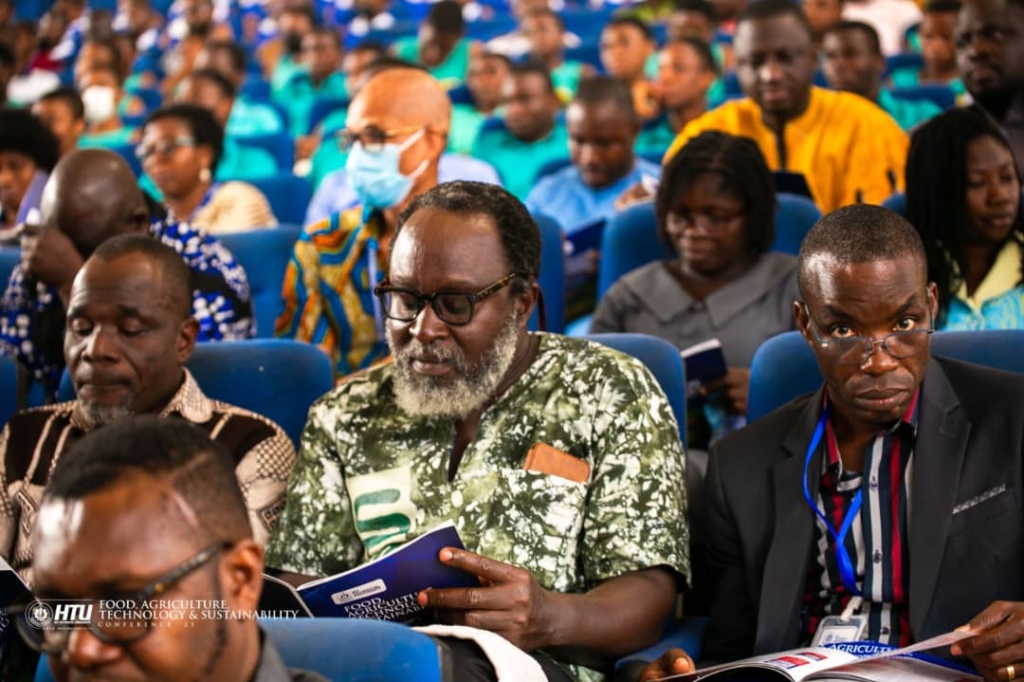
The professor of Plant Molecular Genetics at the University of Ghana said this while delivering his keynote address at the Food, Agriculture, Technology and Sustainability Conference at Ho Technical University (HTU), themed “Rethinking the Future of Food and its Allied Systems in an Era of Sustainability and Circularity.”
“FGP is a good start, but Ghana needs transformation, not another improvement plan. Our greatest opportunity is to build a science-led, innovation-driven, market-ready agricultural economy.”
He said the FGP must succeed and not fail “because if this fails, we’re doomed for life,” outlining that its success would mean Ghana feeding itself, farmers producing for markets, not survival, youth entering agribusiness profitably, climate-resilient, data-driven farming and Ghana becoming a net exporter, not an importer.
The globally recognised plant geneticist and science leader suggested that things be done differently for the desired change, including more science, innovation and modern breeding; strengthened seed systems and breeder seed pipelines; fixed agricultural financing; strong irrigation and water management; and data and digital tools for decision-making.
“Agriculture, you know, is central, but growth slowed down terribly over a very long time; imports rose to over $2.5 billion. And when you look deeper, you see that yields are too low, post-harvest losses. There is weak irrigation and limited finance. And we need to reset Ghana, and I’m happy that we have a government that is talking about resetting Ghana.
What do we mean by resetting Ghana? Past plans failed. Why did they fail? Weak execution. With weak execution, what do you expect? ”
He called for visionary investment, turning knowledge into national power through sustained investment in science, technology and innovation, saying, “The prosperity of nations is written in their budgets for research.”
Prof. Danquah wondered why Ghana would wait for planes to arrive from Paris and Tel Aviv to give vegetable seeds to farmers to plant and said the time had come to start pressing charges of crime against humanity “for politicians who do not invest in science and technology to face the law because, of course, many die of their inaction.”
Prof (Mrs) Ibok N. Oduro, an astute researcher and professor of Post-harvest Technology at the Department of Food Science and Technology at Kwame Nkrumah University of Science and Technology in her presentation described Ghana’s food system as a story of both “progress and paradox,” saying where there were notable strides, there were still challenges of food security, poverty and sustainability issues.
She noted the country had potential for agricultural growth but needed to address factors like climate change and limited access to modern farming techniques and market infrastructure, warning that “We cannot continue as usual. We must innovate not only in laboratories but also in policies, practices and mindsets.”
The Minister of Food and Agriculture, Eric Opoku, was grateful for the conference and said the insights, experiences and dialogue from the conference aligned with the FGP initiative, designed to ensure that Ghana was able to produce food sufficiently to feed its citizens and to ensure the agriculture sector was repositioned to guarantee an incessant supply of raw materials for agro-industrial operations.
He assured the government’s readiness to mobilise all the resources available, material and human, to make an impact, saying, “We have the brainpower, except that we are not making maximum use of the brainpower that we have.”
The Minister of Lands and Natural Resources and Caretaker Minister of Environment, Science and Technology, Emmanuel Armah-Kofi Buah, through his representative, said the transformation of the agriculture sector could not occur in silos but required a coordinated ecosystem that linked research, industry, students, entrepreneurs and policymakers.
“It requires that knowledge generated in universities and research institutions is translated into usable technologies and commercially viable solutions that benefit farmers, agribusinesses and households.”
A representative from the Ghana Circular Economy Centre, Dr. Marindame Kombate, said the circular economy was not a side conversation but central to the future of Ghana's food and agriculture systems, urging, “Let us design a future where waste becomes value, innovation becomes opportunities and a future where Ghana leads Africa in the secular transition.”
Vice-Chancellor of Ho Technical University Prof. Ben Q. Honyenuga said the conference was in line with the university’s vision to become a hub of practical education, advancing sustainable global development and alluded to its breakthrough research, which reduced the gestation period of the baobab plant from between 20 and 30 years to only two and a half.
“Additionally, our niche area in hospitality and tourism management positions us to explore the intersection between food systems and their value chain. We cannot talk about hospitality without talking about food and agriculture, technology and allied fields,” he emphasised.
The Volta Regional Minister, James Gunu, assured the Vice-Chancellor that the Regional Coordinating Council was ready to collaborate with the university.
Latest Stories
-
NDC Deputy National Organizer Aspirant Hamza Umar targets grassroots mobilisation
29 minutes -
Villarreal fight back to beat Napoli and end losing run
3 hours -
Tresoldi nets hat-trick as Club Brugge win Inter thriller
3 hours -
PSG’s Luis Enrique hopes Man City avoid sanctions
3 hours -
Lisandro Martinez issues scathing attack on Man Utd board – has he made things worse?
3 hours -
Saka responds to Arteta’s challenge with ‘huge impact’
3 hours -
Viking hold Bayern in thriller as Kane breaks Messi record
3 hours -
Gordon scores as Barcelona beats Galatasaray
3 hours -
Bumble bought for $1.3bn in ‘bet on the future of humanity’
4 hours -
Imagination Africa, Mentors Chess Academy to host second African Genius Chess Championship at Ghud Park
4 hours -
Paradigm Initiative steps up calls over digital rights, internet freedom in Africa
4 hours -
Saudi man charged with planting ‘sophisticated’ recording device in OpenAI office
4 hours -
Ghana wins UN Human Rights Council seat as calls grow for action against atrocities
4 hours -
Royal Mail losing 400 postal workers a week, says union
4 hours -
Techiman South MP ends decades of water struggle in Asutia
4 hours