

Audio By Carbonatix
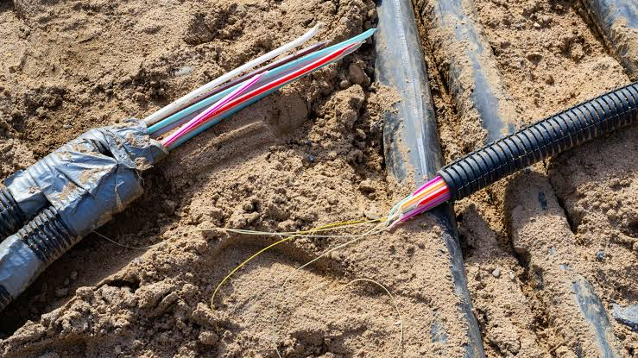
Ghana’s digital economy is grappling with a costly contradiction: while the country invests in expanding connectivity, telecommunications operators are spending tens of millions of dollars to repair networks damaged by construction and other activities.
Between 2021 and 2025, telecommunications operators recorded thousands of fibre cuts annually. Incidents rose from 3,900 cuts in 2021, costing about $7.5 million in repairs, to 10,034 cuts in 2022, costing $17.4 million.
Although the number of cuts fell to 6,344 in 2023 and 5,600 in 2024, cuts exceeded 8,000 in 2025, with direct repair costs reaching approximately $20 million. And the problem persists.
Industry data for the first half of 2026 indicates that reported cuts have already reached 4,289, putting the annual total on pace to exceed 8,000 if no drastic intervention is made to address these fibre cut incidents.
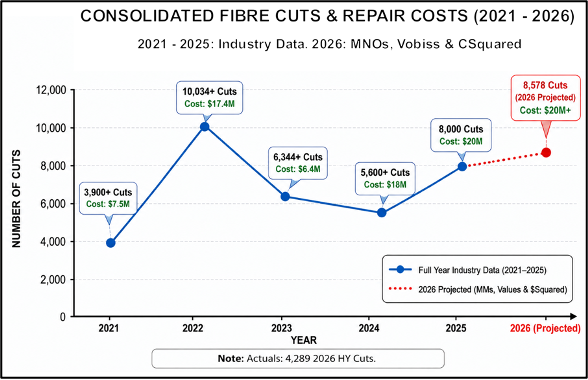
(Source: Consolidated GCT Monthly Fibre Cuts Data)
For an industry that must continually invest in expanding and upgrading networks, the economics are difficult.
Every damaged cable requires resources to locate the fault, repair or replace infrastructure and restore connectivity. The impact also extends beyond the immediate repair bill when businesses, consumers and public institutions lose access to services.
The problem becomes even more significant as Ghana undertakes major physical infrastructure projects.
Road construction can require excavation, drainage works and utility relocation. Without adequate coordination, those activities can damage underground fibre. Construction can also affect aerial networks mounted on poles.
A fibre cable damaged during a road project may appear to be a local infrastructure problem. But the cable could form part of a communications route carrying traffic for thousands of businesses and millions of consumers.
The industry has engaged government agencies, contractors, utility providers and local authorities on the problem, while recognising the role of the National Engineering Coordinating Team in improving coordination.
But the industry's argument is that coordination must now become standard practice rather than an intervention after damage occurs.
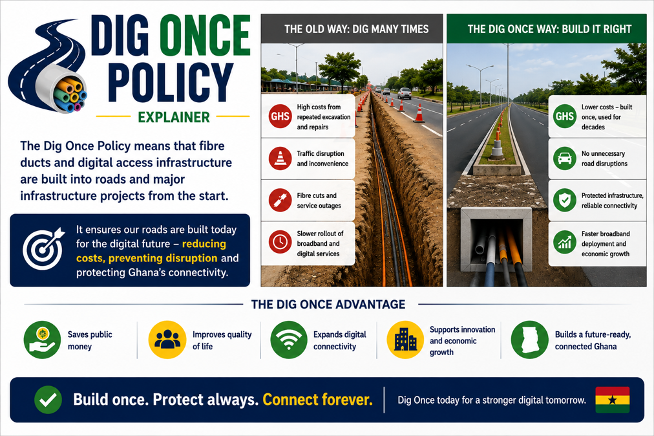
One proposed solution is the Dig Once principle: incorporate empty fibre ducts and other digital infrastructure into new road construction and major rehabilitation projects.
Before excavation begins, existing underground and aerial fibre should be mapped and protected. Future roads should also be designed with pathways for digital infrastructure.
Such measures could reduce repeated excavation, lower future deployment costs and create space for future network expansion.
But coordination alone may not be enough.
The industry is also calling for greater accountability where critical telecommunications infrastructure is deliberately or negligently destroyed.
Ghana increasingly treats connectivity as essential economic infrastructure. Its digital financial services, businesses, public services and emerging AI ambitions all depend on resilient communications networks.
That makes fibre protection more than a telecommunications concern. It is an infrastructure and economic policy issue.
Ghana cannot maximise the return on its infrastructure investments if it repeatedly destroys part of the digital infrastructure that makes those investments productive.
The challenge is therefore no longer simply how to build more roads, fibre and digital infrastructure.
It is how to ensure that one does not destroy the other.
Latest Stories
-
NPP national elections: 3,000–4,000 police to handle security, traffic in Kumasi – Karbo
2 hours -
Atta Akyea fumes as Manhyia MP is to spend another night in EOCO custody
2 hours -
SSNIT says La Beach clearance was to protect hotel investments, beaches to remain public
3 hours -
APSU congratulates St Augustine’s College after back-to-back National Investment Quiz wins
3 hours -
Renewed flood intervention at Mallam Junction raises hopes among residents, businesses
4 hours -
St Augustine’s College retain National Investment Quiz title after nail-biting grand finale
4 hours -
Education infrastructure investment will drive Banda’s development – Ahmed Ibrahim
4 hours -
Teacher unions strike: Gov’t presents fresh proposals as talks end inconclusively
5 hours -
51,000 teachers’ promotion arrears to be validated for October payment – Education Minister
5 hours -
Kwabena Boamah appointed Board Chair for Impact Investing Ghana
5 hours -
Striking teacher unions to meet Fair Wages and Salaries Commission on October 6
6 hours -
EOCO working with AG to arraign Nana Baffour Awuah before weekend court
6 hours -
Duraplast reassures customers after fire, announces October 5 reopening
6 hours -
Call off strike, gov’t will not renege on promotion arrears pledge – Haruna Iddrisu to teacher unions
6 hours -
Committee set up to validate teachers eligible for 20% deprived-area allowance – Education Minister
6 hours