

Audio By Carbonatix
Ghana’s worsening flood crisis is silently draining the economy through lost productivity, traffic congestion, business disruptions and human suffering, economist Prof Peter Quartey has warned.
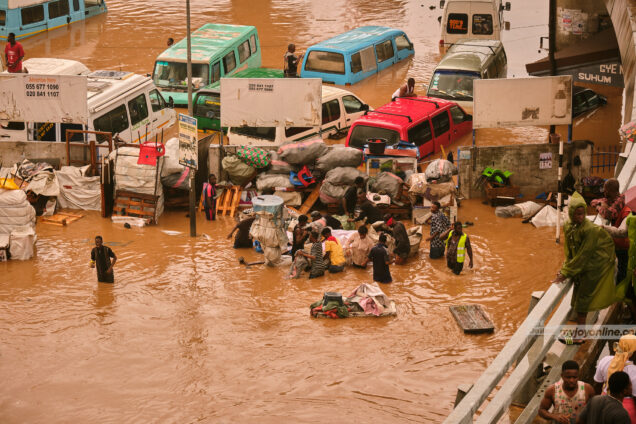
His comments come in the wake of Monday’s devastating floods that hit Accra, parts of the Central Region and other communities, killing 18 people and destroying properties worth millions of cedis.
Speaking on Joy News’ PM Express Business Edition on Thursday, Prof Quartey said the country is repeatedly wasting money on drainage and sanitation projects without value for investment.
“I am very worried, because it looks like we are wasting money. We are not investing our money efficiently or properly. Why do I say so? You put out some numbers for the cost. The government’s WASH program investment: we only invest about ¢750 and ¢780 million a year, and it will surprise you to know that about 80 to 90% of that money is donor-funded.
"So we are not investing in waste management, we are not investing in sanitation, we are just there, so look at the cost in millions of dollars, and look at how much we are investing. So we are basically not investing; the little we are investing is also very inefficient.”
He pointed to recent drainage works as evidence of poor execution and weak oversight.
“Let me give you a typical example. Recently, some funds have been allocated for dredging, storm drains, etc. If you drive on the Weija to Kasoa Road near the West Mills Mall junction, you will see that storm drains have been constructed. Huge amount of money, you see, iron rods, etc. Poor engineering; they are choked. They are totally choked. Water running on the streets. We have invested money, but getting nothing out of it, and that tells you how wasteful we are.”
Prof Quartey also criticised what he described as neglect of waste management systems and weak enforcement of sanitation laws.
“Waste management, we are not investing in waste management. I overheard Zoomlion saying for over eight months, the contract to sweep the streets has not been renewed. I could go on and on and on about our, our, our inability or inaction, and that is costing us, causing businesses the loss of productivity.”
He said flooding and poor infrastructure are directly affecting economic output and daily productivity.
“If people have to, because of poor roads, because of flooding, people have to spend hours. I met your colleague, who tells me how many hours he spends in traffic to go to work. Same with me, same with many other people. We are burning fuel, you know, it’s all waste, and the pollution is given to us businesses.”
According to him, the impact spreads across businesses, workers, supply chains and national output.
“Workers go to work so exhausted they can’t do much. They have to leave office as early as possible, so they don’t get stuck in traffic, business destructions, loss of income, loss of employment, even the value chain. I mean, if there is flooding, your raw material won't reach you. There is flooding, rules cannot move from one place to the other, you know, the cost.”
He added that the consequences extend beyond economics.
“Even the psychological cost itself, then loss of human lives. So I don’t see why there is so much inaction, and we do the same thing; we come back every year and do the same thing.”
Comparing Ghana’s enforcement systems with other countries, he said stronger law enforcement could make a difference.
“People block waterways, and they get away with it. If I had my own way, I would stop appointing DCS and MCEs. I will put retired military officers there to man the assemblies.”
Latest Stories
-
NDC member challenges Dennis Yeboah Twumasi’s eligibility for Bono Regional Secretary elections
9 minutes -
Popular Nigerian gospel singer Toluwanisings dies
20 minutes -
Spio-Garbrah proposes debt swaps to fund reparative justice in Africa and Caribbean
27 minutes -
Alban Bagbin calls for governance reforms and coordinated action to address Africa’s debt crisis
30 minutes -
AAK Academy Ghana trains 22 chocolate and confectionery companies in production techniques
31 minutes -
Adwumawura Programme trains second cohort of young entrepreneurs in Bono East
33 minutes -
Destroying Jimi River for gold could cost us our lives – Asantehene
39 minutes -
Sammy Gyamfi didn’t say BoG has ceded its forex role to us – GoldBod
1 hour -
High Court sets November 4 for ruling on Wontumi’s bail application
2 hours -
Tetteh Kwetey files nomination for NDC Greater Accra Regional Chairmanship
2 hours -
Korle Bu appeals for more doctors, nurses as A&E Centre struggles under pressure
2 hours -
AFCON 2027Q: ‘I’m optimistic Black Stars can turn things around’ – Agyemang-Badu
2 hours -
Digital innovation could widen Africa’s inequalities if people are left out – Sam Jonah
2 hours -
Galamsey is an economic, health and moral problem – Sam Jonah
2 hours -
Africa must create AI technology instead of paying to use it – Sam Jonah
2 hours