

Audio By Carbonatix
Scientists at the Council for Scientific and Industrial Research (CSIR) have urged farmers to adopt climate-smart farming practices to minimise crop losses from flooding.
They also advised farmers to use weather information to guide planting decisions and strengthen resilience against extreme weather events.
The recommendations were made in separate interviews with the Ghana News Agency by Dr Kirpal Agyemang Ofosu, a Research Scientist (Rice Breeder) at the CSIR-Crops Research Institute (CSIR-CRI), and Dr Stephen Yeboah, a Senior Research Scientist at the Institute.
The scientists said although extreme floods could not always be prevented, improved land preparation, drainage, crop selection and timely weather information could significantly reduce their impact on agricultural production.
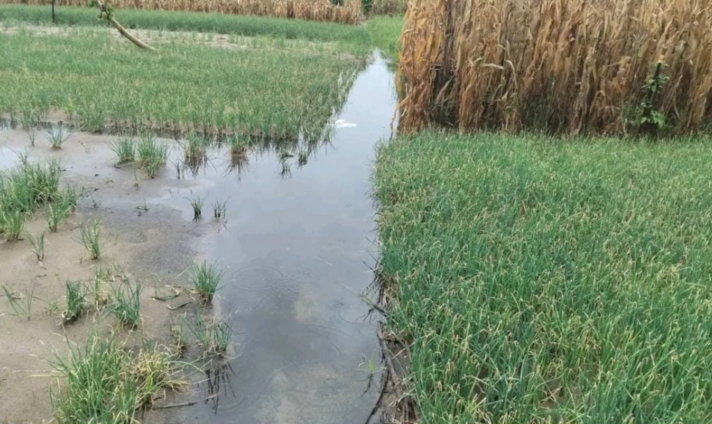
The advice follows flooding that affected parts of the country, including farming communities in the Volta Region, where farms and standing crops were destroyed.
According to the Ghana Meteorological Agency, the June 29 floods resulted from a slow-moving storm system that moved from Togo into Ghana, producing prolonged rainfall, particularly along the coast.
The Minister for the Interior, Alhaji Mohammed Mubarak Muntaka, told Parliament that Accra recorded 169 millimetres of rainfall on June 29 and a cumulative 593 millimetres in June.
Dr Ofosu said Ghana had not yet developed rice varieties specifically for flood tolerance but noted that some locally released varieties were better suited to flood-prone conditions because of their plant characteristics.
He recommended CRI-AgraRice, CRI-Korea Mo and Legon Rice 1 for cultivation in flood-prone areas.
“Farmers need to create drainage canals in and around their fields to direct the flow of water. Such canals should be cleaned regularly throughout the growing season,” he said.
Dr Ofosu also advised farmers to level their fields properly to improve water movement during heavy rainfall, monitor weather forecasts before planting and avoid cultivating in low-lying areas without adequate drainage.
He encouraged farmers to use weather forecasts available on smartphones when making farming decisions and recommended rice, taro and sugarcane for communities that experience frequent flooding because of their tolerance to high moisture conditions.
Dr Yeboah said proper land preparation remained the first line of defence against flood damage.
He advised farmers to plough across slopes instead of along them to reduce runoff and soil erosion.
“If you prepare along the slope, you facilitate runoff and therefore deplete your soil of the required nutrients or carry all your crops away under waterlogging conditions,” he explained.
Dr Yeboah said some existing crop varieties possessed deep and strong root systems that enabled them to better withstand waterlogging, although they were not specifically developed for flood tolerance.
He underscored the importance of timely climate information and early warning systems.
“If farmers had prior information about this flooding, they could have planted early and harvested before the floods or adjusted their planting dates to reduce losses,” he said.
The scientists called on the Government to invest in drainage infrastructure in major farming areas, improve farmers’ access to real-time weather information and strengthen agricultural extension services to support climate-smart farming practices.
Latest Stories
-
Drug cartels may be seeing Ghana as easy route – Lenin Anane Agyei
35 minutes -
Ghana risks gaining notoriety as drug-trafficking hub – Bobby Banson
44 minutes -
Government dismissed my drug trafficking warning, then tried to arrest me – Ntim Fordjour
46 minutes -
Day Two: 3rd Republic Bank-JoyNews Habitat Fair Clinic underway at Junction Mall
46 minutes -
NACOC addressing inherited gaps in fight against drug trafficking – Deputy Director-General
58 minutes -
Taekwondo goes to school as GTF launches five-region youth campaign
1 hour -
The issues Mourinho is struggling to fix at Real Madrid
1 hour -
Hundreds throng EducationUSA College Fair in Kumasi in pursuit of abroad studies
1 hour -
Drug bust: NACOC should be part of port inspection team – Twum-Barimah
1 hour -
Ward appointed Liverpool’s sporting director
1 hour -
This isn’t the first cocaine bust; NPP must stop the politicisation – NACOC deputy boss
1 hour -
Drug bust case: Only Customs officers, MPS officials in scanning room – NACOC
2 hours -
I don’t mind being insulted; I have a crocodile skin – President Mahama
3 hours -
Samson’s Take: Verify the badge – and verify the story
3 hours -
President Mahama explains why Ghana must rethink regulation of TikTok, other new media platforms
3 hours