

Audio By Carbonatix
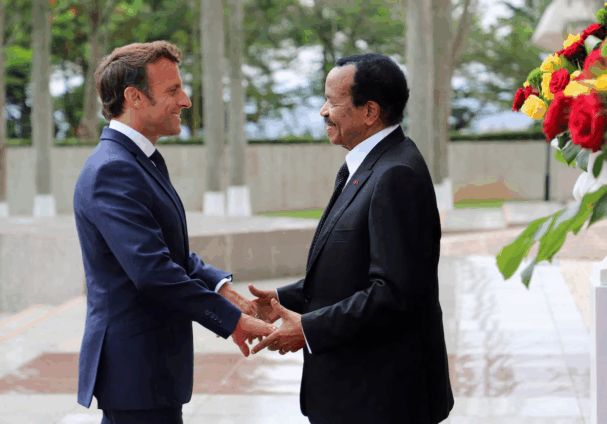
French President Emmanuel Macron formally acknowledged France's role in violent repression during Cameroon's struggle for independence in a letter signed on July 30 but only disclosed on Tuesday.
The letter, addressed to Cameroonian President Paul Biya, follows the findings of a joint Franco-Cameroonian commission that investigated France's role and involvement in the fight for independence between 1945 and 1971.
The Cameroon government did not immediately reply to a Reuters request for comment.
Cameroon was a German colony until it was split between Britain and France after World War I. Under United Nations trusteeship, the French-administered area gained independence in 1960, while the southern British Cameroons voted to join French Cameroon in a federation in 1961.
"The commission's historians clearly established that a war took place in Cameroon, during which French colonial authorities and military forces committed various forms of violent repression in several regions of the country, a war that continued beyond 1960 with France's support for actions taken by the independent Cameroonian authorities," Macron said in the letter.
Macron also acknowledged France’s responsibility in the deaths of independence leaders Ruben Um Nyobè, Paul Momo, Isaac Nyobè Pandjock and Jérémie Ndéléné, who were killed between 1958 and 1960 during military operations conducted under French command.
The French president pledged to open archives, support historical initiatives, and create a joint working group to implement the commission’s recommendations, aiming to reconcile historical memory and strengthen Franco-Cameroonian ties.
Starting with 17th-century outposts and expanding in the 19th century, France built a vast colonial empire, notably in Africa, lasting until the 1960s decolonisation.
The letter follows previous steps by Macron to confront France’s colonial legacy, including acknowledgements of French responsibility in the 1994 Rwandan genocide and the Algerian War.
These gestures come amid shifting dynamics in France’s relationships with African nations, at a time when its presence in parts of the continent, particularly the Sahel, is being increasingly contested.
Latest Stories
-
Northern Births and Deaths Director to face PAC over GH¢71k withdrawals
8 minutes -
Djokovic claims 102nd title of career with China Open win
12 minutes -
Desire FC teams up with Hellas Verona to develop emerging talent in Ghana
16 minutes -
Labone robbery case adjourned to October 22 as prosecution prepares supplementary statements
17 minutes -
BoG must come again on Cedi bouquets; people can use their money as gifts once they don’t deface it – Ayariga
18 minutes -
Mahama Cares administrator calls for stronger financial support for chronic illness patients
21 minutes -
Wontumi not yet confirmed among Mahama’s pardoned convicts – Palgrave
23 minutes -
6 Ghanaian victims of human trafficking arrested in Zambia cybercrime raid – Foreign Affairs Ministry
26 minutes -
Big Dawood leads clean-up, tree-planting campaign to tackle Accra’s sanitation challenges
27 minutes -
Government to launch new legal frameworks on social protection and gender equity
41 minutes -
CSA Ghana opens NCSAM 2026 with call for stronger cybersecurity collaboration
47 minutes -
Yellow Fever deaths in Sissala East worrying – MP
49 minutes -
PAC flags GH¢5.2bn financial irregularities in 2025 audit report
52 minutes -
PAC steps down 2 special audit reports into Ghana’s US Embassy, 13th All African Games
59 minutes -
Yellow Fever outbreak kills 7 in Sissala East
1 hour