

Audio By Carbonatix
Board Chairman of the Ghana Airports Company Limited (GACL), James Agalga, has defended the newly introduced Airport Infrastructure Development Levy (AIDL), insisting that the Ghana Airports Company Limited (GACL) is “on the edge” financially despite recording profits.
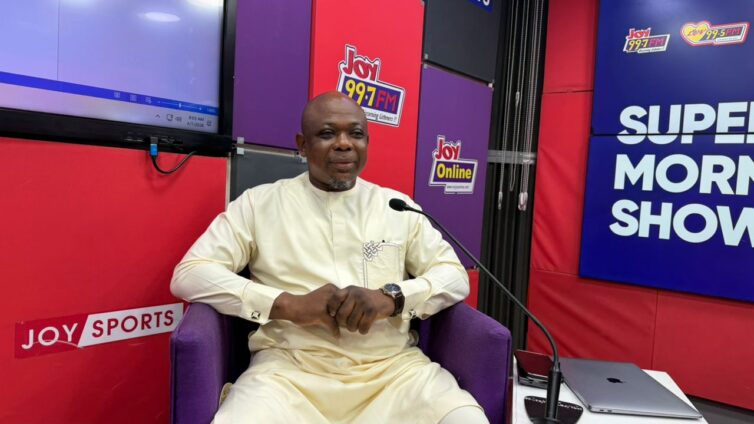
Speaking on the Joy FM Super Morning Show on April 7, Mr Agalga linked the levy directly to the urgent need to expand and repurpose airport infrastructure, particularly the underutilised Terminal 2 (T2) at the Kotoka International Airport.
“Don’t be carried away by the profit you see,” he cautioned. “After all the financial obligations of the company have been honoured… you have virtually nothing left. The company is on edge.”
Mr Agalga explained that T2, which was originally designed to complement Terminal 3 (T3), has not been fully utilised since international operations were moved to T3 following its inauguration. Domestic flights were shifted from Terminal 1 to T2, leaving the facility underused despite prior expansion works.
He noted that efforts to restore T2 to handle international flights would require significant capital investment. “To revert T2 to its former status… requires a lot of money. It’s capital intensive,” he said, adding that even maintaining current operations at T3 comes with high costs.
According to him, this financial pressure makes it imperative for GACL to expand its revenue base, a key justification for the new levy.
The AIDL, which took effect on April 1, 2026, is a mandatory charge applied to all air travel into and out of Ghana. It adds $100 for intercontinental return flights, $70 for regional return trips within Africa, and GH¢100 for domestic travel.
The policy, introduced by the Ministry of Transport in collaboration with GACL, is expected to raise about $800 million over the next decade. The funds will be used for major aviation projects, including a planned physical link between Terminals 2 and 3, expansion of parking facilities, and upgrades to critical infrastructure such as sewerage systems.
Mr Agalga further revealed that only Kotoka International Airport is profitable, with revenues from Accra being used to subsidise loss-making regional airports such as Kumasi, Tamale, and others.
“All regional airports are not profitable,” he said. “So the money you see, about 400 million, is used to subsidise Kumasi, Tamale and all other airports.”
He added that recent expansions in Kumasi, Tamale, and Sunyani have increased operational costs significantly, including staffing, maintenance, and utilities, without generating corresponding revenue.
Despite the government's justification, the levy has drawn criticism from industry players. The International Air Transport Association (IATA) has warned that the additional charges could make Ghana one of the most expensive aviation destinations in West Africa.
Critics, including some Members of Parliament, argue that higher ticket costs could push travellers to alternative regional hubs such as Abidjan and Lomé, potentially affecting Ghana’s competitiveness in tourism and business.
But Mr Agalga maintains the levy is necessary, stressing that without increased revenue, critical infrastructure projects, including the full utilisation of T2 may remain stalled.
Latest Stories
-
Power restoration fault suspected in Kumasi Central Market fire
3 hours -
The 7-foot giant of Ngleshie Amanfro: Seven-foot Ghanaian Ephraim Saawa dreams of joining the national basketball team
4 hours -
Government promises support for Kumasi Central Market fire victims
4 hours -
Vibes The Movie: Big Ghun’s Ghanaian film earns five nominations at 2026 REFFA
4 hours -
MamaCare CEO warns unresolved conflicts among health workers could undermine maternal and neonatal care
5 hours -
Health professionals urged to translate medical knowledge into practice to save mothers
5 hours -
Conflicts among care providers linked to maternal, neonatal deaths – Expert
6 hours -
GIS marks 10th TIME conference, champions improved teaching practices
7 hours -
BRICS Or Balance? What Ghana’s bid really means
7 hours -
GPRTU wants full TRAFFITECH-GH implementation to start in 2027
7 hours -
Mahama announces plans to import electric wheelchairs for PWDs
7 hours -
KGL U17 Colts 2026: Western beat Prempeh Elite Academy to set up final final with Greater Accra Region
8 hours -
Late Solanke strike salvages 10-man Spurs draw at Man United
8 hours -
Gender Ministry to monitor welfare of Nana Akua Addo’s children amid domestic violence case
8 hours -
Benedict Okyere Yeboah: Ghana’s football problem goes beyond sacking a coach
8 hours