

Audio By Carbonatix
Her love for food, mathematics, and physics led her to pursue a degree in Agricultural Engineering at the Kwame Nkrumah University of Science and Technology in 2007.
That flair has its roots two steps backwards when she would come top in a WAEC-organized Mathematics competition for all Junior High Schools in the Western Region.

After serving as a teaching and research assistant upon completion of her bachelor’s degree, Deborah Opandoh decided to pursue a master’s degree in Food and Post-harvest engineering at the same University.
Towards the end of the first year of the programme, she got the privilege to work with the Affordable Design and Entrepreneurship (ADE) group, where they went to rural areas to see how women processed food.
“We realized that most women who processed gari grated by hand, and this was dangerous, inefficient, very laborious and time-wasting.
“They also pressed with rocks which was very dangerous especially to their health as most had issues with their waist and some would need men to carry and turn over the sacs,” she said.
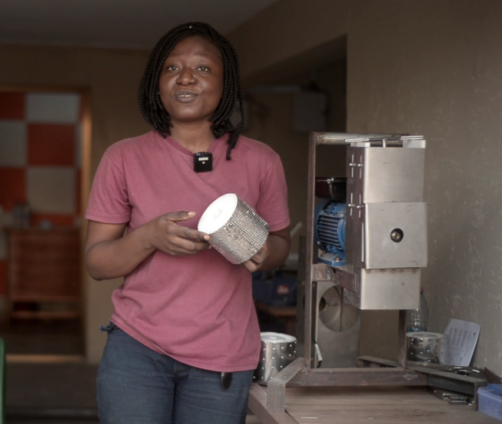
Deborah began working on the grating surfaces of the mini cassava grater for her Masters.
After working with ADE and the Technology Consultancy Centre of KNUST, Deborah co-founded QueenTech Initiative, where she serves as executive director.
“It was a success and was deployed on the field. Since then, we have improved on the designs so many times based on customer feedback and now we are on the 18th grater design and for the press, this is the 4th,” she said.
Another feature which enables the grater to process cassava for foods like banku has now been added to the machine and it's just a one-step process instead of the usual two.
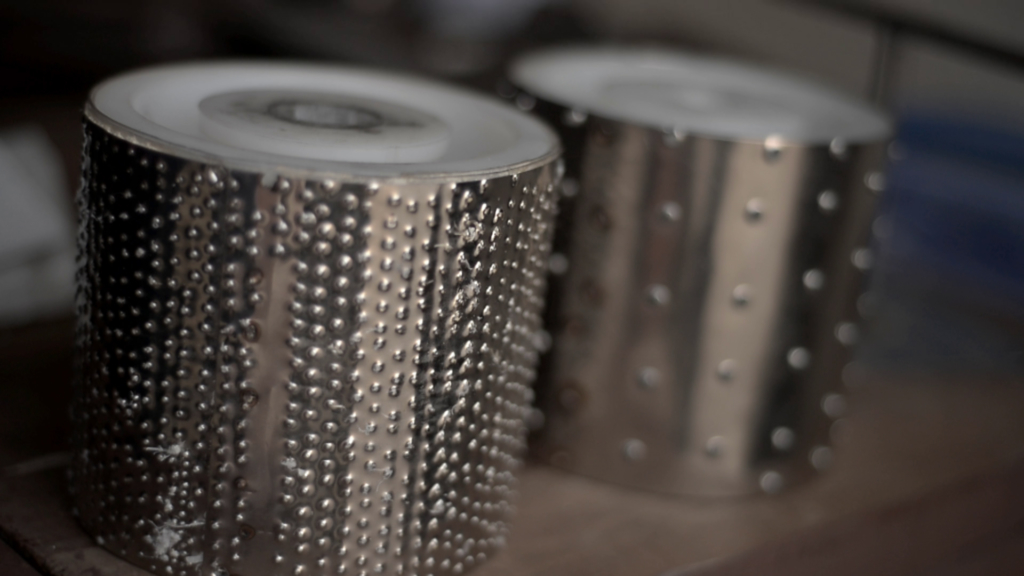
“The mini cassava grater can process about 200 kilograms of cassava per hour. The contact parts are made of stainless steel or food-grade plastic.
“The grater is powered by a 0.75 horsepower electric motor so they don’t have to worry about energy consumption. It’s very efficient; 1400 rpm,” she added.
QueenTech has a collaboration with the Olin and Babson Colleges in the United States.
“Olin assists with the engineering aspect and Babson, the business aspect,” she said.
The cassava grater sells for 850 cedis if paid for upfront and 900 cedis if paid in installments.
QueenTech has a microloan arrangement with the rural women where they make part payment and then monthly down payments for 6 months.
The mini cassava grater is helping people in over 30 rural communities.
Latest Stories
-
COCOBOD dismisses claims of international market exclusion, defends $1.4bn domestic financing shift
21 seconds -
Richmond Quarcoo appointed Ghana’s Chef de Mission for 2028 Olympics
35 minutes -
‘Our missing players are more important’ – Gambia coach fires shot at Ghana
2 hours -
Today’s front pages: Tuesday, September 29, 2026
2 hours -
Ghana ‘showing up differently’ on global stage – Joyce Bawah Mogtari
2 hours -
Ghana’s tuna industry in crisis as 20 hook-and-line vessels collapse
3 hours -
South Tongu MP launches apprenticeship programme for 159 young people
3 hours -
The Pusiga connection behind Gertrude Atongi’s work in New York
4 hours -
Teachers took promotion exams in December to beat government clearance deadline – GNAT
4 hours -
NPA launches 2026 staff welfare week with focus on teamwork and employee wellbeing
4 hours -
Ghana, Saint Kitts and Nevis sign labour deal to strengthen protections for Ghanaian nurses
4 hours -
Delayed promotions put teachers’ retirement benefits at risk – GNAT
4 hours -
No ‘Bawumia candidates’ in NPP executive elections – Anthony Karbo
4 hours -
Over 3,000 displaced as flooding overwhelms Hohoe communities
4 hours -
Sunyani East NPP executives begin reconciliation drive ahead of 2028 polls
4 hours