

Audio By Carbonatix
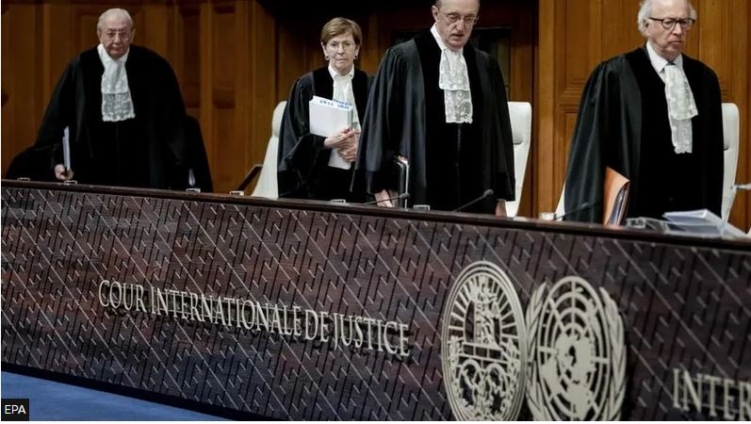
The UN's top court could issue emergency measures ordering Israel to halt its military operations in Gaza.
The session of the International Court of Justice (ICJ) on Friday is part of a case brought by South Africa alleging that Israel is committing genocide.
Both countries testified when the case opened two weeks ago. Israel has vehemently rejected the allegation.
A ruling against Israel is not enforceable by the court but would be politically significant.
More than 25,000 Palestinians - mostly women and children - have been killed and tens of thousands injured, according to the Hamas-run health ministry in Gaza, since Israel began its offensive, triggered by an unprecedented attack on Israel by the group.
The Hamas attack on 7 October killed about 1,300 people, mainly civilians. The attackers also took about 250 people back to Gaza as hostages.
South Africa, which strongly supports the Palestinians, asked the court to issue nine provisional measures, including a halt to military activity by Israel, while it considers the accusation of genocide. A ruling on the latter is not expected for a long time, possibly years.
Israel reacted with outrage to the genocide allegation, accusing South Africa of distorting the truth. It said it had a right to defend itself and was targeting Hamas fighters, not Palestinian civilians.
It asked the judges to dismiss South Africa's request which it said was based on "grossly distorted" and baseless allegations of a non-existent genocide.
In reaching a ruling on Friday, the 17 judges - 15 permanent justices, plus one each from South Africa and Israel - must answer two questions:
Firstly, whether South Africa has met the basic test to show that its claim against Israel can be dealt with under the UN's 1948 Genocide Convention. The convention - to which Israel and South Africa are signatories - defines what constitutes genocide. At this preliminary stage of the case, the bar is relatively low.
Secondly, whether there is a plausible risk of irreparable harm to the Palestinian people in Gaza if Israel's military action continues.
Also, the judges are not limited to South Africa's specific requests. The panel could simply instruct Israel to ensure its actions comply with international law and to ensure that it does not do anything to impede deliveries of food, water or medicines.
The ICJ, though, only has the power to issue advisory opinions. And while its rulings are in theory legally binding, they are not enforceable by the court. If Friday's ruling go against Israel, it is almost certain to be ignored.
It would, however, place additional political pressure on Israel to work towards a ceasefire, and will intensify pressure on Israel's strongest international allies to do what they can behind the scenes to find a resolution and guarantee humanitarian assistance gets to where it is needed.
Latest Stories
-
At least 30 feared dead in crush at Haitian tourist site
60 minutes -
Four arrested over murder of Scottish businessman in Kenya
1 hour -
New Mainoo deal closer, says Man Utd boss Carrick
1 hour -
Sinner beats Alcaraz to return to world top spot
2 hours -
An inappropriate joke nearly ended his career. Now he’s back with more humour
2 hours -
GPL 2025/26: Dreams FC stage stunning comeback to hammer Eleven Wonders
3 hours -
Livestream: The Probe examines Kumasi’s looming water crisis
3 hours -
MTN Ghana gears up to lead Africa’s AI revolution
3 hours -
Philanthropist Alhaji FuZak donates Da’wah bus to Ambariya Sunni community
3 hours -
GUTA calls for suspension of Publican AI system over trade disruptions
3 hours -
TTAG raises alarm over proposed recruitment of 7,000 teachers, demands national posting roadmap
4 hours -
Civilians feared killed after reports of air strike on Nigerian market
4 hours -
Bishop Simon Kofi Appiah installed as new Jasikan Diocese Bishop
4 hours -
Trump’s Strait of Hormuz blockade threat raises risks and leaves predicaments unchanged
4 hours -
US Court backs extradition of former MASLOC CEO Sedina Tamakloe-Attionu to Ghana
4 hours