

Audio By Carbonatix
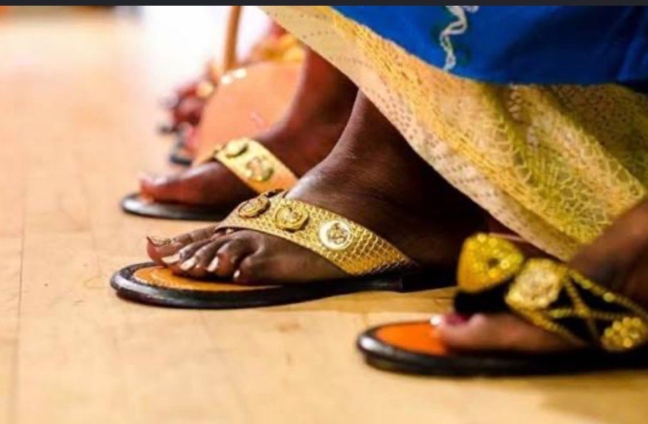
On a wooden table in the bustling commercial hub of Adum in Kumasi, strips of leather and tyres are carefully arranged. With steady hands, artisans cut, shape and stitch them into a pair of slippers that carry centuries of tradition.
These are ‘Ahenema’. A footwear that was once strictly reserved for royalty.
For generations, royal slippers formed an essential part of the regalia worn by chiefs and queens among the Akan, Ga and Ewe ethnic groups in Ghana.
The slipper, simple in appearance yet adorned beautifully, is rich in symbolism, signifying dignity, authority and belonging within traditional leadership.
In the Akan language, a chief is called Ohene, while the plural form is Ahene. The name Ahenema itself reflects that royal connection. It is derived from two words: Ahene, meaning kings, and ma, meaning children, literally translating as “the children of kings.”
Ghana tourism promoter, Johnny, explains that the naming itself carries a story of reverence for authority.
“In the past, Ahenema was worn strictly by the royal descendants and was often named after the king. The method of naming was later changed, and Ahenema was named after the children of the king. This was because the king’s name should not be mentioned in vain,” he said.
Traditionally, Ahenema were crafted from wood and rope, a design that elevated the wearer slightly above the ground. Over time, however, the footwear has evolved alongside changing tastes and materials.
Today, artisans rely on leather, recycled tyres, and rubber to produce the sandals, blending traditional aesthetics with modern practicality.
“We use something called ‘bona,’ leather, tyres, and mine rubber,” said Daniel.
At his shop in Adum, Daniel, popularly known as Chawchaw, has spent years shaping these royal slippers for customers across the country and beyond. For him, making Ahenema is not just a business, but a continuation of cultural identity.
“Ahenema has been in existence for ages. Whenever we wear African prints, that’s what we usually wear to match to look traditional.
“Today, we are beginning to understand our tradition and own it. All young and old wear it now. Because it represents our identity,” he said.
The royal slippers come in two main styles: ‘Asansan Tuo’, the curved design, and ‘Atine’, the straight form. Both have long been worn by chiefs and royalty during festivals, funerals, weddings and other ceremonial gatherings.
The slippers are often distinguished by the number eight carved into the sole. Artisans say the number is a symbol that represents stability and balance.
Beyond style, the sandals carry powerful meaning within the institution of chieftaincy.
“It is very traditional. When a chief’s Ahenema is removed from their feet, it means the rule has ended,” Daniel explained.
Yet what was once restricted to palace courtyards has gradually found its way into everyday cultural expression.
Across Ghana today, Ahenema are no longer worn only by chiefs. They now appear at weddings, festivals, funerals and church services, often paired with kente and other traditional attire.
Daniel believes this growing popularity reflects a renewed appreciation for Ghanaian culture, particularly among younger generations.
“Now people want to wear it to their wedding and naming ceremonies and church,” he said.
But he hopes the enthusiasm for local craftsmanship will extend beyond symbolic celebrations.
“We shouldn’t focus on made in Ghana only when it’s Ghana month. Let’s add it to our lifestyle so we can promote Ghana,” he appealed.
As Ghana marks another Ghana Month celebration, the quiet craft of Ahenema making continues in roadside workshops like Daniel’s, where leather, rubber and tradition come together to produce a slipper that carries history beneath every step.
What once walked only the courts of kings now walks confidently among the people. A strong reminder that cultural costumes, like Ahenema, are something Ghanaians continue to carry forward.
Latest Stories
-
Unchecked imports and the Middle East crisis threaten Ghana’s fragile food inflation anchor
15 minutes -
Ecobank Junior Saver Big Pitch to reward 10 winners with GH¢2,000 each
19 minutes -
AMA demolishes unauthorised pigsty obstructing Agbogbloshie waste evacuation exercise
20 minutes -
I was filled with disbelief – Akosua Achia Sarpong Esq. shares her first reaction
20 minutes -
Snake Village: A look at Volta Region’s hidden snake village and its tourism potential (Video)
27 minutes -
Election Watch Ghana calls for constitutional reforms to strengthen Electoral Commission independence
30 minutes -
NACOC, Postal and Courier Services Regulatory Commission intensify efforts to curb drug trafficking
31 minutes -
Ga Mantse chairs committee to drive Accra Green and Clean City Initiative
33 minutes -
Drivers threaten to remove traders from lorry stations over TrafficTech concerns
36 minutes -
AI could create 10 to 20 times more jobs despite current recruitment slowdown – Hubtel CEO
38 minutes -
Sexual abuse in schools persists because perpetrators are not held accountable – Dr Nyarkoa
46 minutes -
Chief Justice has designated Achimota Court to handle petroleum diversion cases – NPA CEO
49 minutes -
Philip Nai and friends gear up for bigger seventh Christmas outreach
50 minutes -
GSA strengthens electricity meter testing to protect consumers and improve energy reliability
51 minutes -
‘Dismissed or suspended? Ghanaians deserve clarity’ – NPP demands clarity on Ampofo Ankrah’s fate
55 minutes