


Audio By Carbonatix
A Ghanaian researcher, Nana Kwame Kwabi Boateng, is part of a team of scientists that has made a groundbreaking discovery, reshaping the understanding of how blood clots form.
Nana Boateng is the first author on this landmark study published in Blood, the world’s leading hematology journal.
A key component of blood clots is a protein called fibrin. When a blood vessel is injured, fibrin forms a mesh-like network that is stabilised by an enzyme called Factor XIII, helping to prevent excessive bleeding and initiate wound healing.
This new research has found that another enzyme known as tissue transglutaminase (TG2) can modify a specific part of fibrin called the β-chain, particularly during traumatic injury. Until now, scientists believed that this part of fibrin (β-chain) did not play a role in clot formation. This breakthrough provides a new perspective on how scientists understand clot structure and function, offering potential applications in trauma care, wound healing, and clotting disorders.
The research was conducted in collaboration with Dr. Mitchell J. Cohen and Dr. Ernest E. Moore of Denver Health Medical Center; Dr. Lauren Poole at Rutgers University; Riley Marie Wimberley at Michigan State University; and a multidisciplinary team from the University of Colorado, including Dr. Lauren Schmitt, Dr. Jacob P. Rose, and Dr. Angelo D’Alessandro. The study was co-led by senior authors Prof. Kirk C. Hansen from the University of Colorado and Prof. James P. Luyendyk from Michigan State University.
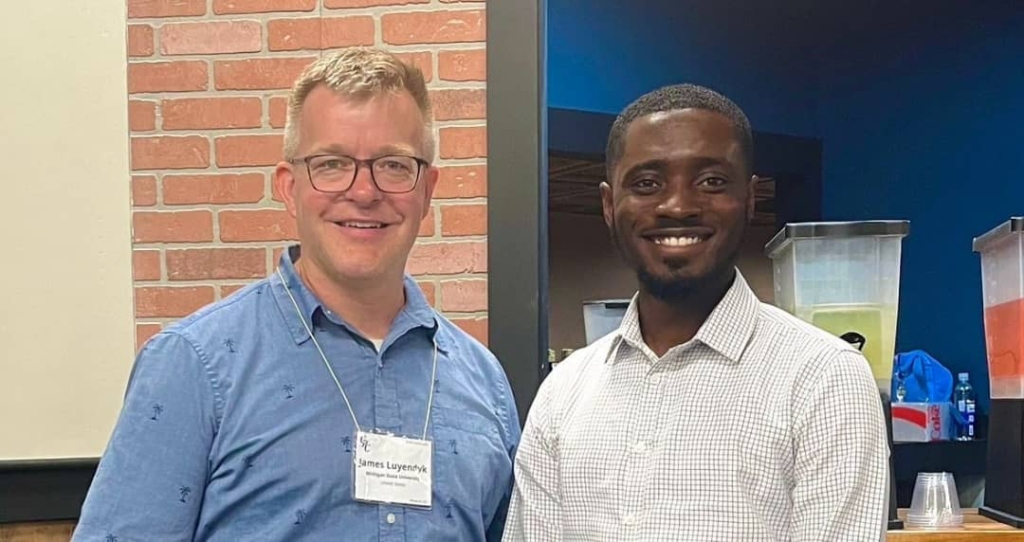
Nana Boateng is a registered pharmacist and a graduate of the School of Pharmacy, Central University in Ghana. He holds a Master of Science degree in Clinical Pharmacology (with Distinction) from the University of Aberdeen, UK, and is currently pursuing his PhD at Michigan State University.
The discovery has been highlighted by the Michigan State University College of Veterinary Medicine (MSU CVM) for its potential to reshape understanding, diagnosis and treatment of trauma, wound healing, and clot-related diseases across both human and veterinary medicine.
The work has already garnered international recognition, earning Nana Boateng an invitation to deliver an oral presentation at the 2025 Joint Conference of the International Fibrinogen Research Society and the International Society for Fibrinolysis and Proteolysis in Greece, where he also received a research award in recognition of his presentation.
Latest Stories
-
Mustapha Hamid misses out on NPP Vice Chairmanship by 31 votes despite early poll lead
8 minutes -
Kojo Bamba, Henry Nana Boakye and Nana Akomea elected NPP Vice Chairmen
54 minutes -
From Delta Force to NPP First Vice Chairman – Kojo Bamba’s political journey
59 minutes -
Police restore calm at Larteh following Odwira festival disturbance
2 hours -
‘All the camps will dissolve’ – Bawumia demands one NPP for 2028
2 hours -
There is no time to waste – Bawumia orders NPP to begin 2028 work
2 hours -
Sarkodie visits MobileMoney Fintech LTD
2 hours -
John Boadu unveils new NPP strategy to win back youth and modernise party
2 hours -
Hawa Koomson elected NPP National Women’s Organiser
2 hours -
John Boadu begins NPP rebuild from grassroots ahead of 2028 election
2 hours -
Titus Glover wins NPP National Organiser race on second attempt
2 hours -
Winning 2028 election won’t be easy; we must work harder – Bawumia
2 hours -
You’ll be part of 2028 campaign; there’s enough work for all of us – Bawumia to NPP aspirants
2 hours -
John Boadu moves to unite NPP after heated leadership contest
2 hours -
Today is not a day of victory but a day of responsibility and great unity – John Boadu
2 hours