

Audio By Carbonatix
The Minority Leader, Alexander Afenyo-Markin, has called for a fundamental rethink of Ghana’s economic and foreign policy strategy, warning that global power dynamics now pose a direct challenge to smaller economies such as Ghana.
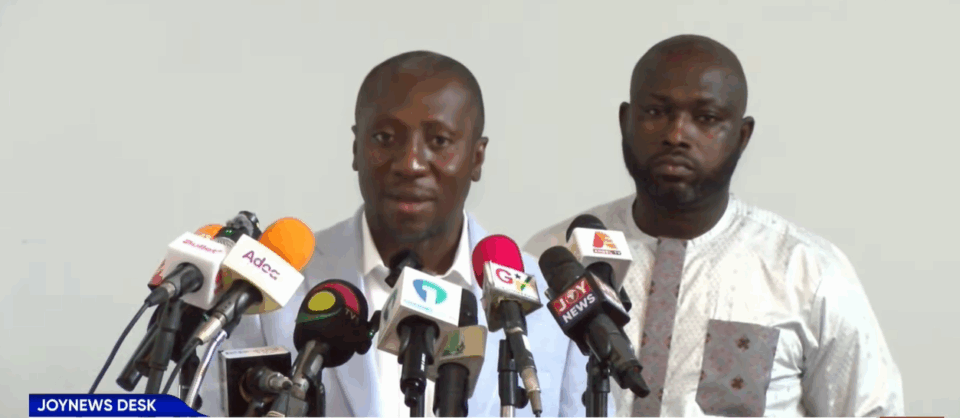
Speaking at a press conference on Monday, January 26, Afenyo-Markin said the country could no longer rely on “comfortable stories of mutual benefit” in an increasingly competitive global system, where economic integration is being used as an instrument of leverage rather than cooperation.
“For a smaller economy like Ghana, this is not an abstract debate. It is a direct challenge,” he said, adding that global structures are increasingly being exploited through what he described as “debt traps, currency games and control over key exports”.
According to the Minority Leader, Ghana must respond decisively by building a strong and resilient domestic economy capable of withstanding external pressures.
He stressed the need for strategic autonomy to ensure that no foreign power can exert undue influence over the country’s economic or political decisions.
“Economic sovereignty cannot remain a slogan. It must become the solid foundation of an independent foreign policy,” he stated.
Afenyo-Markin also urged the government to deliberately diversify Ghana’s international relationships.
While emphasising the importance of deepening ties across Africa, he called for a balanced and cautious engagement with traditional partners, including the United States, the European Union, the United Kingdom, China and Canada, as well as emerging global powers.
He warned against over-reliance on any single external actor, stressing that cooperation must not come at the expense of national sovereignty.
“We must engage carefully with our partners without surrendering our sovereignty to any single dominant player,” he said.
The Minority Leader further argued that Ghana’s foreign policy must be firmly grounded in the constitutional values practised domestically.
He criticised what he described as a “so-called pragmatic policy” that ignores impunity, corruption and injustice at home in the name of realism.
“That is not realism,” Afenyo-Markin asserted. “It is a performance of sovereignty that hides a quiet acceptance of dependence. We cannot project moral clarity abroad if we refuse to practise it at home.”
Latest Stories
-
Antwi HiMight thrills fans with Antwi ne Antwi hits at Adom FM’s Y2K Jam [Video]
11 minutes -
Amb. Edward Boateng congratulates Boadu, Kodua on election wins
36 minutes -
John Boadu pledges to rebuild NPP from grassroots and restore ‘winning machinery’
38 minutes -
Ashaiman Assembly deploys monitoring system to curb dumping in storm drain
50 minutes -
John Boadu must rebuild, unite NPP for 2028 – Edward Boateng
52 minutes -
Executive intimidation of opposition undermines separation of powers – Prof Oquaye
56 minutes -
I have no issue with John Boadu; we’ll work together – Justin Kodua
2 hours -
Adom FM Y2K Jam delivers a night of music, fashion and nostalgia
3 hours -
Lawrence Kobena Nsarko Otoo, Esq
4 hours -
Bel-Aqua intensifies mental well-being campaign ahead of 15th anniversary
4 hours -
From banking to party finances: Alfred Kwadwo Thompson elected NPP Treasurer
4 hours -
George Christian Papa Mends
4 hours -
Ali Suraj elected NPP NASARA Coordinator
4 hours -
Mustapha Hamid misses out on NPP Vice Chairmanship by 31 votes despite early poll lead
4 hours -
Kojo Bamba, Henry Nana Boakye and Nana Akomea elected NPP Vice Chairmen
5 hours