

Audio By Carbonatix
The government has given banks, telecommunications companies, hospitals, schools, insurance firms and other institutions until November 2, 2026, to stop requesting photocopies of Ghana Cards for identity verification and fully adopt biometric authentication.
The directive follows the coming into force of the National Identity Register (Amendment) Regulations, 2026 (L.I. 2523) on June 9, 2026, with a three-month transition period running from July 27 to November 2, 2026, to allow institutions to integrate with the National Identification Authority's (NIA) Identity Verification System.
The new regulations are intended to reduce identity theft and protect the personal data of Ghanaians by making biometric verification the standard method of confirming a person's identity.
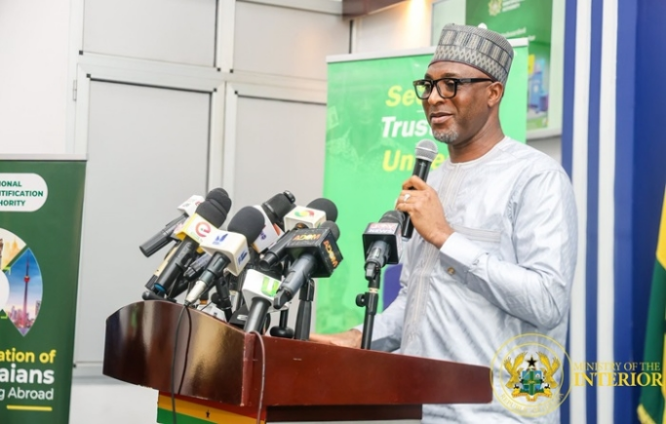
Announcing the new measures at a press briefing in Accra on Wednesday, July 22, 2026, the Minister for the Interior, Mr Muntaka Mohammed-Mubarak, said the amended regulations were introduced to strengthen the country's identity verification system and prevent the misuse of personal information.
"We have put in place a safeguard for what is most personal to every citizen, your identity," he said.
Under the amended regulations, organisations are no longer permitted to request, retain, reproduce or rely on photocopies, scanned copies or images of the Ghana Card for identity verification. They are also barred from relying solely on visual inspection of the card and must instead verify identities electronically against the National Identity Register or by using NIA-approved match-on-card verification devices.
Mr Muntaka said the changes had become necessary because the long-standing practice of checking a Ghana Card by sight or keeping photocopies did not provide reliable proof of identity and exposed citizens to identity theft.
READ ALSO: Biometric verification of Ghana Card now mandatory under new regulations – Interior Minister
"For too long, identity checks in this country have relied on officers glancing at the card or a business photocopying and filing it away," he said.
"A photocopy can be altered. A scanned image can be misused or reused without the owner's knowledge or consent. A Ghana Card can be presented by someone who is not the rightful owner. A visual check alone cannot confirm identity."
He said biometric verification confirms, at the point of a transaction, that the person presenting the Ghana Card is its rightful owner without leaving copies of personal information in filing cabinets, mobile phones or email inboxes.
For the public, the change means banks, hospitals, telecommunications companies, insurance firms, schools, government agencies and other institutions should no longer ask customers to submit photocopies of their Ghana Cards. Instead, identities will be verified electronically through approved biometric systems.
Mr Muntaka urged all organisations that verify identities as part of their operations to complete their integration with the NIA's Identity Verification System before the transition period ends.
He said the NIA had published specifications for approved portable card readers and biometric verification devices on its website and would provide technical support and public education during the transition period.
Sanctions
The Interior Minister warned that organisations that fail to comply with the amended regulations would face sanctions.
He said institutions that continue to ignore the requirements risk fines running into thousands of penalty units, suspension or termination of access to the NIA's Identity Verification System.
Mr Muntaka said any individual who misuses a Ghana Card or, without reasonable excuse, refuses to allow a law enforcement officer or another authorised person to verify his or her identity by scanning a fingerprint on the card or taking a live photograph commits an offence and may face a fine, imprisonment or both.
He said the NIA would establish an enforcement team to inspect organisations, investigate reported breaches and work with law enforcement agencies to enforce the regulations across the country.
Mr Muntaka explained that the sanctions were intended to hold organisations and individuals accountable where they continued to expose citizens' personal data to unnecessary risk after being given enough time to comply.
Identity theft
Mr Muntaka said wider use of biometric verification would make it more difficult for criminals to impersonate others or use stolen identities to commit offences.
He explained that visual inspection alone often failed to distinguish between people with similar appearances, increasing the risk of identity fraud.
"It is very, very easy for people to steal other people's identity in this country," he said.
"You and I must work together to support the security agencies to make sure people cannot steal other people's data and use it for the wrong reasons."
He disclosed that the government was also working with the ministry responsible for communications on identity verification measures linked to SIM registration. He said a timetable for that exercise would be announced after arrangements had been completed to reduce inconvenience to the public.
Reporting breaches
Responding to concerns about institutions that might continue demanding photocopies of Ghana Cards, Mr Muntaka said the NIA would publish two toll-free telephone numbers for members of the public to report breaches.
He said the amended regulations gave the Authority stronger enforcement powers. He added that institutions that deliberately flouted the law could face sanctions, including the withdrawal of licences or the closure of businesses where permitted by law.
"You have a right to expect that your Ghana Card will not be casually photocopied in any organisation," he said.
"This law exists to protect you, not to burden you."
Mr Muntaka said the government would work with stakeholders to roll out the biometric verification system nationwide while enforcing the regulations to protect the identities and personal data of Ghanaians.
Latest Stories
-
Young girls demand climate action, stronger protection against child marriage
8 minutes -
Ex-gang boss sentenced to 40 years for orchestrating Tupac Shakur’s murder
8 minutes -
From near-deferral to three awards: UMaT graduate’s academic journey
10 minutes -
Atta Akyea denies seeking presidential pardon for Wontumi in galamsey case
48 minutes -
Photos: Mahama commissions 85-bed Police Hospital ward, donates two ambulances
57 minutes -
GTEC directs Ghana’s public universities to reopen by October 16 and begin lectures on October 19
58 minutes -
Star Oil donates GH¢1million towards construction of new CID facility
1 hour -
Court hands Adjetey Sowah, two others lifetime bans after Amputee Football legal dispute
1 hour -
NDC appoints Julius Kwame Anthony as a Deputy Communications Director
1 hour -
Ghana repatriates 120 Nigerians rescued from suspected cybercrime centres
1 hour -
NPP rejects Emelia Agbenyo’s appointment as Deputy EC Chair, demands withdrawal
1 hour -
EOCO grants Suame MP John Darko enquiry bail in GH¢27m SIC investigation
1 hour -
NPP cannot question EC appointment after appointing own people to Commission – Kwakye Ofosu
1 hour -
BoG deepens public trust with regional stakeholder forum in Techiman
2 hours -
‘We have turned the tide’ – Ato Forson says Ghana is ready to take off
2 hours