

Audio By Carbonatix
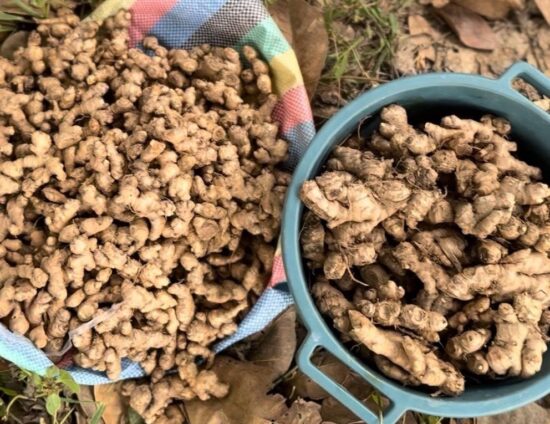
The Ghana Statistical Service (GSS) says sustained high ginger inflation presents significant opportunities for investment in the crop’s value chain.
The development could benefit smallholder farmers, agro-processors, and investors as demand from industry and export markets continues to rise.
The GSS data showed that ginger recorded year-on-year inflation of 111.3 per cent in July 2026, making it the highest-inflation item and the third-largest individual contributor to food inflation.
The Government Statistician Dr Alhassan Iddrisu, speaking at the July Consumer Price Index (CPI) and inflation release in Accra, said the sharp increase in ginger prices reflected strong demand and attractive returns that domestic producers and commercial farmers could capitalise on.
He said the crop’s high inflation was linked to its long gestation period, limited growing areas, strong demand from the pharmaceutical and beverage industries, transport delays, poor rural road networks, and inadequate storage.
Dr Iddrisu urged farmers to expand acreage under ginger alongside staples such as maize, cassava, and plantain to take advantage of the crop’s high profit margins.
He said the logistics and supply chain challenges also created opportunities for logistics firms, aggregators, and transport operators to establish efficient farm-to-market distribution systems.
Dr Iddrisu also identified investment in cold storage and warehousing as another promising area, saying it could help businesses manage supply gluts and shortages, stabilise year-round ginger availability, and build more consistent supply chains.
“The sustained demand for ginger opens room for agro-processors to move into ginger powder, packaged pastes, essential oils, beverages, and dried exports - products that can capture greater value in both local retail and international export markets, while cushioning the sector against the perishability of raw produce,” he said.
The General Agricultural Workers’ Union (GAWU) supported the GSS observation, saying the price surge presented an opportunity for value chain players to expand plantation farming and meet growing demand.
Dr Paschal Ajongba Saviour Kaba, Deputy General Secretary of GAWU, told the Ghana News Agency in an interview that the government needed to introduce deliberate policies to improve access to agricultural finance, including subsidised interest rates for farmers.
He said low-interest lending, similar to schemes in countries such as China, could unlock the sector’s potential, arguing that commercial lending rates were prohibitive given the risks associated with agriculture and the limited insurance coverage available to farmers.
Dr Kaba called for a review of the mandate of institutions such as the Agricultural Development Bank (ADB) to restore their original focus on providing farmers with tailored, lower-cost financing.
“The government must increase its interest in agriculture and not make the sector reliant mainly on private capital and invest in agricultural manpower and extension services so that producers will have the technical know-how to boost yields,” he said.
Dr Kaba explained that ginger’s seven-to-nine-month gestation period, coupled with high rainfall in parts of the Bono and Ashanti regions, limited the speed at which supply could respond to demand.
He said the crop’s perceived aphrodisiac properties, together with demand from beverage and pharmaceutical companies, had led some farmers to sell directly to processing and alcohol-brewing firms under input-credit arrangements rather than through open markets.
Dr Kaba said the practice had contributed to sustained pressure on market prices and called for large-scale plantation development for key agricultural commodities, similar to approaches adopted in neighbouring Côte d’Ivoire, supported by affordable credit.
“If government supports with targeted credit and infrastructure, Ghana can turn this scarcity-driven price boom into sustainable export and industrial growth, while helping bring food inflation down,” he said.
Latest Stories
-
Education Minister assures teachers of salary adjustments by October 16
7 seconds -
Abass Osabutey declares bid for NDC Deputy National Organiser position
2 minutes -
Education Minister inaugurates NDU Governing Council, announces $25m seed funding
10 minutes -
THE LAW 101: La Beach Demolitions – The State’s own documents, the courts’ orders – and the bulldozers
13 minutes -
DVLA contributes GH¢17.7m to Consolidated Fund in 2025
16 minutes -
Why disaster risk reduction must connect early warnings, preparedness and financial protection to household-level resilience
23 minutes -
The AI Gold Rush: Who strikes gold and who gets left behind?
47 minutes -
Australia visa scandal: Pius Hadzide says failed checks left him carrying the blame
1 hour -
Pius Hadzide rejects blame for journalists’ visas in 2018 Australia scandal
1 hour -
What Is Wrong With Us: We queue for the Colosseum while our own Castles crumble
1 hour -
Dangote IPO fever could deepen Africa’s capital markets, Citi Bank executive says
2 hours -
US hopes diesel deal can ‘soften’ Moscow on peace talks, sources say
2 hours -
Oil falls as Russia diesel supply prospects counter Gulf supply risks
2 hours -
Moroccan centrist party agrees to form coalition government with three other parties
2 hours -
IMF cites AI slowdown, spiking yields as looming global market risks
2 hours