

Audio By Carbonatix
Nearly seven out of every 10 Ghanaians who encountered bribery while accessing public services in the second half of 2025 were asked by public officials to make unofficial payments, according to new governance data released by the Ghana Statistical Service (GSS).
The findings, presented at a Governance Series event organised by Three Reports and the GSS on Tuesday, August 4, 2026, reveal a sharp deterioration in citizens' day-to-day experiences with corruption during the latter part of the year, even as Ghana's overall governance performance showed improvement compared with 2024.
Government Statistician Dr Alhassan Iddrisu told the gathering that the proportion of Ghanaians who paid a bribe rose from 14.3 percent in the first half of 2025 to 18.0 percent between July and December, meaning approximately one in every six citizens gave money or a gift in addition to the official fee to access a public service.
Requests by officials for extra payments increased even more sharply, jumping from 50.9 per cent in the first half of the year to 69.4 per cent in the second.
"So the pressure sits at the counter," Dr Iddrisu observed. "The problem now is less what citizens offer and more of what officials would ask."
The survey also found that the proportion of citizens who refused to pay when asked rose from 3.0 per cent in the first half of 2025 to 4.9 per cent in the second half, suggesting a growing willingness among Ghanaians to resist bribe demands.
Despite the deterioration in the latest six-month period, the government statistician stressed that the broader annual trend remained positive. Comparing the full year of 2025 with the 2024 baseline, contact with public officials rose from 55.7 percent to 71.9 percent, representing about 1.6 million additional interactions, yet the proportion of citizens who reported paying bribes fell from 18.4 percent to 16.8 percent. High-value bribe payments exceeding GH¢1,000 nearly halved, dropping from 14.7 percent to 7.6 percent.
"The full year, which is 2025, got better compared to 2024. Both of these stories are true, and that's the beauty of the six-monthly survey that we do, to be able to look at trends within waves and even compare between years," Dr Iddrisu explained.
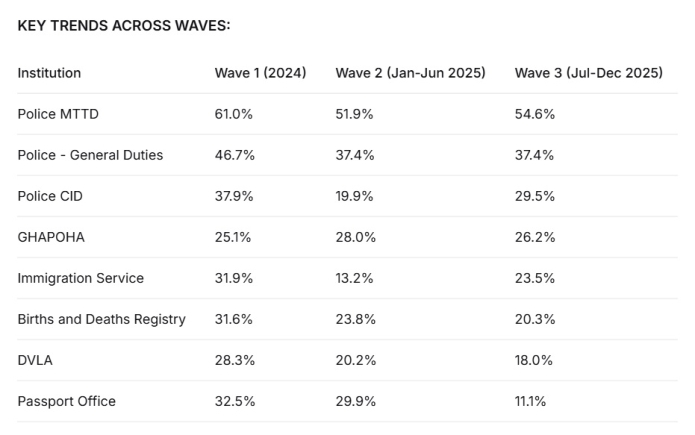
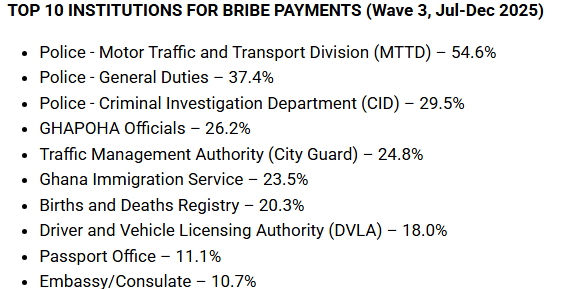
The survey, which follows the same nationally representative households across all 16 regions, identified the Ghana Police Service, particularly the Motor Traffic and Transport Department (MTTD), as the institution most frequently associated with bribery. More than half of respondents who interacted with MTTD officers reported giving gifts or making unofficial payments, though the incidence declined from 61.0 per cent in 2024 to 53.6 per cent in 2025.
"Every one of the biggest offending public institutions improved. I must say that the police remain top of the list," Dr Iddrisu said. "Over half of those dealing with the Motor Traffic and Transport Department still reported giving a gift. But even there, the numbers moved the right way."
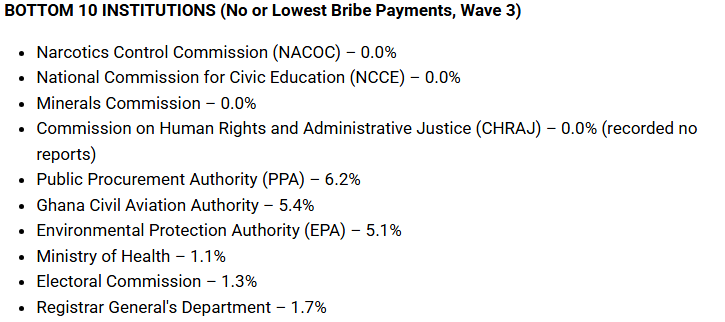
Dr Iddrisu said bribery in Ghana is concentrated in a relatively small number of high-contact institutions, noting that the Police Service, MTD, and Police General Duties consistently top the list, while institutions such as the NCCE, Narcotics Control Commission, and Minerals Commission recorded no reports of gift-giving.
The report also found that the sense of exclusion from governance eased sharply over the full year. Those saying they had no say at all in decisions dropped from 42.4 percent in 2024 to 29.7 percent in 2025, while those feeling no influence at all fell from 43.2 percent to 33.0 percent.
However, the latest six-month data showed a slight weakening on voice, with the share who felt completely shut out edging up to 30.5 percent. Exclusion falls hardest on the young, the old, the unemployed, and persons living with difficulty in performing everyday activities.
On the form of bribe payments, money remained the dominant item given in addition to an official fee, accounting for 94.8 percent in Wave 3, while the giving of valuables such as land or goods roughly doubled over the year. Payments of GH¢500 or less remained the most common, while high-value payments above GH¢1,000 increased between the two six-month waves.
Dr Iddrisu said the findings point to clear priorities: digitising service delivery to remove the discretion that invites informal payment, protecting citizens who refuse to pay, making reporting channels credible and accessible, and widening participation to reach those still left outside.
"Good governance is the foundation under every development plan we have as a country," he said.
The Governance Series, supported by partners including the African Centre for Parliamentary Affairs, the Commission on Human Rights and Administrative Justice, the Ghana Anti-Corruption Coalition, Transparency International Ghana, and the PAIRed Programme, is funded by the Hewlett Foundation.
The latest findings are based on interviews conducted with household heads during the first quarter of 2026 using computer-assisted telephone interviewing, covering experiences between July and December 2025.
Latest Stories
-
Sri Lanka’s ex-first lady arrested over alleged misuse of children’s hospital donations
5 minutes -
La Traditional Council kicks against redevelopment of La Pleasure Beach without consultation
7 minutes -
Some basic schools have just 2 or 3 teachers despite needing 9 – Right To Play
12 minutes -
Mahama to cut sod for SSNIT-funded Accra Convention Centre
13 minutes -
FAO calls for stronger REDD+ systems to unlock climate finance
14 minutes -
Illegal mining pushes Birim River turbidity to 50,000 NTU – Abuakwa South MP
14 minutes -
Bawumia’s opponent in 2028 will face nearly two decades of experience and preparation – Gabby Otchere-Darko
17 minutes -
Community 25 water shortage temporary, GWL assures residents
18 minutes -
‘Standing with teachers means supporting them in classrooms’ – NTC Registrar
21 minutes -
FAO urges innovation, technology to strengthen Ghana’s food security
21 minutes -
Haruna Iddrisu vows to resolve teachers’ strike within days
22 minutes -
Melcom serves 1,000 meals to children in selected orphanage homes
26 minutes -
Mohammed Polo vouches for Karim Zito to lead Black Stars
40 minutes -
Asthma Ghana donates over GH¢50,000 worth of aerochambers to Ho Teaching Hospital
40 minutes -
Inflation rises to 5.2% in September 2026 as prices in Services sector still high
47 minutes