

Audio By Carbonatix
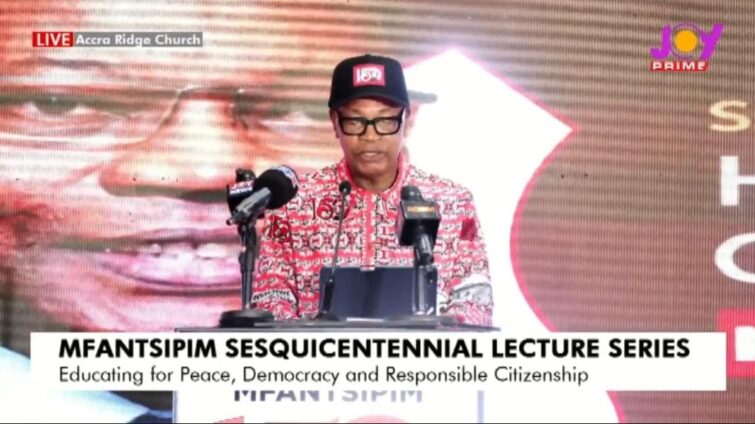
Former African Union High Representative for Silencing the Guns, Dr Mohamed Ibn Chambas, has warned that no democracy can thrive where corruption becomes normalised, stressing that the fight against graft must begin with ethical education from childhood rather than relying solely on law enforcement.
Delivering the second Mfantsipim Sesquicentennial Lecture in Accra on Wednesday, July 29, Dr Chambas said corruption poses a grave threat to democratic governance and national development, with consequences that extend far beyond the loss of public funds.
"No democracy can flourish where corruption becomes normalised," he said.
According to him, corruption pollutes lakes, rivers and other water bodies, degrades forests, weakens public institutions, discourages investment, widens inequality and erodes citizens' confidence in government.
"Its effects are inarguably detrimental," he stated.
Dr Chambas maintained that while effective law enforcement remains essential in tackling corruption, it is insufficient on its own to eradicate the problem.
"Combating corruption requires more than effective law enforcement. It requires ethical formation from childhood," he said.
He argued that integrity should not begin only when an individual assumes public office but must be cultivated in the classroom through deliberate value-based education.
According to him, children who learn fairness, responsibility, respect for public property and honesty—including resisting the temptation to cheat in examinations—are more likely to become adults who uphold the public trust and refrain from abusing positions of responsibility.
He described education as one of the most effective long-term anti-corruption strategies available to any nation, urging schools to place equal emphasis on character formation and academic achievement.
Looking ahead to Ghana's future, Dr Chambas said the country's democracy would ultimately be sustained not only by constitutional provisions, the courts or electoral institutions, but by generations of citizens committed to justice, truth, tolerance and accountability.
He called on the country to prepare young people not merely to inherit democracy but to improve and consolidate it, defend freedom and dedicate their talents to harnessing Ghana's vast resources for the benefit of all citizens without leaving anyone behind.
Dr Chambas said such a commitment represents the true meaning of responsible citizenship and is essential to safeguarding Ghana's democratic future.
Latest Stories
-
Central Regional Minister urges use of religious platforms to change environmental, sanitation practices
3 minutes -
Henry Kweku Banning
4 minutes -
Execution of US murderer Christa Pike halted an hour before it was due to happen
6 minutes -
GoldBod generates US$1.87bn in FX in September, exceeds monthly target
9 minutes -
SOE comments controversy: ‘We must never abandon our humanity because of judicial office’ – CJ
19 minutes -
Samuel Kojo Brace declares intention to contest NPP parliamentary primary in Ahanta West
20 minutes -
Dr Apaak calls for evidence-based education response to emergencies
24 minutes -
Pilot may have sought to crash Israel-bound flight after stabbing other pilot, Netanyahu says
29 minutes -
Report flags potential money laundering, terrorist financing risks among Ghana’s NGOs
29 minutes -
Breast Cancer Awareness Month launched: 2,695 women die from breast cancer annually — Dr Ann-Dadzie
36 minutes -
Mahama’s proposed airline looks to South America, Caribbean as Ghana confronts mounting drug trafficking cases
52 minutes -
5% progress on Suame Interchange Phase One inadequate – Roads Minister tasks contractor to speed up work
54 minutes -
Photos: Vice President joins GAAS Awards to celebrate outstanding women leaders
55 minutes -
OSP vs Ken Ofori-Atta, SML and others: Court gives OSP four more weeks to serve Ofori-Atta with summons
57 minutes -
High Commission sends caution to Ghanaians in South Africa ahead of planned protests
60 minutes