

Audio By Carbonatix
The late Minister for Environment once made a memorable remark on the floor of Parliament before his untimely passing that “The Minority has staged more walkouts than their total numbers in Parliament.”
While the comment was delivered with irony, it raises an important question worth examining: Are the frequent walkouts in Ghana’s Parliament strengthening or weakening our democracy?
As a student of politics, democracy, and governance, I find myself reflecting on the increasing use of parliamentary walkouts, particularly by the New Patriotic Party (NPP) Minority Caucus in the current Ninth Parliament. Walkouts, much like demonstrations, are legitimate democratic tools. They allow individuals or groups to express dissatisfaction, register protest, and signal that they disagree with the direction of proceedings.
However, an important question often goes unasked: does every Member of Parliament participating in these walkouts genuinely support the decision to leave the chamber? Or are some compelled by party discipline and the whip system to demonstrate solidarity, even when they may privately disagree?
A parliamentary walkout is, at its core, a symbolic act. It occurs when members conclude that their participation is either unwanted or unlikely to influence the outcome of deliberations. By withdrawing their physical presence, they send a political message to both Parliament and the public.
In that sense, walkouts have democratic value. They are a peaceful way of expressing dissent and avoiding confrontational exchanges. They communicate disagreement without disrupting parliamentary order.
Yet democracy is not only about protest; it is also about persuasion. When lawmakers leave the chamber, Parliament loses the opportunity to hear alternative viewpoints, challenge assumptions, and improve legislation through rigorous debate. Silence, however symbolic, can never fully substitute for well-reasoned argument.
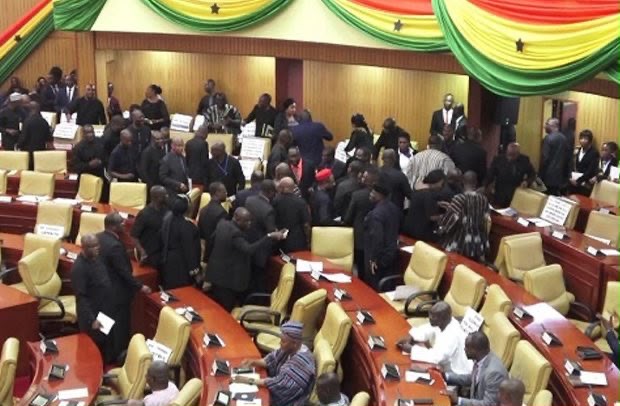
The Ninth Parliament has witnessed several notable walkouts by the Minority Caucus, including those surrounding the passage of the GH¢1 levy and, more recently, the Tribunal Bill. The events of July 16, 2026, however, deserve particular attention.
During proceedings, Minority Leader Hon. Alexander Afenyo-Markin was heard telling a colleague, “I take responsibility for this,” as he attempted to calm tensions within the caucus. Moments later, he informed the Speaker that we could not be part of the deliberations and the eventual passage of the bill.
The choice of the word “we” is significant.
Anyone who followed the parliamentary proceedings that day could also hear another Minority MP urging colleagues to remain in the chamber rather than walk out, arguing that they should stay and face the Majority. The Minority Leader reportedly responded by asking, What is our essence of being in the chamber?
At the time, only 16 Minority MPs were present in the chamber. Observers also noted what appeared to be visible hesitation from Hon. Vincent Ekow Assafuah, suggesting that not every member was entirely convinced by the decision to leave. This raises another important question: was it the personal decision of the Minority Leader, or was it truly the collective decision of the entire NPP caucus?
Such questions matter because parliamentary democracy thrives not only on party unity but also on individual conviction and robust deliberation.
Walkouts may serve as a legitimate cry for attention, but they can also diminish the very institution they seek to influence. The constitutional responsibility of the Minority is to scrutinise the Majority, hold the government accountable, and present alternative arguments on behalf of the citizens who elected them. That responsibility is best fulfilled inside the chamber, not outside it.
Press conferences certainly have their place in democratic politics, but they cannot replace debate on the floor of Parliament. Parliament is the nation’s official house of record. Every speech delivered, every argument advanced, and every objection raised becomes part of Ghana’s democratic history. Those contributions often carry greater weight than statements made after proceedings have concluded.
Ghana’s democracy continues to mature. As it does, we must ask ourselves whether our parliamentary practices are evolving to deepen democratic accountability or merely reinforcing partisan loyalties. The whip system is an important feature of parliamentary governance, but it should not extinguish independent judgment or meaningful participation.
The health of our democracy depends not only on the right to walk out but also on the willingness to stay, debate, persuade, and be persuaded. In Parliament, disagreement is not a weakness - it is democracy at work.
Latest Stories
-
He entered at eight. He is now 16: Ghana’s children growing up in prayer camps
40 minutes -
‘Development must not always begin from Accra’ — Anwelle Foundation launched in Jirapa
43 minutes -
PKO trio eye victories at Odwira Festival
3 hours -
346 Ghana Navy recruits pass out after 26 weeks of intensive training
3 hours -
Newsfile to discuss EOCO-MP arrest, drug trafficking, speech arrests and $235m water debt
4 hours -
JoyNews gets results as listeners raise GH¢40,000 to help 17-year-old student with cerebral palsy attend SHS
4 hours -
Vice President calls for stronger local pharmaceutical production to reduce medicine imports
5 hours -
The brewing tension at KNUST; Beware the Ides of October….
5 hours -
Health Ministry moves to integrate traditional medicine into mainstream healthcare
5 hours -
550 pupils in Kintampo South get educational lifeline as ‘Seeds of Hope’ reaches farming communities
6 hours -
Opoku Mensah urges Christian Council, House of Chiefs to speak up on democratic freedoms
6 hours -
Teacher unions’ strike: Minority demands immediate payment of teacher arrears, 20% deprived area allowance
6 hours -
The Accra-Kumasi Expressway: Building it right
6 hours -
Beyond gold exports: Building value and economic resilience from Ghana’s gold
6 hours -
2027 AFCONQ: Ghana under pressure as Gambia beat Somalia 2-1
7 hours