


Audio By Carbonatix
The Ghana Institute of Horticulturists (GhIH) has called on the government to establish a dedicated Horticulture Authority and urgently rehabilitate major irrigation schemes and tomato-processing factories to strengthen Ghana’s tomato value chain.
The Institute said a coordinated approach involving government, researchers, farmers, the private sector and other stakeholders was needed to increase domestic tomato production, create jobs and reduce the country’s dependence on imported fresh and processed tomatoes.
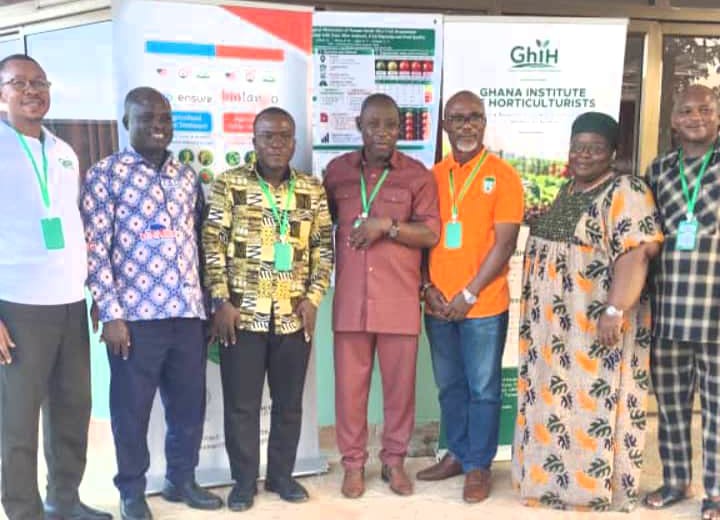
The call was contained in a seven-point communiqué issued on Friday, October 2, 2026, at the close of the GhIH’s 26th Annual General Meeting and Scientific Conference held at Fiapre, near Sunyani in the Bono Region.
The three-day conference, held under the theme “Building a Resilient Tomato Value Chain in Ghana: Need for Stronger Stakeholder Engagement,” brought together professionals and stakeholders from the horticulture sector, including research scientists from the Council for Scientific and Industrial Research (CSIR), university lecturers, agriculture directors, farmer-based organisations and non-governmental organisations.
The GhIH commended the government for initiatives under the Feed Ghana programme aimed at increasing domestic tomato production, particularly the vegetable programme known as Yɛredua.
However, the Institute said persistent challenges across the tomato value chain required targeted interventions and stronger coordination among stakeholders.
It called for the establishment of a dedicated fund to support the development and release of locally adaptable tomato varieties that are high-yielding, disease- and pest-resistant and tolerant to heat.
In the interim, it urged the government to subsidise recommended hybrid and open-pollinated tomato varieties approved by the Ministry of Food and Agriculture (MoFA).
The Institute also called for the urgent rehabilitation of major irrigation schemes, including Tono, Vea, Bontanga and Akumadan, to increase dry-season tomato production across the country.
According to the GhIH, improving irrigation infrastructure would help farmers sustain production beyond the main farming season and contribute to a more reliable supply of tomatoes.
The Institute further expressed its readiness to collaborate with MoFA and the Ministry of Local Government, Chieftaincy and Religious Affairs to develop tailored training programmes for Agriculture Extension Agents and Technical Officers.
The training, it said, should focus on technologies and practices required to improve tomato production and post-harvest handling, with the knowledge subsequently passed on to farmers.
The GhIH also urged the government to increase investment in greenhouse tomato production to complement open-field cultivation, particularly during the dry season.
It said stronger collaboration between government and the private sector was also necessary to guarantee markets and fair prices for farmers.
“A guaranteed market and good prices for tomato produce” would help sustain farmers’ interest and encourage continuous production, the Institute said.
On processing, the GhIH called for the urgent rehabilitation and operationalisation of existing tomato-processing factories, including the Pwalugu and Wenchi Tomato Factories.
It said reviving the factories would expand the market for locally produced tomatoes, reduce reliance on imported processed tomato products and create opportunities for increased youth employment.
The Institute said Ghana’s horticulture industry had significant potential to absorb young people and women, increase national revenue and contribute to food and nutrition security.
However, it warned that these objectives could not be achieved through fragmented policies and programmes.
“We, therefore, reiterate our call on Government to consider the establishment of a Horticulture Authority that will focus on the development of the horticulture industry in Ghana,” the Institute said.
The GhIH reaffirmed its readiness to work with government and other stakeholders to strengthen Ghana’s horticulture industry and build a more resilient tomato value chain.
Latest Stories
-
Baffour Awuah’s arrest is a political witch-hunt – Kofi Bentil
4 minutes -
MT Asharami Ghana arrives in Tema as government pushes stronger LPG infrastructure
6 minutes -
Weweso JHS wins 5th edition of Otumfuo Reading Competition 2026
9 minutes -
‘Criminal law can’t turn every poor commercial judgment involving state entity into an offence’ – Victoria Bright
10 minutes -
Baffour Awuah has shown willingness to cooperate, qualifies for self-recognisance bail – Kofi Bentil
20 minutes -
NPP national officers’ elections 2026: Who is contesting the nine national positions?
26 minutes -
EOCO is only carrying out its mandate, not violating Baffour Awuah’s rights – Dzimegah
34 minutes -
Heavy security at Baba Yara Stadium as NPP elects national officers today
40 minutes -
Horticulturists call for dedicated authority, irrigation and tomato factory revival
58 minutes -
Nakpayili E-Block opens, admits first batch of 650 students after nearly a decade of neglect
60 minutes -
Ethel Cofie writes: You need board experience to get board experience
1 hour -
Baffour Awuah expected in court as EOCO moves to meet bail deadline
1 hour -
Happy 76th Birthday to the Daily Graphic!
1 hour -
Weija Children’s Hospital now operational with 120-bed capacity – Health Minister
1 hour -
Health Minister orders deployment of 40 additional health workers to Weija Children’s Specialist Hospital
2 hours